Scientists Reveal How Signals Travel Through Rats' Whiskers
May 17, 2006 rat

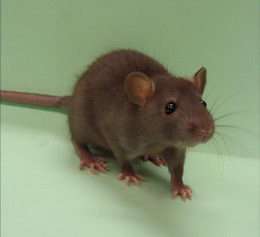
Like blind peoples’ fingers, rats use their whiskers to engage in active sensing – a combination of movement and touch – when trying to figure out the location and identity of a certain object. But how the brain decodes the signals it receives from the whiskers is unclear.

Ph.D. student Chunxiu Yu, working together with colleagues Dori Derdikman and Dr. Sebastian Haidarliu in the laboratory of Prof. Ehud Ahissar of the Weizmann Institute's Neurobiology Department, have now provided surprising new insights into the mechanisms involved, suggesting that the signals travel from the whiskers through three distinct regions in the thalamus – a central gateway of the brain – along three separate pathways: One conveying signals relating to whisker movement; the second conveying touch signals (providing information on where an object is); and the third conveying complex combinations of movement and touch signals (providing information on what the object is).

They propose that these pathways function within three parallel feedback loops that control various aspects of sensor movements much like thermostats controlling temperature – by constantly monitoring the signals they receive and changing their responses accordingly.

The authors suggest that these separate pathways work in parallel on different levels of a brain hierarchy, with the higher, more complex levels (object identification) building on the lower levels (movement and touch) to implement new behaviors.

Prof. Ehud Ahissar’s research is supported by the Nella and Leon Benoziyo Center for Neurosciences; the Carl and Micaela Einhorn-Dominic Institute for Brain Research; the Edith C. Blum Foundation; the Irving B. Harris Foundation; and Ms. Esther Smidof, Switzerland. Prof. Ahissar is the incumbent of the Helen Diller Family Professorial Chair in Neurobiology.

Source: Weizmann Institute of Science


Rate this story - 3 /5 (2 votes)


May 17, 2006 all stories

Comments: 0

3 /5 (2 votes)

  • hide
  • Related Stories

  • Mathematical keys to a sixth sense -- the lateral-line system
    created Aug 28, 2009 | popularity not rated yet | comments 0
  • Caltech scientists decipher the neurological basis of timely movement
    created Jun 06, 2008 | popularity not rated yet | comments 0
  • Magnetic levitation gives computer users sense of touch
    created Mar 04, 2008 | popularity not rated yet | comments 0
  • Scientists develop robotic rats to aid in rescue missions
    created Feb 11, 2008 | popularity not rated yet | comments 0
  • Electrical implant steadies balance disorder in animals
    created Aug 06, 2007 | popularity not rated yet | comments 0


Other News

Scientists release Key Largo wood rats in first test of restocking experiment

Biology / Ecology

created 42 minutes ago | popularity not rated yet | comments 0

The seven pioneers spent the week preparing for their upcoming ordeal in North Key Largo, sampling berries and other local fare, redecorating homes with sticks, leaves and whatever else they got their little paws on, and ...


giant oarfish

Bizarre giant oarfish filmed (w/ Video)

Biology / Plants & Animals

created 1hour ago | popularity 5 / 5 (1) | comments 0 | with audio podcast report

(PhysOrg.com) -- A rare giant oarfish, probably the largest bony fish in the ocean, has been filmed off the Gulf of Mexico. This is possibly the first time the fish has been observed in its natural environment.


Great tits: birds with character

Great tits: birds with character

Biology / Plants & Animals

created 13 hours ago | popularity 5 / 5 (3) | comments 3 | with audio podcast

(PhysOrg.com) -- In humans and animals alike, individuals differ in sets of traits that we usually refer to as personality. An important part of the individual difference in personality is due to variation ...


Cells can read damaged DNA without missing a beat

Biology / Cell & Microbiology

created 12 hours ago | popularity 5 / 5 (1) | comments 0 | with audio podcast

Scientists have shown that cells' DNA-reading machinery can skim through certain kinds of damaged DNA without skipping any letters in the genetic "text." The studies, performed in bacteria, suggest a new mechanism that can ...


Study carried out into biological risks of eating reptiles

Study carried out into biological risks of eating reptiles

Biology / Cell & Microbiology

created 15 hours ago | popularity 3 / 5 (2) | comments 4

Reptiles are bred in captivity primarily for their skins, but some restaurants and population groups also want them for their meat. A study shows that eating these animals can have side effects that call into ...