New Twist on Origin of Human Species
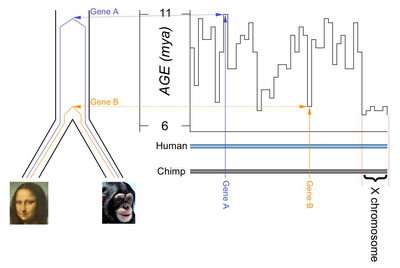
New study suggests that the last common ancestor shared between chimps and humans may be ~1 million years more recent than previous estimates. Additional findings reveal a particularly young age of one of the human sex chromosomes and point to a complex process of speciation, with possible interbreeding during speciation.
The evolutionary split between human and chimpanzee is much more recent – and more complicated – than previously thought, according to a new study by scientists at the Broad Institute of MIT and Harvard and at Harvard Medical School published in the May 17 online edition of Nature.
The results show that the two species split no more than 6.3 million years ago and probably less than 5.4 million years ago. Moreover, the speciation process was unusual – possibly involving an initial split followed by later hybridization before a final separation.
“The study gave unexpected results about how we separated from our closest relatives, the chimpanzees. We found that the population structure that existed around the time of human-chimpanzee speciation was unlike any modern ape population. Something very unusual happened at the time of speciation”, said David Reich, the senior author of the Nature paper, and an associate member of the Broad Institute and assistant professor at Harvard Medical School’s Department of Genetics.
Previous molecular genetic studies have focused on the average genetic difference between human and chimpanzee. By contrast, the new study exploits the information in the complete genome sequence to reveal the variation in evolutionary history across the human genome. In theory, scientists have long known that some genomic regions must be ‘older’ than others, meaning that they trace back to different times in the common ancestral population that gave rise to both humans and chimps (see Graphic). But, the new study is the first to actually measure the range of ages. It gave three surprising results:
• the time of from the beginning to the completion of divergence between the two species ranges over more than 4 million years across different parts of the genome. This range is much larger than expected.
• the youngest regions are unexpectedly recent – being no more than 6.3 million years old and probably no more than 5.4 million years old. This finding implies that human-chimp speciation itself is far more recent than previously thought.
• if one looks only at the X chromosome, it almost entirely falls at the lower end of the time frame. In fact, the average age of the X chromosome is ~1.2 million years “younger” than the average across the 22 autosomal (non-sex) chromosomes.
“The genome analysis revealed big surprises, with major implications for human evolution,” said Eric Lander, Director of the Broad Institute and co-author of the Nature paper. “First, human-chimp speciation occurred more recently than previous estimates. Second, the speciation itself occurred in an unusual manner that left a striking impact across chromosome X. The young age of chromosome X is an evolutionary ‘smoking gun.’”
The estimate that humans and chimpanzees probably split less than 5.4 million years ago is more recent by ~1 to 2 million years than a previous estimate of 6.5-7.4 million years based on the famous Toumaï hominid fossil (Sahelanthropus tchadensis), which has features thought to be distinctive to the human lineage.
“It is possible that the Toumaï fossil is more recent than previously thought,” said Nick Patterson, a senior research scientist and statistician at the Broad Institute and first author of the Nature paper. “But if the dating is correct, the Toumaï fossil would precede the human-chimp split. The fact that it has human-like features suggest that human-chimp speciation may have occurred over a long period with episodes of hybridization between the emerging species.”
The possibility of “hybridization” – that is, initial separation of the two species, followed by interbreeding and then final separation – would also explain the strange phenomenon seen on chromosome X. Interbreeding is known to place strong selective pressures on sex chromosomes, which could translate to a very young age for chromosome X.
“Hybridization” is commonly observed to play a role in speciation in plants, but evolutionary biologists do not generally view it as an important way to produce a new species in animals.
“A hybridization event between human and chimpanzee ancestors could help explain both the wide range of divergence times seen across our genomes, as well as the relatively similar X chromosomes,” said Reich. “That such evolutionary events have not been seen more often in animal species may simply be due to the fact that we have not been looking for them.”
As the researchers note in the Nature paper, it should be possible to refine the timeline of speciation and test the possible explanations based on complete genome sequencing of gorilla and other primates, which is already underway at several centers including the Broad Institute.
Reference: Patterson N et al. (2006). Genetic evidence for complex speciation of humans and chimpanzees. Nature (advance online publication) DOI: 10.1038/nature04789
Source: Broad Institute


