Trio of Neptunes and their belt
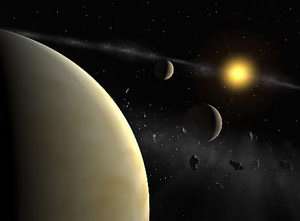
May 17, 2006 Planetary System Around HD 69830 (Artist's Impression)

The HARPS measurement reveal the presence of three planets with masses between 10 and 18 Earth masses around HD 69830, a rather normal star slightly less massive than the Sun. The planets´ mean distance are 0.08, 0.19, and 0.63 the mean distance between the Earth and the Sun. From previous observations, it seems that there exists also an asteroid belt, whose location is unknown. It could either lie between the two outermost planets, or farther from its parent star than 0.8 the mean Earth-Sun distance. Credit: ESO

Using the ultra-precise HARPS spectrograph on ESO's 3.6-m telescope at La Silla (Chile), a team of European astronomers have discovered that a nearby star is host to three Neptune-mass planets. The innermost planet is most probably rocky, while the outermost is the first Neptune-mass planet to reside in the habitable zone. This unique system is likely further enriched by an asteroid belt.

"For the first time, we have discovered a planetary system composed of several Neptune-mass planets", said Christophe Lovis, from the Geneva Observatory and lead-author of the paper presenting the results.

During more than two years, the astronomers carefully studied HD 69830, a rather inconspicuous nearby star slightly less massive than the Sun. Located 41 light-years away towards the constellation of Puppis (the Stern), it is, with a visual magnitude of 5.95, just visible with the unaided eye. The astronomers' precise radial-velocity measurements allowed them to discover the presence of three tiny companions orbiting their parent star in 8.67, 31.6 and 197 days.
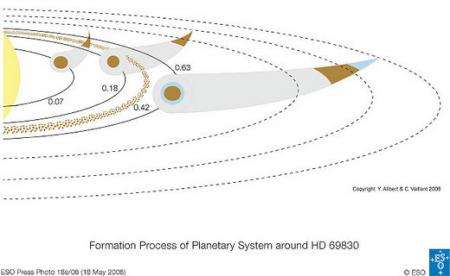
Formation Process of the Planetary System around HD 69830
Enlarge

Illustration of the possible formation process and present day structure of the planetary system around HD 68930. The three planets form from embryos originally located at larger distances (dashed ellipses) than the present ones (indicated by solid ellipses at 0.07, 0.18 and 0.63 the mean Earth-Sun distance). The embryos of the inner and middle planets start interior to the ice line, so that these two planets build up from rocky planetesimals and gas. The two planets consist of a central rocky core (in brown) and an envelope of gas (in gray). The embryo of the outermost planet starts beyond the ice line, and the planet accumulates a large amount of ice at the beginning of its formation. The planet finally consists of a central rocky core (brown), surrounded by a shell of water (ice or liquid - in blue), and a quite massive gas envelope (gray). Credit: ESO

"Only ESO's HARPS instrument installed at the La Silla Observatory, Chile, made it possible to uncover these planets", said Michel Mayor, also from Geneva Observatory, and HARPS Principal Investigator. "Without any doubt, it is presently the world's most precise planet-hunting machine".

The detected velocity variations are between 2 and 3 metres per second, corresponding to about 9 km/h! That's the speed of a person walking briskly. Such tiny signals could not have been distinguished from 'simple noise' by most of today's available spectrographs.

The newly found planets have minimum masses between 10 and 18 times the mass of the Earth. Extensive theoretical simulations favour an essentially rocky composition for the inner planet, and a rocky/gas structure for the middle one. The outer planet has probably accreted some ice during its formation, and is likely to be made of a rocky/icy core surrounded by a quite massive envelope. Further calculations have also shown that the system is in a dynamically stable configuration.

The outer planet also appears to be located near the inner edge of the habitable zone, where liquid water can exist at the surface of rocky/icy bodies. Although this planet is probably not Earth-like due to its heavy mass, its discovery opens the way to exciting perspectives.

"This alone makes this system already exceptional", said Willy Benz, from Bern University, and co-author. "But the recent discovery by the Spitzer Space Telescope that the star most likely hosts an asteroid belt is adding the cherry to the cake."

With three roughly equal-mass planets, one being in the habitable zone, and an asteroid belt, this planetary system shares many properties with our own solar system.

"The planetary system around HD 69830 clearly represents a Rosetta stone in our understanding of how planets form", said Michel Mayor. "No doubt it will help us better understand the huge diversity we have observed since the first extra-solar planet was found 11 years ago."

Source: European Southern Observatory


print this article email this article download pdf blog this article bookmark this article     Stumble it Digg this share on Facebook retweet share on Reddit add to delicious
Rate this story - 4.3 /5 (12 votes)


May 17, 2006 all stories

Comments: 0

4.3 /5 (12 votes)
  • Stumble this up

  • Digg this

  • share this

  • hide
  • Related Stories


  • hide
  • Relevant PhysicsForums posts

  • Some help with a X-Ray astronomy question please!
    created 9 hours ago
  • Help with Images and Optical Instrument Question..
    created 20 hours ago
  • Redshift as a distance indicator
    created Nov 26, 2009
  • Question about 2-body gravity
    created Nov 24, 2009
  • More from Physics Forums - General Astronomy

Other News

The Energy Sources of Ultraluminous Galaxies

The Energy Sources of Ultraluminous Galaxies

Space & Earth / Astronomy

created 3 hours ago | popularity 5 / 5 (1) | comments 0

(PhysOrg.com) -- Ultraluminous infrared galaxies ((ULIRGs) are galaxies whose luminosity exceeds that of a trillion suns; for comparison, the Milky Way galaxy has a typical (and much more modest) luminosity ...


Fermi Telescope Peers Deep into Microquasar

Fermi Telescope Peers Deep into Microquasar (w/ Video)

Space & Earth / Astronomy

created 2 hours ago | popularity 5 / 5 (1) | comments 0

(PhysOrg.com) -- NASA's Fermi Gamma-ray Space Telescope has made the first unambiguous detection of high-energy gamma-rays from an enigmatic binary system known as Cygnus X-3. The system pairs a hot, massive ...


Space shuttle Atlantis, 7 astronauts back on Earth (AP)

Space shuttle Atlantis, 7 astronauts back on Earth

Space & Earth / Space Exploration

created 4 hours ago | popularity not rated yet | comments 0

(AP) -- Space shuttle Atlantis and its seven astronauts returned to Earth with a smooth touchdown Friday to end an 11-day flight that resupplied the International Space Station.


Herschel takes a peek at the ingredients of the galaxies

Herschel takes a peek at the ingredients of the galaxies

Space & Earth / Astronomy

created 1hour ago | popularity not rated yet | comments 0

(PhysOrg.com) -- The European Space Agency has today released spectacular new observations from the Herschel Space Observatory, including the UK-led SPIRE instrument. Spectrometers on board all three Hershel ...


China is set to launch its second moon orbiter next October, state media have reported

China to launch second lunar probe: state media

Space & Earth / Space Exploration

created 8 hours ago | popularity 5 / 5 (3) | comments 0

China will launch its second moon orbiter next October, state media reported Friday, as it powers ahead with a space programme that has sparked concerns abroad.