Colombian frog believed extinct found alive
May 18, 2006
Colombian frog believed extinct found alive

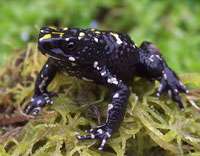
The Atelopus ebenoides marinkellei was last seen in the same region of Boyacá in 1995. © Carlos Rocha/UPTC

Researchers exploring a Colombian mountain range found surviving members of a species of Harlequin frog believed extinct due to a killer fungus wiping out amphibian populations in Central and South America.

The discovery of what could be the last population of the painted frog (Atelopus ebenoides marinkellei) indicates the species has survived the fungus, providing hope that other species also might avoid elimination from the epidemic caused by a pathogenic fungus of unknown origin.

Professor Carlos Rocha and a team of researchers from the Pedagogical and Technological University of Boyacá - UTPC supported by Conservation International, the Darwin Initiative and the Fund for Environmental Action and Childhood made the discovery in early May in the deserts of Sarna and Toquilla in Boyacá in eastern Colombia.

The painted frog, which is found only in the deserts of Colombia's highlands, was last seen in 1995 in the area of Siscunsi, in the same region as Boyacá. After 11 years without a sighting, scientists considered the species extinct because of a lethal skin fungus, known as chytridiomycosis, and other hazards threatening the survival of a third of all amphibian species around the world.

"The scientific importance of the finding must motivate us to adopt urgent measures toward saving the last of these amphibians, both in the wild and through captive breeding programs," said Fabio Arjona, executive director of Conservation International in Colombia. "That will require a lot of support from the local and international communities."

The painted frog is one of 110 species of a diverse group of neo-tropical amphibians that live mostly in Colombia. The country's amphibian population is considered among the most diverse on Earth and key in the conservation efforts to protect amphibian species worldwide. So far, 42 of the 113 species of Atelopus found in the Tropical Andes Hotspot that includes parts of Colombia, Ecuador, Peru and Venezuela have experienced population declines of up to 50 percent.

Frogs provide innumerable ecosystem services by consuming insects and serving as indicators of overall environmental health of an ecosystem. The disappearance of amphibians could cause numerous consequences, including an increase in illnesses such as malaria due to the disappearance of amphibians that feed on mosquitoes carrying the disease. An extinction crisis among amphibians indicates drastic environmental changes caused by human impact such as deforestation and global warming.

Source: Conservation International

4.5 /5 (11 votes)  

Rank 4.5 /5 (11 votes)
Tags

Relevant PhysicsForums posts

More news stories

Entire genome of extinct human decoded from fossil

(PhysOrg.com) -- In 2010, Svante Pääbo and his colleagues presented a draft version of the genome from a small fragment of a human finger bone discovered in Denisova Cave in southern Siberia. The ...

Biology / Biotechnology

created Feb 07, 2012 | popularity 4.7 / 5 (57) | comments 43 | with audio podcast

Why are there so few fish in the Earth's oceans?

(PhysOrg.com) -- A Stony Brook University researcher has found that, contrary to popular belief, there are not plenty of fish in the sea.

Biology / Plants & Animals

created Feb 08, 2012 | popularity 4.3 / 5 (15) | comments 25 | with audio podcast

The power of estrogen -- male snakes attract other males

A new study has shown that boosting the estrogen levels of male garter snakes causes them to secrete the same pheromones that females use to attract suitors, and turned the males into just about the sexiest ...

Biology / Plants & Animals

created Feb 10, 2012 | popularity 4.8 / 5 (6) | comments 2 | with audio podcast

Miami battling invasion of giant African snails

No one knows how they got there. But an invasion of African giant snails has southern Florida in a panic over potential crop damage, disease and general yuckiness surrounding the slimy gastropods.

Biology / Ecology

created Feb 10, 2012 | popularity 4.5 / 5 (2) | comments 5

Deciding to go left or right: Researchers use device to determine that lower animals can navigate too

For decades, scientists have associated binary decision making — opting to go left or right — with higher-ranking animals, including humans. A team of Harvard researchers, however, is rewriting that ...

Biology / Plants & Animals

created Feb 09, 2012 | popularity 4 / 5 (1) | comments 4 | with audio podcast


Walney offshore wind farm is world's biggest (for now)

(PhysOrg.com) -- The Walney wind farm on the Irish Sea--characterized by high tides, waves and windy weather--officially opened this week. The farm is treated in the press as a very big deal as the Walney ...

GPS court ruling leaves US phone tracking unclear

A US Supreme Court decision requiring a warrant to place a GPS device on the car of a criminal suspect leaves unresolved the bigger issue of police tracking using mobile phones, legal experts say.

Study finds that anti-diabetic medication can prevent the long-term effects of maternal obesity

In a study to be presented today at the Society for Maternal-Fetal Medicine's annual meeting, The Pregnancy Meeting, in Dallas, Texas, researchers will report findings that show that short therapy with the anti-diabetic medication ...

Europe stakes billion-dollar bet on new rocket

A pencil-slim rocket is scheduled to lift into space from South America on Monday, carrying a billion-dollar bet that Europe can grab a juicy slice of the market to place satellites in low orbit.

Netflix settlement trims 14 pct off 4Q earnings

(AP) -- Netflix pressed the rewind button on its fourth-quarter earnings after settling allegations that the video subscription service violated a consumer-privacy law.

Europeans protest controversial Internet pact

Tens of thousands of people marched in protests in more than a dozen European cities Saturday against a controversial anti-online piracy pact that critics say could curtail Internet freedom.