New century of thirst for world's mountains
May 18, 2006
New century of thirst for world's mountains

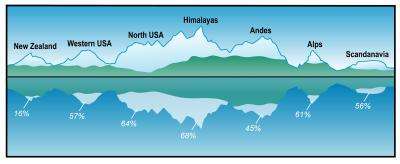
The most detailed climate model to date of global mountain ranges compares snow-water concentrations between now (top) and the century's end, as reflected in the percentage of snow-water that will remain on the peaks. South America, Europe,Western United States and New Zealand are projected to be the hardest hit by warming-induced snowmelt. Credit: Pacific Northwest National Laboratory

By the century's end, the Andes in South America will have less than half their current winter snowpack, mountain ranges in Europe and the U.S. West will have lost nearly half of their snow-bound water, and snow on New Zealand's picturesque snowcapped peaks will all but have vanished.

Such is the dramatic forecast from a new, full-century model that offers detail its authors call "an unprecedented picture of climate change." The decline in winter snowpack means less spring and summer runoff from snowmelt. That translates to unprecedented pressure on people worldwide who depend on summertime melting of the winter snowpack for irrigation and drinking water.

Hardest hit are mountains in temperate zones where temperatures remain freezing only at increasingly higher elevations, said Steven J. Ghan, staff scientist at the Department of Energy's Pacific Northwest National Laboratory and lead author of a study describing the model in the current Journal of Climate. PNNL scientist Timothy Shippert was co-author.

Alaska in 2100 will maintain but 64 percent of its year 2000 snowpack. In Europe, the Alps will be at 61 percent and Scandinavia 56 percent. The Sierras, Cascades and southern Rockies will be at 57 percent of current levels. The Andes will drop to 45. And Mt. Cook and its snowcapped neighbors in New Zealand will be much less scenic at 16 percent of current.

Ghan said the model, which actually simulated years 1977 to 2100 to use known data as calibration, differs from past attempts because it generates snow information for small areas – 5 kilometer grids, or about 3-miles – on mountains ranges over such a long period.

"Global climate models have never been run at 5 kilometers resolution for a period covering more than a couple of months," Ghan said, "even on the biggest computers in the world."

Ghan deployed a divide-and-conquer method to data crunching called "physically-based global downscaling" he and colleagues had used previously on mountains in the U.S. West. The world's mountain ranges are chopped into 10 different "elevation classes." For each elevation class, data such as air circulation, moisture and temperature is used to determine snowfall to the surface. The surface snow is then distributed across the grids according to the local surface elevation.

The entire century-plus simulation, based on the National Center for Atmospheric Research Community Climate System Model funded by the National Science Foundation and DOE, can be run on a modest supercomputer over a few weeks. Ghan and Shippert used one at the PNNL-based W.R. Wiley Environmental Molecular Sciences Laboratory.

Ghan cautioned about "significant limitations" to the model. For example, field observations in Africa suggest the famous snows of Mt. Kilimanjaro will be gone within decades, and on Greenland signs point to accelerated snow and ice melt.

"This climate model doesn't show that," Ghan said. "That doesn't mean Kilimanjaro and Greenland aren't in trouble. But our model doesn't account for all of the snow loss that is possible. Our model neglects downward flow of snow by avalanches and snow slides, glacial creep in places where snowfall is heavy and the snow doesn't have time to melt."

Source: Pacific Northwest National Laboratory

4.2 /5 (13 votes)  

Rank 4.2 /5 (13 votes)
Tags

Related Stories
Relevant PhysicsForums posts
  • Do some geologists actually act a lot like Randy Marsh?
    created19 hours ago
  • Discrepancy between oxygen and carbon-dioxide levels
    createdFeb 09, 2012
  • where gems are found in the world
    createdFeb 09, 2012
  • Wind Waves in Reservoir ~ Wind run-up and Wind set-up
    createdFeb 08, 2012
  • Balance of oxygen in the atmosphere
    createdFeb 01, 2012
  • The case for a methanol-based economy
    createdJan 30, 2012
  • More from Physics Forums - Earth

More news stories

Europe stakes billion-dollar bet on new rocket

A pencil-slim rocket is scheduled to lift into space from South America on Monday, carrying a billion-dollar bet that Europe can grab a juicy slice of the market to place satellites in low orbit.

Space & Earth / Space Exploration

created 18 hours ago | popularity 3.5 / 5 (2) | comments 0

Political leaders play key role in how worried Americans are by climate change: study

More than extreme weather events and the work of scientists, it is national political leaders who influence how much Americans worry about the threat of climate change, new research finds.

Space & Earth / Environment

created Feb 06, 2012 | popularity 5 / 5 (6) | comments 72

NASA budget will axe Mars deal with Europe: scientists

US President Barack Obama's budget proposal to be submitted next week for 2013 will cut NASA's budget by 20 percent and eliminate a major partnership with Europe on Mars exploration, scientists said Thursday.

Space & Earth / Space Exploration

created Feb 10, 2012 | popularity 5 / 5 (3) | comments 48

Humans may have helped the decline of African rainforests 3000 years ago

(PhysOrg.com) -- Large areas of rainforests in Central Africa mysteriously disappeared over three thousand years ago, to be replaced by savannas. The prevailing theory has been that the cause was a change ...

Space & Earth / Environment

created Feb 10, 2012 | popularity 4.1 / 5 (14) | comments 19 | with audio podcast report

High planetary tilt lowers odds for life?

Highly-tilted worlds would have extreme seasons, subjecting life to alternating periods of scorching and subzero temperatures. This could make the development of all but hardiest, simplest creatures a long ...

Space & Earth / Space Exploration

created Feb 06, 2012 | popularity 4.8 / 5 (12) | comments 14 | with audio podcast


Walney offshore wind farm is world's biggest (for now)

(PhysOrg.com) -- The Walney wind farm on the Irish Sea--characterized by high tides, waves and windy weather--officially opened this week. The farm is treated in the press as a very big deal as the Walney ...

GPS court ruling leaves US phone tracking unclear

A US Supreme Court decision requiring a warrant to place a GPS device on the car of a criminal suspect leaves unresolved the bigger issue of police tracking using mobile phones, legal experts say.

Europeans protest controversial Internet pact

Tens of thousands of people marched in protests in more than a dozen European cities Saturday against a controversial anti-online piracy pact that critics say could curtail Internet freedom.

Study finds that anti-diabetic medication can prevent the long-term effects of maternal obesity

In a study to be presented today at the Society for Maternal-Fetal Medicine's annual meeting, The Pregnancy Meeting, in Dallas, Texas, researchers will report findings that show that short therapy with the anti-diabetic medication ...

Netflix settlement trims 14 pct off 4Q earnings

(AP) -- Netflix pressed the rewind button on its fourth-quarter earnings after settling allegations that the video subscription service violated a consumer-privacy law.

Navy to begin tests on electromagnetic railgun prototype launcher

The Office of Naval Research (ONR)'s Electromagnetic (EM) Railgun program will take an important step forward in the coming weeks when the first industry railgun prototype launcher is tested at a facility ...