Physicists detail Earthshine's role in planet hunting and climate variables
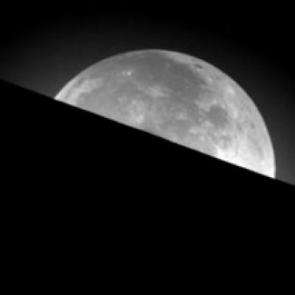
How the study of Earthshine continues to elucidate climate variables and how the use of Earthshine data may help to search for advanced life on distant planets, will be the foci of an upcoming panel discussion in Baltimore led by solar physicist Philip R. Goode, PhD, and a panel of researchers. Earthshine is the reflected light from earth which creates the ghostly glow completing the circular outline of a partial moon.
Goode, distinguished professor at New Jersey Institute of Technology (NJIT) and director of Big Bear Solar Observatory (BBSO), Calif., leads the talk May 23, 2006, at the Baltimore Convention Center during the 2006 joint assembly of six geophysical societies, including the American Geophysical Union.
NJIT has managed and operated BBSO since 1997. In April of 2007, Goode plans to see first light from a new 1.6-meter aperture telescope installed at BBSO. The instrument is expected to be the most capable ground-based solar telescope in the world.
Joining Goode's panel are NJIT Research Professor Pilar Montanes-Rodriguez, PhD, and Wesley A. Traub, PhD, chief scientist for NASA's Navigator Program to search for extrasolar planets, and project scientist for NASA's Terrestrial Planet Finder Coronagraph Mission. Traub works at NASA's Jet Propulsion Laboratory, managed by the California Institute of Technology.
Since the 16th century when Leonardo Da Vinci first described Earthshine, the idea has captivated both scientists and poets. Goode and the Big Bear team of Montanes-Rodriguez with NJIT Research Professor Enric Palle have used Earthshine observations to determine changes in the earth's climate. Much of this research has focused on the relationship of cloud cover to global warming.
More recently, Goode has been developing a worldwide network of inexpensive ground-based robotic telescopes to measure Earthshine to better understand climate variables. "I see these telescopes, capable of engaging scientists worldwide--even ones in developing nations--in significant studies of climate change," Goode said. "Not that Earthshine data should be limited to climate change. I see it also useful in the search for life on other planets." He will discuss these telescopes along with his Earthshine research as related to global warming at the panel discussion.
Earthshine has enabled Montanes-Rodriguez to gauge requirements for discovering complex life on distant planets. "At any moment, satellite cloud cover data reveals the amount of vegetation that would be visible from just above the Earth. This knowledge can be combined with earthshine observations to successfully detect vegetation on the Earth as though it were a distant planet," she said. "Although the typical day's signal might be weaker than scientists previously thought, it can still be clearly seen on certain days."
Using real cloud cover satellite data and Earthshine spectral data, Montanes-Rodriguez showed that for a few days during the year when Earth's vegetation signal is prominent, vegetation can very clearly be seen from space. Such days are visible around the time of a full moon and depend upon reflecting a tiny fragment of Earth--typically small cloud-free, green crescents, such as the Amazon rain forests.
"Montanes-Rodriguez has measured the spectral Earthshine with state-of-the-art accuracy, calibrated the albedo by also observing lunar eclipses, and modeled it as if you were a distant astronomer looking at our solar system, and seeing under what circumstances you could find an Earthlike planet," said Goode. Montanes-Rodriguez also gauged the task's difficulty.
Traub has modeled what one might expect the Earthshine looked like in the distant past. And, he measured the spectral Earthshine.
"There is a close connection between Earthshine and extrasolar planets," Traub said. "The reflected spectrum is exactly the same as an astronomer would see from a nearby star. So turning this around, we can test our ability to detect life on a nearby planet by seeing if we can detect life on Earth, using Earthshine."
Traub's models of the Earth's spectrum cover the full range of Earth's geological history. "The carbon-dioxide dominated atmosphere of the early Earth can be seen clearly in the thermal infrared spectrum," Traub said. "The rise of oxygen, from life, showed up in the visible spectrum. If we find an extra solar planet in any of these stages of the Earth's past history, we will be able to identify it as such."
Details of the Earthshine spectra measured and modeled by Traub and his colleagues show strong bands of oxygen, water and ozone, all good signs of life. Earth's blue-enhanced brightness (the blue sky) from visible and near-infrared spectra was also visible. Thermal infrared spectra of the earth, taken by a spacecraft to Mars several years ago, were similarly helpful, showing carbon dioxide, ozone, and water. With an improved spectrometer, Traub said, methane and nitrous oxide could have been seen.
Source: New Jersey Institute of Technology


