Supernova Explosion May Have Caused Mammoth Extinction
A distant supernova that exploded 41,000 years ago may have led to the extinction of the mammoth, according to research that will be presented tomorrow (Sept. 24) by nuclear scientist Richard Firestone of the U.S. Department of Energy’s Lawrence Berkeley National Laboratory.
Firestone, who conducted this research with Arizona geologist Allen West, will unveil this theory at the 2nd International Conference "The World of Elephants" in Hot Springs, SD. Their theory joins the list of possible culprits responsible for the demise of mammoths, which last roamed North America roughly 13,000 years ago. Scientists have long eyed climate change, disease, or intensive hunting by humans as likely suspects.
Now, a supernova may join the lineup. Firestone and West believe that debris from a supernova explosion coalesced into low-density, comet-like objects that wreaked havoc on the solar system long ago. One such comet may have hit North America 13,000 years ago, unleashing a cataclysmic event that killed off the vast majority of mammoths and many other large North American mammals. They found evidence of this impact layer at several archaeological sites throughout North America where Clovis hunting artifacts and human-butchered mammoths have been unearthed. It has long been established that human activity ceased at these sites about 13,000 years ago, which is roughly the same time that mammoths disappeared.
They also found evidence of the supernova explosion’s initial shockwave: 34,000-year-old mammoth tusks that are peppered with tiny impact craters apparently produced by iron-rich grains traveling at an estimated 10,000 kilometers per second. These grains may have been emitted from a supernova that exploded roughly 7,000 years earlier and about 250 light years from Earth.
“Our research indicates that a 10-kilometer-wide comet, which may have been composed from the remnants of a supernova explosion, could have hit North America 13,000 years ago,” says Firestone. “This event was preceded by an intense blast of iron-rich grains that impacted the planet roughly 34,000 years ago.”
In support of the comet impact, Firestone and West found magnetic metal spherules in the sediment of nine 13,000-year-old Clovis sites in Michigan, Canada, Arizona, New Mexico and the Carolinas. Low-density carbon spherules, charcoal, and excess radioactivity were also found at these sites.
“Armed with only a magnet and a Geiger counter, we found the magnetic particles in the well-dated Clovis layer all over North America where no one had looked before,” says Firestone.
Analysis of the magnetic particles by Prompt Gamma Activation Analysis at the Budapest Reactor and by Neutron Activation Analysis at Canada’s Becquerel Laboratories revealed that they are rich in titanium, iron, manganese, vanadium, rare earth elements, thorium, and uranium. This composition is very similar to lunar igneous rocks, called KREEP, which were discovered on the moon by the Apollo astronauts, and have also been found in lunar meteorites that fell to Earth in the Middle East an estimated 10,000 years ago.
“This suggests that the Earth, moon, and the entire solar system were bombarded by similar materials, which we believe were the remnants of the supernova explosion 41,000 years ago,” says Firestone.
In addition, Berkeley Lab’s Al Smith used the Lab’s Low-Background Counting Facility to detect the radioactive isotope potassium-40 in several Clovis arrowhead fragments. Researchers at Becquerel Laboratories also found that some Clovis layer sediment samples are significantly enriched with this isotope.
“The potassium-40 in the Clovis layer is much more abundant than potassium-40 in the solar system. This isotope is formed in considerable excess in an exploding supernova, and has mostly decayed since the Earth was formed,” says Firestone. “We therefore believe that whatever hit the Earth 13,000 years ago originated from a recently exploded supernova.”
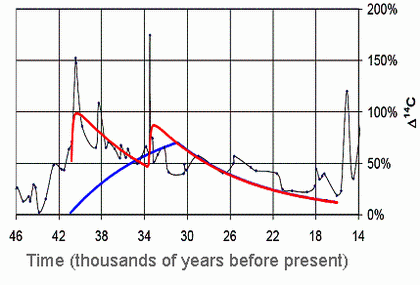
Image: Radiocarbon peaks in Icelandic marine sediment samples, indicated by the black line, coincide with three supernova-caused events that Firestone and Wells believe led to the extinction of the mammoth
Firestone and West also uncovered evidence of an even earlier event that blasted parts of the Earth with iron-rich grains. Three mammoth tusks found in Alaska and Siberia, which were carbon-dated to be about 34,000 years old, are pitted with slightly radioactive, iron-rich impact sites caused by high-velocity grains. Because tusks are composed of dentine, which is a very hard material, these craters aren’t easily formed. In fact, tests with shotgun pellets traveling 1,000 kilometers per hour produced no penetration in the tusks. Much higher energies are needed: x-ray analysis determined that the impact depths are consistent with grains traveling at speeds approaching 10,000 kilometers per second.
“This speed is the known rate of expansion of young supernova remnants,” says Firestone.
The supernova’s one-two punch to the Earth is further corroborated by radiocarbon measurements. The timeline of physical evidence discovered at Clovis sites and in the mammoth tusks mirrors radiocarbon peaks found in Icelandic marine sediment samples that are 41,000, 34,000, and 13,000 years old. Firestone contends that these peaks, which represent radiocarbon spikes that are 150 percent, 175 percent, and 40 percent above modern levels, respectively, can only be caused by a cosmic ray-producing event such as a supernova.
“The 150 percent increase of radiocarbon found in 41,000-year-old marine sediment is consistent with a supernova exploding 250 light years away, when compared to observations of a radiocarbon increase in tree rings from the time of the nearby historical supernova SN 1006,” says Firestone.
Firestone adds that it would take 7,000 years for the supernova’s iron-rich grains to travel 250 light years to the Earth, which corresponds to the time of the next marine sediment radiocarbon spike and the dating of the 34,000-year-old mammoth tusks. The most recent sediment spike corresponds with the end of the Clovis era and the comet-like bombardment.
“It’s surprising that it works out so well,” says Firestone.
Source: Berkeley Lab


