First pictures from the map of the universe mission
May 22, 2006 First pictures from the map of the universe mission

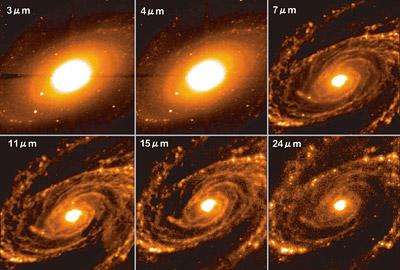
These infrared images of the galaxy M81 were taken by the near- and mid-Infrared Camera (IRC) on board Akari. The observed wavelengths are 3, 4, 7, 11, 15, and 24 microns, respectively. M81 is a spiral galaxy located at a distance of about 12 million light years from us. The images at 3 and 4 microns show the distribution of stars in the inner part of the galaxy without any obscuration from intervening dust clouds. At 7 and 11 microns it is possible to see the radiation from organic materials in the interstellar gas of the galaxy. The distribution of the dust heated by young hot stars is exhibited in the images at 15 and 24 micron, showing that the star forming regions sit along the spiral arms of the galaxy. Credit: JAXA

An ambitious mission by the Japan Aerospace Exploration Agency (JAXA) to make a new, high resolution map of the universe has just successfully returned its first pictures.

The AKARI (formerly ASTRO-F) infrared space telescope is making its All-Sky Survey at infrared wavelengths with sharper images and a much higher sensitivity than the first infrared astronomical sky survey satellite launched in 1983. AKARI will leave a tremendous legacy for the future of astronomy. Most of the light ever emitted in the Universe was emitted in the infra-red part of the spectrum, so the range of objects that can be studied by this survey is huge.

Today (May 22nd), at a press conference in Japan, JAXA released spectacular infra-red images of the Nebula IC 4954 that show the birth of stars in their cradle of formation.

“These first images are extremely promising,” said Dr. Stephen Serjeant, Senior Lecturer in Astrophysics at the Open University, said. ”The beautiful filigree structure in the nebula was impossible to see with the previous satellite IRAS. After having worked on this for so many years, it is wonderful to see our labours rewarded so clearly. AKARI can do many things that no other telescope on the Earth or in space can.”

Glenn White, Professor of Astronomy at The Open University and The CCLRC Rutherford Appleton Laboratory, adds: “The AKARI mission will redefine our view of the Universe at infrared wavelengths, achieving considerably sharper images through its improved higher spatial resolution and sensitivity over the whole sky than previously available. It offers a major new observatory facility to probe the cradles of star formation, that are normally obscured from the view of other telescopes, the formation and evolution of planetary systems, and to observe the embryonic galaxies assembling toward the edge of the observable universe. History tells us that any similar step forward in performance over what has gone before, is likely to reveal unexpected new phenomena or classes of objects that can help to redefine our understanding of the Universe”

Dr Richard Savage, postdoctoral research fellow at the University of Sussex, said "It's wonderful to see the first images coming from the AKARI space telescope, after so much hard work by everyone on the project. It's particularly gratifying to see how well AKARI is functioning; this bodes extremely well for the science we will be able to produce from the mission."

Michael Rowan-Robinson, Head of Astrophysics at Imperial College London, said: "The great power of the AKARI mission is that it is an all-sky survey in the far infrared with improved sensitivity and greatly improved resolution compared to the IRAS mission of the 1980s. It will be a major step forward at these wavelengths."

Dr. Seb Oliver (Reader in Astronomy at the University of Sussex) says "Dr. Richard Savage and I have just returned from Japan where we spent an exhausting time looking at the first data from Akari. We are delighted that everything appears to be performing just as we hoped and look forward to many exciting results to come."

Dr Chris Pearson, European Space Agency support astronomer to the Japanese at JAXA's Institute of Space and Aeronautical Science (ISAS), said "It is an enormous milestone for all those involved in the AKARI mission to finally see the fruits of their years of hard labour manifested in these breathtaking images of our infrared Universe. The team is now looking forward to producing an atlas of the entire infrared sky in addition to many more such beautiful images."

Source: PPARC


print this article email this article download pdf blog this article bookmark this article     Stumble it Digg this share on Facebook retweet share on Reddit add to delicious
Rate this story - 4.6 /5 (29 votes)


May 22, 2006 all stories

Comments: 0

4.6 /5 (29 votes)
  • Stumble this up

  • Digg this

  • share this

  • hide
  • Related Stories

  • AKARI presents detailed all-sky map in infrared light
    created Jul 11, 2007 | popularity not rated yet | comments 0
  • Wealth of new results from AKARI infrared sky-surveyor
    created Mar 26, 2007 | popularity not rated yet | comments 0
  • Revealing the mysteries of galaxy formation
    created Nov 01, 2006 | popularity not rated yet | comments 0
  • Akari's observations of galaxy M101
    created Sep 07, 2007 | popularity not rated yet | comments 0
  • AKARI's observations of asteroid Itokawa
    created Aug 23, 2007 | popularity not rated yet | comments 0


  • hide
  • Relevant PhysicsForums posts

  • Black hole confusion
    created 14 hours ago
  • Moon tied to Earth
    created 22 hours ago
  • Water on the Moon!
    created Nov 13, 2009
  • Is it possible for a single super-massive black hole...
    created Nov 13, 2009
  • More from Physics Forums - General Astronomy

Other News

Wind power turbines in Dali, in China's southwestern Yunnan province

China tipped as global leader in green tech

Space & Earth / Environment

created 10 hours ago | popularity 2.5 / 5 (2) | comments 4

China can become the world's top exporter of "green technology" if it carries out crucial energy and ecological reforms, leading environmental campaigners said here Saturday.


Underwater robot probes depths for Istanbul quake clues

Space & Earth / Earth Sciences

created 10 hours ago | popularity 5 / 5 (3) | comments 0

A state-of-the-art underwater robot called BOB may hold the key to protecting millions of people around Turkey's biggest city against a massive earthquake scientists say is all but inevitable.


LCROSS Impact Data Indicates Water on Moon

LCROSS Impact Finds Water on the Moon

Space & Earth / Space Exploration

created Nov 13, 2009 | popularity 4.9 / 5 (24) | comments 9

(PhysOrg.com) -- The argument that the moon is a dry, desolate place no longer holds water. Secrets the moon has been holding, for perhaps billions of years, are now being revealed to the delight of scientists ...


Hawaii planning to replenish sand at Waikiki Beach

Space & Earth / Environment

created 11 hours ago | popularity 3 / 5 (1) | comments 0

(AP) -- Hawaii officials are appealing to the state's tourism authority for funds to restore part of world-famous Waikiki Beach.


Cyclone Phyan raining on Tibet after breaking a record in India

Cyclone Phyan raining on Tibet after breaking a record in India

Space & Earth / Earth Sciences

created 21 hours ago | popularity 4 / 5 (2) | comments 0

Cyclone Phyan broke a 43 year record when it made landfall north of the city of Mumbai, India during the evening hours on November 11. NASA's Aqua satellite captured Phyan's landfall with one instrument, and ...