Einstein papers to go on sale in London
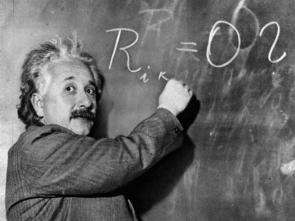
May 22, 2006 Albert Einstein

A collection of Albert Einstein's papers are to go on sale next month in London, reportedly expected to garner at least $1.5 million.

The papers reveal Einstein's struggles, failures and doubts -- ironically made worse by an apparently shaky grasp of mathematics, The Guardian reported Monday.

The collection details Einstein's accomplishments in physics, including his unprecedented general theory of relativity in 1916, as well as his frustration at not being able to achieve "a grand theory of everything."

The 15 manuscripts and 33 letters written between 1933 and 1954 were collected by Ernst Gabor Straus, a young mathematician whom Einstein selected to help him during his time at Princeton University.

The papers have been privately held by Straus and his family, The Guardian said, noting Einstein scholars were not aware they existed until Straus's wife and son decided to put them on the market.

The Straus family decided not to auction the material, since selling the collection as a whole would command a higher price, the newspaper said.

Copyright 2006 by United Press International


print this article email this article download pdf blog this article bookmark this article     Stumble it Digg this share on Facebook retweet share on Reddit add to delicious
Rate this story - 3 /5 (6 votes)


May 22, 2006 all stories

Comments: 0

3 /5 (6 votes)
  • Stumble this up

  • Digg this

  • share this

  • hide
  • Related Stories

  • In Memoriam: Martin J. Klein, Historian of Modern Physics, Edited Einstein Papers
    created Apr 10, 2009 | popularity not rated yet | comments 0
  • Fluorescent proteins illuminating biomedical research
    created Jan 25, 2009 | popularity not rated yet | comments 0
  • Researchers discover a protein that amplifies cell death
    created Jan 15, 2009 | popularity not rated yet | comments 0
  • Physicist John Wheeler, Einstein collaborator, dead at 96
    created Apr 15, 2008 | popularity not rated yet | comments 0
  • Testing Einstein: Is Dark Energy Constant?
    created Oct 11, 2007 | popularity not rated yet | comments 0


  • hide
  • Relevant PhysicsForums posts

Other News

Solving big problems

Solving big problems with new quantum algorithm

Physics / Quantum Physics

created 12 hours ago | popularity 4.5 / 5 (17) | comments 0

(PhysOrg.com) -- In a recently published paper, Aram Harrow at the University of Bristol and colleagues from MIT in the United States have discovered a quantum algorithm that solves large problems much faster ...


First Bose-Einstein condensation of strontium

First Bose-Einstein condensation of strontium

Physics / Quantum Physics

created 17 hours ago | popularity 5 / 5 (4) | comments 1

In an international first, scientists from the Institute of Quantum Optics and Quantum Information (IQOQI, Austria) produced a Bose-Einstein condensate of the alkaline-earth element strontium, thus narrowly ...


Contracts Awarded for Production of NSLS-II Storage Ring Magnets

Physics / General Physics

created 10 hours ago | popularity not rated yet | comments 0

(PhysOrg.com) -- All seven contracts for the production of the NSLS-II storage ring magnets have now been awarded -- a significant milestone for the project. The magnets -- 750 in total -- will be made by vendors in the United ...


Stars Fueled by Dark Matter Could Hold Secrets to the Universe

Stars Fueled by Dark Matter Could Hold Secrets to the Universe

Physics / General Physics

created Nov 03, 2009 | popularity 4.5 / 5 (53) | comments 43

(PhysOrg.com) -- The first stars in the universe may have been very different from the stars we see today, yet they may hold clues to understanding some of the mysterious features of the universe. These "dark ...


Second Law of Thermodynamics May Explain Economic Evolution

Second Law of Thermodynamics May Explain Economic Evolution

Physics / General Physics

created Nov 02, 2009 | popularity 4.3 / 5 (31) | comments 28

(PhysOrg.com) -- Terms such as the "invisible hand," laissez-faire policy, and free-market principles suggest that economic growth and decline in capitalist societies seem to be somehow self-regulated. Now, ...