Astrophysicists Discover 'Compact Jets' From Neutron Star
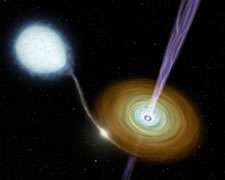
Compact jets that shoot matter into space in a continuous stream at near the speed of light have long been assumed to be a unique feature of black holes. But these odd features of the universe may be more common than once thought.
Astrophysicists using NASA's Spitzer Space Telescope recently spotted one of these jets around a super-dense dead star, confirming for the first time that neutron stars as well as black holes can produce these fire-hose-like jets of matter. A paper detailing their surprising discovery appears in this week’s issue of the Astrophysical Journal Letters.
"For years, scientists suspected that something unique to black holes must be fueling the continuous compact jets because we only saw them coming from black hole systems,” said Simone Migliari, an astrophysicist at the University of California, San Diego’s Center for Astrophysics and Space Sciences and the lead author of the paper. “Now that Spitzer has revealed a steady jet coming from a neutron star in an X-ray binary system, we know that the jets must be fueled by something that both systems share.”
A neutron star X-ray binary system occurs when a normal star orbits a dead star that is so dense all of its atoms have collapsed into neutrons, hence the name “neutron star.” The normal star circles the neutron star the same way Earth orbits the Sun.
Migliari and his colleagues from four institutions in the U.S. and Europe used Spitzer's super sensitive infrared eyes to study a jet in one such system called 4U 0614+091. In this system, the neutron star is more than 14 times the mass of its orbiting stellar companion.
As the smaller star travels around its dead partner, the neutron star's intense gravity picks up material leaving the smaller star’s atmosphere and creates a disk around itself. The disk of matter, or accretion disk, circles the neutron star similar to the way rings circle Saturn. According to Migliari, accretion disks and intense gravitational fields are characteristics that black holes and neutron stars in X-ray binaries share.
“Our data show that the presence of an accretion disk and an intense gravitational field may be all we need to form and fuel a compact jet,” he said.
Typically, radio telescopes are the tool of choice for observing compact jets around black holes. At radio wavelengths, astronomers can isolate the jet from everything else in the system. However, because the compact jets of a neutron star can be more than 10 times fainter than those of a black hole, using a radio telescope to observe a neutron star's jet would take many hours of observations.
With Spitzer's supersensitive infrared eyes, Migliari's team detected 4U 0614+091's faint jet in minutes. The infrared telescope also helped astronomers infer details about the jet's geometry. System 4U 0614+091 is located approximately 10,000 light years away in the constellation Orion.
Other co-authors of the paper are John Tomsick of UCSD; Thomas Maccarone, Rob Fender and David Russell of the University of Southampton, UK; Elena Gallo of UC Santa Barbara; and Gijs Nelemans of the University of Nijmegen in the Netherlands.
NASA's Jet Propulsion Laboratory manages the Spitzer Space Telescope and science operations for the mission are conducted at the Spitzer Science Center at the California Institute of Technology.
Source: University of California, San Diego


