Desert Pathfinder at Work
Sub-millimetre APEX telescope inaugurated at Chajnantor.
The Atacama Pathfinder Experiment (APEX) project celebrates the inauguration of its outstanding 12-m telescope, located on the 5100 m high Chajnantor plateau in the Atacama Desert (Chile).
The APEX telescope, designed to work at sub-millimetre wavelengths, in the 0.2 to 1.5 mm range, passed successfully its Science Verification phase in July, and since then is performing regular science observations. This new front-line facility provides access to the "Cold Universe" with unprecedented sensitivity and image quality.
After months of careful efforts to set up the telescope to work at the best possible technical level, those involved in the project are looking with satisfaction at the fruit of their labour: APEX is not only fully operational, it has already provided important scientific results.
"The superb sensitivity of our detectors together with the excellence of the site allow fantastic observations that would not be possible with any other telescope in the world," said Karl Menten, Director of the group for Millimeter and Sub-Millimeter Astronomy at the Max-Planck-Institute for Radio Astronomy (MPIfR) and Principal Investigator of the APEX project.
Millimetre and sub-millimetre astronomy opens exciting new possibility in the study of the first galaxies to have formed in the Universe and of the formation processes of stars and planets. In particular, APEX allows astronomers to study the chemistry and physical conditions of molecular clouds, that is, dense regions of gas and dust in which new stars are forming. Among the first studies made with APEX, astronomers took a first glimpse deep into cradles of massive stars, observing for example the molecular cloud G327 and measuring significant emission in carbon monoxide and complex organic molecules (see ESO PR Photo 30b/05).
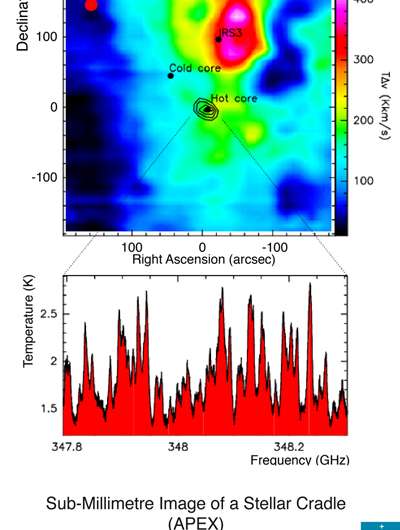
Image: ESO PR Photo 30b/05 is an image of the giant molecular cloud G327 taken with APEX. More than 5000 spectra were taken in the line of the carbon monoxide molecule (CO), one of the best tracers of molecular clouds, in which star formation takes place. The bright peak in the north of the cloud is an evolved star forming region, where the gas is heated by a cluster of new stars. The most interesting region in the image is totally inconspicuous in CO: the G327 hot core, as seen in methanol contours. It is a truly exceptional source, and is one of the richest sources of emission from complex organic molecules in the Galaxy (see spectrum at bottom). Credit: Wyrowski et al. (map), Bisschop et al. (spectrum).
The official inauguration of the APEX telescope will start in San Pedro de Atacama on September, 25th.
The Ambassadors in Chile of some of ESO’s member states, the Intendente of the Chilean Region II, the Mayor of San Pedro, the Executive Director of the Chilean Science Agency (CONICYT), the Presidents of the Communities of Séquitor and Toconao, as well as representatives of the Ministry of Foreign Affairs and Universities in Chile, will join ESO’s Director General, Dr. Catherine Cesarsky, the Chairman of the APEX Board and MPIfR director, Prof. Karl Menten, and the Director of the Onsala Space Observatory, Prof. Roy Booth, in a celebration that will be held in San Pedro de Atacama.
The next day, the delegation will visit the APEX base camp in Sequitor, near San Pedro, from where the telescope is operated, as well as the APEX site on the 5100m high Llano de Chajnantor.


