Hubble Captures a 'Five-Star' Rated Gravitational Lens
May 23, 2006 Hubble Captures a 'Five-Star' Rated Gravitational Lens

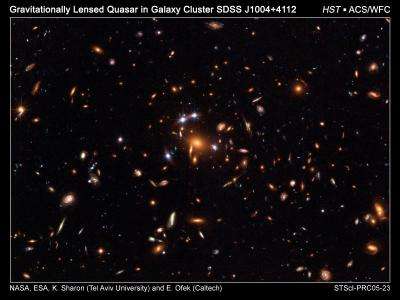
NASA's Hubble Space Telescope has captured the first-ever picture of a group of five star-like images of a single distant quasar. The multiple-image effect seen in the Hubble picture is produced by a process called gravitational lensing, in which the gravitational field of a massive object -- in this case, a cluster of galaxies -- bends and amplifies light from an object -- in this case, a quasar -- farther behind it. The galaxy cluster creating the lens is known as SDSS J1004 4112 and was discovered in the Sloan Digital Sky Survey. It is one of the more distant clusters known (seven billion light-years away), and is seen as it appeared when the universe was half its present age. Credit: ESA, NASA, K. Sharon (Tel Aviv University) and E. Ofek (Caltech)

The multiple-image effect seen in the Hubble picture is produced by a process called gravitational lensing, in which the gravitational field of a massive object -- in this case, a cluster of galaxies -- bends and amplifies light from an object -- in this case, a quasar -- farther behind it.

Although many examples of gravitational lensing have been observed, this "quintuple quasar" is the only case so far in which multiple quasar images are produced by an entire galaxy cluster acting as a gravitational lens.

The background quasar is the brilliant core of a galaxy. It is powered by a black hole, which is devouring gas and dust and creating a gusher of light in the process. When the quasar's light passes through the gravity field of the galaxy cluster that lies between us and the quasar, the light is bent by the space-warping gravity field in such a way that five separate images of the object are produced surrounding the
cluster's center. The fifth quasar image is embedded to the right of the core of the central galaxy in the cluster. The cluster also creates a cobweb of images of other distant galaxies gravitationally lensed into arcs.

The galaxy cluster creating the lens is known as SDSS J1004+4112 and was discovered in the Sloan Digital Sky Survey. It is one of the more distant clusters known (seven billion light-years away), and is seen as it appeared when the universe was half its present age.

Spectral data taken with the Keck I 10-meter telescope show that these are images of the same galaxy. The spectral results match those inferred by a lens model based only on the image positions and measurements of the light emitted from the quasar.

A gravitational lens will always produce an odd number of lensed images, but one image is usually very weak and embedded deep within the light of the lensing object itself. Though previous observations of SDSS J1004+4112 have revealed four of the images of this system, Hubble's sharp vision and the high magnification of this gravitational lens combine to place a fifth image far enough from the core of the central imaging galaxy to make it visible as well.

The galaxy hosting the background quasar is at a distance of 10 billion light-years. The quasar host galaxy can be seen in the image as multiple faint red arcs. This is the most highly magnified quasar host galaxy ever seen.

The Hubble picture also shows a large number of stretched arcs that are more distant galaxies lying behind the cluster, each of which is split into multiple distorted images. The most distant galaxy identified and confirmed so far is 12 billion light-years away (corresponding to only 1.8 billion years after the Big Bang).

By comparing this image to a picture of the cluster obtained with Hubble a year earlier, the researchers discovered a rare event -- a supernova exploding in one of the cluster galaxies. The supernova exploded seven billion years ago, and the data, together with other supernova observations, are being used to try to reconstruct how the universe was enriched by heavy elements through these explosions.

Source: Space Telescope Science Institute


print this article email this article download pdf blog this article bookmark this article     Stumble it Digg this share on Facebook retweet share on Reddit add to delicious
Rate this story - 4.7 /5 (27 votes)


May 23, 2006 all stories

Comments: 0

4.7 /5 (27 votes)
  • Stumble this up

  • Digg this

  • share this

  • hide
  • Related Stories

  • Computer Finds Massive Black Hole in Nearby Galaxy
    created Jun 09, 2009 | popularity not rated yet | comments 0
  • Fermi telescope reveals best-ever view of the gamma-ray sky
    created Mar 11, 2009 | popularity not rated yet | comments 0
  • Astronomers Discover Link Between Supermassive Black Holes and Galaxy Formation
    created Feb 02, 2009 | popularity not rated yet | comments 0
  • Discovery Reveals that Distant Quasars Live in Massive Dark-Matter Halos
    created Feb 22, 2007 | popularity not rated yet | comments 0
  • Astronomers discover a trio of quasars
    created Jan 08, 2007 | popularity not rated yet | comments 0


  • hide
  • Relevant PhysicsForums posts

  • Question about 2-body gravity
    created 2 hours ago
  • life on Mars
    created 4 hours ago
  • Semi-major axis from cartesian co-ordinates
    created 17 hours ago
  • Primary Mirror grinding
    created 19 hours ago
  • More from Physics Forums - General Astronomy

Other News

Researchers Establish Common Seasonal Patterns Among Bacterial Communities in Arctic Rivers

Researchers Establish Common Seasonal Patterns Among Bacterial Communities in Arctic Rivers

Space & Earth / Earth Sciences

created 11 minutes ago | popularity not rated yet | comments 0

(PhysOrg.com) -- New research on bacterial communities throughout six large Arctic river ecosystems reveals predictable temporal patterns, suggesting that scientists could use these communities as markers ...


From Greenhouse to Icehouse

From Greenhouse to Icehouse

Space & Earth / Earth Sciences

created 3 hours ago | popularity 4 / 5 (2) | comments 6

A new study that reconstructed ocean temperatures from millions of years ago could provide new insight into how the Earth responds to climate change.


'Cosmic fruit machine' matches collisions

'Cosmic fruit machine' matches collisions

Space & Earth / Astronomy

created 5 hours ago | popularity 5 / 5 (1) | comments 1

(PhysOrg.com) -- A new website will give everyone the chance to contribute to science by playing a 'cosmic fruit machine' and compare images of colliding galaxies with millions of simulated images of galactic ...


Humanity would need five Earths to create the resources needed if everyone lived as like Americans, a report has stated

Mankind using Earth's resources at alarming rate

Space & Earth / Environment

created 3 hours ago | popularity 2.6 / 5 (5) | comments 6

Humanity would need five Earths to produce the resources needed if everyone lived as profligately as Americans, according to a report issued Tuesday.


Supervolcano eruption -- in Sumatra -- deforested India 73,000 years ago

Supervolcano eruption -- in Sumatra -- deforested India 73,000 years ago

Space & Earth / Earth Sciences

created 20 hours ago | popularity 4.4 / 5 (12) | comments 2

A new study provides "incontrovertible evidence" that the volcanic super-eruption of Toba on the island of Sumatra about 73,000 years ago deforested much of central India, some 3,000 miles from the epicenter, ...