Sweet success for pioneering hydrogen energy project
May 23rd, 2006 Sweet success for pioneering hydrogen energy project

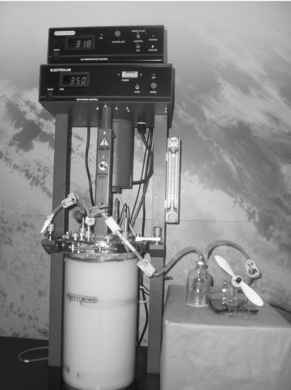
Coupling of Bio-H2 made by fermentation of confectionery waste to the operation of a PEM fuel cell used to drive an electrical device.

Bacteria that can munch through confectionery could be a valuable source of non-polluting energy in the years ahead, new research has shown. In a feasibility study funded by the Engineering and Physical Sciences Research Council, bioscientists at the University of Birmingham have demonstrated that these bacteria give off hydrogen gas as they consume high-sugar waste produced by the confectionery industry.

The hydrogen has been used to generate clean electricity via a fuel cell. Looking to the future, it could also be used to power the hydrogen-fuelled road vehicles of tomorrow. There is increasing recognition that, over the coming decades, hydrogen could provide a mainstream source of energy that is a safe, environmentally friendly alternative to fossil fuels.

This was a highly successful laboratory demonstration of bacterial hydrogen production using confectionery waste as a feedstock. The waste was supplied by Birmingham-based international confectionery and beverage company Cadbury Schweppes plc, a partner in the initiative. An economic assessment undertaken by another partner, C-Tech Innovation Ltd, showed that it should be practical to repeat the process on a larger scale.

As well as energy and environmental benefits, the technique could provide the confectionery industry (and potentially other foodstuff manufacturers) with a useful outlet for waste generated by their manufacturing processes. Much of this waste is currently disposed of in landfill sites.

In this project, diluted nougat and caramel waste was introduced into a 5 litre demonstration reactor (although other similar wastes could be used). The bacteria, which the researchers had identified as potentially having the right sugar-consuming, hydrogen-generating properties, were then added.

The bacteria consumed the sugar, producing hydrogen and organic acids; a second type of bacteria was introduced into a second reactor to convert the organic acids into more hydrogen. The hydrogen produced was fed to a fuel cell, in which it was allowed to react with oxygen in the air to generate electricity. Carbon dioxide produced in the first reactor was captured and disposed of safely, preventing its release into the atmosphere.

Waste biomass left behind by the process was removed, coated with palladium and used as a catalyst in another project, funded by the Biotechnology and Biological Sciences Research Council (BBSRC), aimed at identifying ways of removing pollutants such as chromium (VI) and polychlorinated biphenyls (PCBs) from the environment. The reactors used by this parallel initiative also required hydrogen and this was supplied by the confectionery waste initiative too, further underlining the 'green' benefits offered by the new hydrogen production technique.

Professor Lynne Macaskie of the University of Birmingham's School of Biosciences led the research team. "Hydrogen offers huge potential as a carbon-free energy carrier," she comments. "Although only at its initial stages, we've demonstrated a hydrogen-producing, waste-reducing technology that, for example, might be scaled-up in 5-10 years' time for industrial electricity generation and waste treatment processes."

The team is now engaged in follow-up work which will produce a clearer picture of the overall potential for turning a wider range of high-sugar wastes into clean energy using the same basic technique.

See the new technology in action at http://bst.portlandpress.com/bst/033/bst0330076add.htm. This video clip shows gas from the reactor being fed to a fuel cell, producing electricity that enables the electric fan to turn.

Source: Engineering and Physical Sciences Research Council


print this article email this article download pdf blog this article bookmark this article     Digg this Stumble it share on Facebook share on Reddit add to delicious save to Yahoo! bookmarks
4.8/5 after 26 votes


May 23rd, 2006 all stories
Technology / Energy

Comments: 0
Rank: 4.8/5 after 26 votes

  • Stumble this up

  • Digg this

  • Share it:
  • share on Facebook
  • share on MySpace
  • share on Slashdot
  • rss-newsfeed
  • share on Google
  • share on Reddit
  • add to delicious
  • save to Yahoo! bookmarks
  • share on Windows Live
  • Add to Mixx!
Rating: 4.8/5 after 26 votes

  • Related Stories

  • Nuclear fusion power project to start in 2018: official
    created Jun 18, 2009 | popularity not rated yet | comments 0
  • Nuclear fusion power project to start in slimmed-down version
    created Jun 08, 2009 | popularity not rated yet | comments 0
  • Engineering Carbon for Impressive Hydrogen Storage
    created May 22, 2009 | popularity not rated yet | comments 0
  • Scientists work to plug microorganisms into the energy grid
    created May 18, 2009 | popularity not rated yet | comments 0
  • In S.C., high-tech bet on hydrogen-powered cars may be move in wrong direction
    created May 10, 2009 | popularity not rated yet | comments 0

Tags


  • Physicists Demonstrate Quantum Memory with Matter Qubits
    Physicists Demonstrate Quantum Memory with Matter Qubits
    Physics / General Physics
    created Jul 03, 2009 | popularity 4.4 / 5 (17) | comments 1
  • 'Holey' Nanosheets for Wastewater Dye Removal
    Nanotechnology / Nanomaterials
    created Jul 01, 2009 | popularity 5 / 5 (5) | comments 1
  • Jellyfish Robot Swims Like its Biological Counterpart
    Jellyfish Robot Swims Like its Biological Counterpart
    Electronics / Robotics
    created Jun 26, 2009 | popularity 4.4 / 5 (8) | comments 1
  • Could Maxwell's Demon Exist in Nanoscale Systems?
    Could Maxwell's Demon Exist in Nanoscale Systems?
    Physics / General Physics
    created Jun 24, 2009 | popularity 4.4 / 5 (18) | comments 29
  • Living Safely with Robots, Beyond Asimov's Laws
    Living Safely with Robots, Beyond Asimov's Laws
    Electronics / Robotics
    created Jun 22, 2009 | popularity 4.6 / 5 (54) | comments 40
  • Other News

    EMC raises offer for Data Domain

    Technology / Business

    created 35 minutes ago | popularity not rated yet | comments 0

    Computer storage giant EMC raised its offer to purchase data storage firm Data Domain on Monday in a bid to top a rival offer for the company by data management firm NetApp.


    Translate this: 'cognition-strength interfaces'

    Translate this: 'cognition-strength interfaces'

    Technology / Engineering

    created 2 hours ago | popularity 5 / 5 (1) | comments 0

    (PhysOrg.com) -- A highly ambitious European project used basic cognitive function, eye-tracking and keystroke logging as the starting point for the study of human-computer interaction for translation. It ...


    HTC Touch

    Taiwan's HTC earnings edge down in Q2

    Technology / Business

    created 5 hours ago | popularity not rated yet | comments 0

    HTC Corp, Taiwan's leading smartphone maker, said Monday its net profit in the second quarter was down almost two percent from a year earlier.


    Samsung announces earnings estimate (AP)

    Samsung announces earnings estimate

    Technology / Business

    created 5 hours ago | popularity not rated yet | comments 0

    (AP) -- Samsung Electronics Co., the world's biggest manufacturer of memory chips, announced quarterly earnings estimates for the first time Monday, saying it hopes to reduce market confusion and speculation ...


    DoCoMo invests $45.5M in US mobile video firm

    Technology / Business

    created 3 hours ago | popularity not rated yet | comments 0

    (AP) -- NTT DoCoMo, Japan's largest mobile phone operator, said Monday it spent $45.5 million to take a 35 percent share in a U.S. company that makes multimedia technology for its mobile phones.