Carbon-based quantum dots could mean 'greener' technology in medicine, biology
May 23, 2006
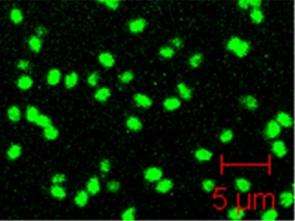
Microscope image of bacterial spores (Bacillus subtilis) labeled with luminescent carbon nanoparticles. B. subtilis serves as a common model for anthrax research. These carbon nanoparticles, or carbon dots, could lead to safer, disposable biosensors to detect biological warfare agents. Measurement shown is 5 micrometers. Image courtesy of Dr. Ya-Ping Sun of Clemson University
Chemists at Clemson University say they have developed a new type of quantum dot that is the first to be made from carbon. Like their metal-based counterparts, these nano-sized "carbon dots" glow brightly when exposed to light and show promise for a broad range of applications, including improved biological sensors, medical imaging devices and tiny light-emitting diodes (LEDs), the researchers say.
The development, which could help broaden the use of quantum dot technologies, is described in a research communications published online today by the Journal of the American Chemical Society. The paper will appear in the journal's June 7 print edition.
The carbon-based quantum dots show less potential for toxicity and environmental harm and have the potential to be less expensive than metal-based quantum dots, the scientists say. Cheap disposable sensors that can detect hidden explosives and biological warfare agents such as anthrax also are among the possibilities envisioned by the researchers.
"Carbon is hardly considered to be a semiconductor, so luminescent carbon nanoparticles are very interesting both fundamentally and practically," says study leader Ya-Ping Sun, Ph.D., a chemist at the university, located in Clemson, S.C. "It represents a new platform for the development of luminescent nanomaterials for a wide range of applications."
Quantum dots have generated much interest in recent years, especially for potential applications in biology and medicine. These tiny particles -- thousands of times smaller than the width of a human hair -- have been developed from compounds composed of lead, cadmium and, more recently, silicon. But these materials have raised concerns over potential toxicity and environmental harm. As a result, scientists have begun to look for more benign compounds for making quantum dots.
Researchers have known for some time that carbon nanoparticles, due partly to their enormous surface area, have unusual chemical and physical properties quite different from their bulk form. Using nanoparticles produced from graphite, Sun and his associates demonstrated that when these carbon nanoparticles are covered with special polymers, they glow brightly when exposed to light, behaving as tiny light bulbs. The dots glow continuously as long as a light source is present, they say.
The scientists believe that this photoluminescence may be due to the presence of "pockets" or holes on the surface of the carbon dots that trap energy. The polymer coating acts as a "molecular band-aid," enabling light emission from the inside of the polymer casing, they say. Scientists believe that metal-based quantum dots emit light by a somewhat different mechanism.
The two-sided polymer coating allows researchers to attach antibodies or other labeling materials to the carbon dot, says Sun. This could lead to improved dyes for medical imaging and also the development of sensors that light up in the presence of a target, such as anthrax or even food-borne pathogens. In lab studies, the researchers successfully labeled anthrax-like spores with luminescent carbon dots, resulting in glowing spores that were easily viewed under a microscope.
Source: American Chemical Society
-
Physics team calculates that graphene disks could be complete optical absorbers
Feb 01, 2012 |
5 / 5 (2) |
0
-
Graphene quantum dots: The next big small thing
Jan 12, 2012 |
5 / 5 (6) |
0
-
Scientists solve mystery of colorful armchair nanotubes
Jan 09, 2012 |
5 / 5 (2) |
2
-
A single cell endoscope: Researchers use nanophotonics for optical look inside living cells
Dec 20, 2011 |
5 / 5 (10) |
1
-
Researchers unravel the mystery of quantum dot blinking
Nov 09, 2011 |
5 / 5 (12) |
1
-
Engineers build first sub-10-nm carbon nanotube transistor
Feb 01, 2012 |
4.9 / 5 (31) |
30
-
Something old, something new: Evolution and the structural divergence of duplicate genes
Jan 31, 2012 |
4.6 / 5 (7) |
1
-
The hidden nanoworld of ice crystals: Revealing the dynamic behavior of quasi-liquid layers
Jan 30, 2012 |
5 / 5 (3) |
1
-
Stock market network reveals investor clustering
Jan 27, 2012 |
3.9 / 5 (23) |
8
-
Of microchemistry and molecules: Electronic microfluidic device synthesizes biocompatible probes
Jan 26, 2012 |
5 / 5 (1) |
0
-
Stem cell question.
Feb 10, 2012
-
Protease cleavage
Feb 10, 2012
-
Pertubance in a model
Feb 10, 2012
-
Cancer drugs and Alzheimer's, Oh my!
Feb 09, 2012
-
Squishing cells
Feb 09, 2012
-
Any books/articles for evolutionary stable strategy models in humans?
Feb 09, 2012
- More from Physics Forums - Biology
More news stories
New kind of solar cell could capture significantly more energy than current cells
New solar cells could increase the maximum efficiency of solar panels by over 25%, according to scientists from the University of Cambridge.
Feb 08, 2012 |
4.5 / 5 (12) |
14
|
Nanoshell whispering galleries improve thin solar panels
Visitors to Statuary Hall in the U.S. Capitol Building may have experienced a curious acoustic feature that allows a person to whisper softly at one side of the cavernous, half-domed room and for another on ...
Nanotechnology / Nanomaterials
Feb 07, 2012 |
4.3 / 5 (6) |
6
|
'Dark plasmons' transmit energy
Microscopic channels of gold nanoparticles have the ability to transmit electromagnetic energy that starts as light and propagates via "dark plasmons," according to researchers at Rice University.
Feb 09, 2012 |
4.8 / 5 (9) |
1
|
Revealing how a battery material works
Since its discovery 15 years ago, lithium iron phosphate (LiFePO4) has become one of the most promising materials for rechargeable batteries because of its stability, durability, safety and ability to deliver ...
Nanotechnology / Nanomaterials
Feb 08, 2012 |
5 / 5 (5) |
0
|
Nanotube therapy takes aim at breast cancer stem cells
Wake Forest Baptist Medical Center researchers have again proven that injecting multiwalled carbon nanotubes (MWCNTs) into tumors and heating them with a quick, 30-second laser treatment can kill them.
Nanotechnology / Bio & Medicine
Feb 09, 2012 |
5 / 5 (1) |
0
|
Walney offshore wind farm is world's biggest (for now)
(PhysOrg.com) -- The Walney wind farm on the Irish Sea--characterized by high tides, waves and windy weather--officially opened this week. The farm is treated in the press as a very big deal as the Walney ...
GPS court ruling leaves US phone tracking unclear
A US Supreme Court decision requiring a warrant to place a GPS device on the car of a criminal suspect leaves unresolved the bigger issue of police tracking using mobile phones, legal experts say.
Europeans protest controversial Internet pact
Tens of thousands of people marched in protests in more than a dozen European cities Saturday against a controversial anti-online piracy pact that critics say could curtail Internet freedom.
Europe stakes billion-dollar bet on new rocket
A pencil-slim rocket is scheduled to lift into space from South America on Monday, carrying a billion-dollar bet that Europe can grab a juicy slice of the market to place satellites in low orbit.
Study finds that anti-diabetic medication can prevent the long-term effects of maternal obesity
In a study to be presented today at the Society for Maternal-Fetal Medicine's annual meeting, The Pregnancy Meeting, in Dallas, Texas, researchers will report findings that show that short therapy with the anti-diabetic medication ...
Netflix settlement trims 14 pct off 4Q earnings
(AP) -- Netflix pressed the rewind button on its fourth-quarter earnings after settling allegations that the video subscription service violated a consumer-privacy law.