Tiny, self-powered sensor for future hydrogen economy
Hydrogen has been called “the fuel of the future.” But the gas is invisible, odorless and explosive at high concentrations, posing a safety problem for hydrogen-powered cars, filling stations and other aspects of the so-called hydrogen economy.
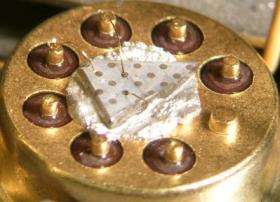
Now, a team of more than a dozen University of Florida engineering faculty and graduate students has found a way to jump that hurdle: a tiny, inexpensive sensor device that can detect hydrogen leaks and sound the alarm by wireless communication.
The cool part? The device, called a sensor node because it is designed to work in tandem with dozens or hundreds more like it, has the ability to draw its power from a tiny internal power source that harvests energy from small vibrations. That means future versions could one day operate continuously without batteries or maintenance when affixed to cars, refrigerators, pumps, motors or any other machine that gives off a slight vibration.
“You need lots of hydrogen sensors to detect leaks, but you don’t want to have to maintain them or change the battery every couple of months,” said Jenshan Lin, an associate professor of electrical and computer engineering and the lead investigator on the NASA-funded sensor project. “Our sensor can operate completely independently.”
Lin and his colleagues developed the sensor node over the past two years as a part of the NASA Hydrogen Research Program at UF. The program spans several research projects. NASA uses liquid hydrogen to fuel the space shuttle, and the goal of the $1 million-plus sensor project is to help the space agency improve the safety and reliability of all its hydrogen systems.
The card deck-sized sensor node has been tested successfully in a UF laboratory, and researchers say the next step is to miniaturize it and test it at NASA labs and in field conditions. But its long-range applications potentially go far beyond NASA to the development of hydrogen as an increasingly important fuel source, perhaps even in the family car.
Hydrogen is the principal energy source in fuel cells, the futuristic, non-polluting power devices that President Bush has targeted as a leading alternative to fossil fuels. Bush in 2003 launched the $1.2 billion Hydrogen Fuel Initiative aimed at making the technology commercially viable. That effort faces huge challenges, not the least of which is finding energy-efficient ways to extract hydrogen from water, where it is most abundant.
The handful of fuel cell-powered cars and buses on the road today could become far more common if those challenges are overcome. But for that to happen, the nation will need hydrogen filling stations, distribution pumps and pipes, and other engineering elements of a mammoth hydrogen infrastructure replacing today’s gasoline-based infrastructure.
That’s where the UF sensor node could play a role.
“You will need to have sensors all over the place – if there is a leak, you can see which ones light up, and where the leak is, and how quickly it is spreading. That way you can shut off valves and avoid a major problem,” said Steve Pearton, a professor of materials science and engineering and one of the faculty members on the project.
UF materials, electrical and chemical engineering researchers all had a hand in crafting the node. The materials and chemical researchers came up with the sensor, which is based on zinc oxide nanorods – what Pearton called “whiskers” of zinc oxide through which pass an extremely tiny electrical current. The more hydrogen surrounding these whiskers, the more conductive they become, providing a way to measure the ambient hydrogen in the air.
The electrical engineering researchers figured out how to amplify the signal enough to make it readable by a microcontroller. They also developed a tiny wireless transmitter to send the information to a central base station. The electrical engineers further found ways to power the device either through conventional solar cells or a “piezo-electric vibrational energy harvesting system” that draws on energy from vibrations produced by a variety of mechanical and electrical equipment.
Laboratory tests of the node, attached and energized by the vibrations of a mechanical shaker, showed that it could detect hydrogen concentrations of as little as 10 parts per million and successfully transmit the information as far as 20 meters, or about 65 feet. Ten parts per million is well below the level at which hydrogen becomes explosive.
Papers about the different technologies within the sensor node have appeared in academic journals in recent years, but the complete sensor was for the first time presented in its entirety at a conference late last month at a conference in Orlando.
The other UF faculty members on the project are Khai Ngo, Toshikazu Nishida and Jing Guo, professor, associate professor and assistant professor, respectively, of electrical engineering; Fan Ren, professor of chemical engineering; and Dave Norton, professor of materials science and engineering. Numerous graduate students also participated.
Source: University of Florida


