Panasonic Develops VCSEL Laser with Surface Plasmon Mirrors
May 25, 2006 Panasonic Develops VCSEL Laser with Surface Plasmon Mirrors

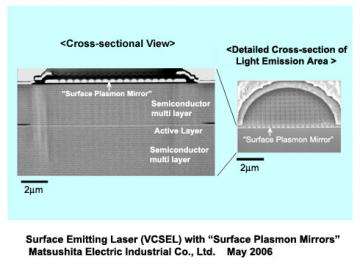
Panasonic today announced the development of a novel VCSEL (Vertical Cavity Surface Emitting Laser) utilizing an epoch-making physical phenomenon called as surface plasmon resonance. This is the world first demonstration of high output power in the VCSEL taking advantage of the surface plasmon resonance. The laser is applicable to practical high speed and short distance optical communication such as optical interconnection and plastic fiber communication.

The VCSEL features a novel "Surface Plasmon Mirror" in which a periodic silver nano-holes array is formed. The laser successfully achieves both high output power and low threshold current by effectively controlling the reflectance and the transmittance at the mirror. The VCSEL can reduce the power consumption in optical communication systems.

The surface Plasmon resonance drastically enhances optical transmission through the silver nano-holes array at an optimized pitch of the holes resulting in high optical output of 2mW. The used silver is known as the metal exhibiting the maximum resonant effect as well as very high reflectance. The enhanced reflectance at the mirror successfully reduces the threshold current down to 0.5mA.

In addition, fabrication process of the silver nano-holes is successfully established using electron beam lithography. In order to avoid any degradation of the silver, the nano-holes are entirely covered by dielectric films such as silicon nitride.

Applications for forty three domestic and eleven international patents have been filed. These research and development results have been presented at Conference on Lasers and Electro-Optics (CLEO) 2006, held in Long Beach, California, U.S. from May 21 to 26, 2006.

Source: Panasonic


print this article email this article download pdf blog this article bookmark this article     Stumble it Digg this share on Facebook retweet share on Reddit add to delicious
Rate this story - 4.2 /5 (10 votes)


May 25, 2006 all stories

Comments: 0

4.2 /5 (10 votes)
  • Stumble this up

  • Digg this

  • share this

  • hide
  • Related Stories


  • hide
  • Relevant PhysicsForums posts

  • Bodies in motionÂ…..
    created 2 hours ago
  • Refraction optics help
    created 2 hours ago
  • A basketball Jump Shot
    created 2 hours ago
  • help with accelerometer
    created 4 hours ago
  • More from Physics Forums - General Physics

Other News

Engineers image nanostructure of a solid acid catalyst and boost its catalytic activity

Nanotechnology / Nanomaterials

created 1hour ago | popularity 5 / 5 (1) | comments 1

The catalytic processes that facilitate the production of many chemicals and fuels could become much more environmentally friendly thanks to a breakthrough achieved by researchers from Lehigh and Rice Universities.


New transparent insulating film could enable energy-efficient displays

New transparent insulating film could enable energy-efficient displays

Nanotechnology / Nanomaterials

created 5 hours ago | popularity 4.8 / 5 (6) | comments 0

Johns Hopkins materials scientists have found a new use for a chemical compound that has traditionally been viewed as an electrical conductor, a substance that allows electricity to flow through it. By orienting ...


Ideal nanoparticle cancer therapies surf the bloodstream

Nanotechnology / Bio & Medicine

created 6 hours ago | popularity 5 / 5 (1) | comments 0

Eric Shaqfeh studies blood at Stanford University, using computer models that simulate how the fluid and the cells it contains move around. On November 11 at a meeting of the scientific society AVS, he will present his latest ...


New Digital 'Electronics' Concept May Continue Moore's Law

New Digital 'Electronics' Concept May Continue Moore's Law

Nanotechnology / Nanophysics

created Nov 05, 2009 | popularity 4.6 / 5 (56) | comments 9

(PhysOrg.com) -- Computers of the future could be operating not on electrons, but on tiny waves traveling through an electron "fluid," if a new proposal is successful. The new circuit design, recently introduced ...


Findings show nanomedicine promising for treating spinal cord injuries

Findings show nanomedicine promising for treating spinal cord injuries

Nanotechnology / Bio & Medicine

created Nov 08, 2009 | popularity 4.5 / 5 (4) | comments 0

(PhysOrg.com) -- Researchers at Purdue University have discovered a new approach for repairing damaged nerve fibers in spinal cord injuries using nano-spheres that could be injected into the blood shortly ...