Growing Glowing Nanowires to Light Up the Nanoworld
May 25, 2006 Growing Glowing Nanowires to Light Up the Nanoworld

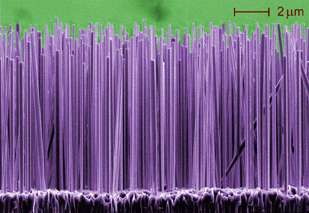
NIST "grows" semiconductor nanowires that emit ultraviolet light as part of a project to make prototype nano-lasers and other devices and the measurement tools needed to characterize them. Electron micrograph shows the gallium nitride wires growing on a silicon substrate (color added for contrast.) Credit: Lorelle Mansfield/NIST

The nano world is getting brighter. Nanowires made of semiconductor materials are being used to make prototype lasers and light-emitting diodes with emission apertures roughly 100 nm in diameter—about 50 times narrower than conventional counterparts. Nanolight sources may have many applications, including “lab on a chip” devices for identifying chemicals and biological agents, scanning-probe microscope tips for imaging objects smaller than is currently possible, or ultra-precise tools for laser surgery and electronics manufacturing.

Researchers at the National Institute of Standards and Technology (NIST) are growing nanowires made of gallium nitride alloys and making prototype devices and nanometrology tools. The wires are grown under high vacuum by depositing atoms layer by layer on a silicon crystal.

NIST is one of few laboratories capable of growing such semiconductor nanowires without using metal catalysts, an approach believed to enhance luminescence and flexibility in crystal design. The wires are generally between 30 and 500 nanometers in diameter and up to 12 micrometers long. When excited with a laser or electric current, the wires emit an intense glow in the ultraviolet or visible parts of the spectrum, depending on the alloy composition.

A paper in the May 22 issue of Applied Physics Letters* reports that individual nanowires grown at NIST produce sufficiently intense light to enable reliable room-temperature measurements of their important characteristics. For example, the peak wavelength of light emitted with electric field parallel to the long axis of a nanowire is shifted with respect to the peak wavelength emitted with electric field perpendicular to the wire. Such differences in emission are used to characterize the nanowire materials and also may be exploited to make sensors and other devices.

NIST has grown a variety of nanowires and extensively characterized their structural and optical properties, finding few defects, strains or impurities, which results in high light output compared to the bulk material.** The wires also can be transferred from the silicon crystal to other substrates, such as sapphire, and arranged using electric fields. The NIST team has used the nanowires to make a number of prototype devices, including light-emitting diodes, field-effect transistors, and nanowire “bridge” structures that may be useful in sensors and nanoscale mechanical resonators.

Citation:
*J.B. Schlager, N.A. Sanford, K.A. Bertness, J.M. Barker, A. Roshko and P.T. Blanchard. 2006. Polarization-resolved photoluminescence study of individual GaN nanowires grown by catalyst-free MBE. Applied Physics Letters. May 22.

** K.A. Bertness, N.A. Sanford, J.M. Barker, J.B. Schlager, A. Roshko, A.V. Davydov and I. Levin. 2006. Catalyst-Free Growth of GaN Nanowires. Journal of Electronic Materials 35, 576. April.

Source: NIST


print this article email this article download pdf blog this article bookmark this article     Stumble it Digg this share on Facebook retweet share on Reddit add to delicious
Rate this story - 4.3 /5 (16 votes)


May 25, 2006 all stories

Comments: 0

4.3 /5 (16 votes)
  • Stumble this up

  • Digg this

  • share this

  • hide
  • Related Stories

  • Chemists measure copper levels in zinc oxide nanowires
    created Feb 19, 2008 | popularity not rated yet | comments 0
  • ‘High Q’ Nanowires May be Practical Oscillators
    created Nov 27, 2007 | popularity not rated yet | comments 0
  • NIST Demos Industrial-Grade Nanowire Device Fabrication
    created Oct 26, 2007 | popularity not rated yet | comments 0
  • Silicon nanowires upgrade data-storage technology
    created Jun 09, 2007 | popularity not rated yet | comments 0
  • Placing single nanowires: NIST makes the connection
    created Apr 27, 2007 | popularity not rated yet | comments 0


  • hide
  • Relevant PhysicsForums posts

  • Component vectors
    created 1hour ago
  • vacuum question
    created 8 hours ago
  • inertia
    created 9 hours ago
  • Enthalpy and it's use in Gibb's Free Energy
    created 11 hours ago
  • More from Physics Forums - General Physics

Other News

Nanowire Formation

Nanowires key to future transistors, electronics

Nanotechnology / Nanophysics

created 1hour ago | popularity 5 / 5 (1) | comments 0

(PhysOrg.com) -- A new generation of ultrasmall transistors and more powerful computer chips using tiny structures called semiconducting nanowires are closer to reality after a key discovery by researchers ...


Nanotube defects equal better energy and storage systems

Nanotube defects equal better energy and storage systems

Nanotechnology / Nanomaterials

created Nov 19, 2009 | popularity 4.4 / 5 (10) | comments 2

(PhysOrg.com) -- Most people would like to be able to charge their cell phones and other personal electronics quickly and not too often. A recent discovery made by UC San Diego engineers could lead to carbon ...


Water droplets direct self-assembly process in thin-film materials

Nanotechnology / Nanomaterials

created Nov 23, 2009 | popularity 5 / 5 (4) | comments 2

You can think of it as origami - very high-tech origami. Researchers at the University of Illinois have developed a technique for fabricating three-dimensional, single-crystalline silicon structures from thin films by coupling ...


Fast, easy, and highly sensitive arsenic detection with gold nanoparticles

Nanotechnology / Nanomaterials

created Nov 25, 2009 | popularity 5 / 5 (1) | comments 0

(PhysOrg.com) -- Mention of arsenic poisoning usually brings to mind underhanded murder. However, the danger of arsenic poisoning from contaminated drinking water is far greater. Low concentrations of arsenic are found in ...


Using superconducting probes to get a picture of what it's like inside CNTs

Nanotechnology / Nanophysics

created Nov 20, 2009 | popularity 4.4 / 5 (9) | comments 0

(PhysOrg.com) -- "Carbon nanotubes are exciting for fundamental physics, and for potential technological applications," Nadya Mason tells PhysOrg.com. "However, we are generally limited in the way that we can study them. ...