Wonder Wedge on Wheels — Braking Without Hydraulics
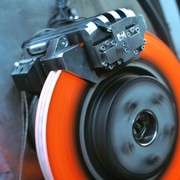
With its EWB (Electronic Wedge Brake), Siemens is aiming for a revolution in braking system technology for passenger cars. Compared to today’s hydraulic brakes, the EWB is more efficient, responds faster, requires far less energy, reduces a vehicle’s weight and saves space. At the International Motor Show (IAA) in Frankfurt (the show runs until September 26), automotive supplier Siemens VDO announced its entry into this multi-billion-euro market. Before the end of this year, the company wants to make the EWB available in a test vehicle.
The electronic wedge brake works by a similar principle to that used in brakes for horse-drawn carriages, where a wedge was used to bring the wheel to a standstill. The EWB, however, relies on sophisticated sensor technology and electronics to prevent the brakes from locking and ensure highly efficient and controlled braking (see the following report). The wedge uses a vehicle’s kinetic energy, converting it into braking energy. By reinforcing itself this way, the EWB needs only one tenth of the actuating energy required by today's hydraulic braking systems. Given this superior efficiency, the EWB will also have smaller dimensions, which will reduce total vehicle weight. What’s more, the EWB will dispense with the need for brake lines, a servo-unit and a brake fluid reservoir. This will free up a volume of about 22 liters in the engine compartment, giving vehicle designers additional scope.
Likewise, the nearly ubiquitous antilock braking systems (ABS) and the less common electronic stability programs will be replaced by the software integrated into the EWB system. Plans call for a new algorithm to take on these functions, enabling the EWB to react faster than ABS systems. While a conventional ABS takes between 140 and 170 milliseconds to generate full braking power, the EWB needs only about 100 milliseconds and therefore shortens the braking distance because a car covers the distance of 1.40 meters in one second at a speed of 100 kilometers per hour. This also means the wedge brake will play an important role in making it possible for drivers to keep vehicles under control even in difficult situations.
And the principle behind the electronic wedge brake isn’t only suitable for use in passenger cars: Trucks and trailers also could be equipped with the EWB. Today’s wedge technology can be used to brake virtually any spinning object. Possible applications include systems for elevators, high-speed trains, and for motors used in automation and conveyance technologies.


