How a Zebra Lost its Stripes: Rapid Evolution of the Quagga
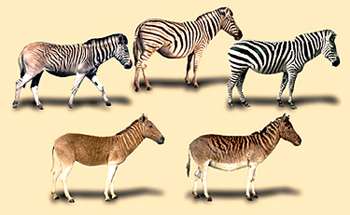
September 26, 2005 Existing zebra (top row) and extinct quagga (bottom row)

DNA from museum samples of extinct animals is providing unexpected information on the extent and effect of the Ice Age as well as the path of species evolution, according to a report by scientists from Yale University, the Smithsonian Institute and the Max Planck Institute for Evolutionary Anthropology.

Image: Existing zebra (top row) and extinct quagga

The quagga, Equus quagga, a South African relative of horses and zebras, having a front half with zebra-like stripes and a back section like a horse with no marking, became extinct about 100 years ago. The pelt from a quagga museum specimen was the subject of tissue sampling that launched the field of ancient DNA analysis.

“Twenty years ago this exact species opened the field of ancient DNA studies on extinct animals,” said one of the authors, Gisella Caccone, senior research scientist in the Department of Ecology and Evolutionary Biology at Yale. “Now, thanks to technological advances in the field, we revisited the story and used a population level approach to this question by analyzing a larger fragment of DNA and multiple specimens.”

In the past, the quagga has alternatively been described as a species and a subspecies of the Plains zebra.These researchers asked how and when the quagga diverged from all the remaining related horses, zebras, and asses. They compared the genetics, coat color and habitats of existing zebras with related extinct species.

The mitochondrial DNA markers from 13 museum specimens, including the only skeleton in museum collections, which is at Yale’s Peabody Museum of Natural History, showed that quagga likely diverged from Plains zebra about 120,000 to 290,000 years ago during the Ice Age. These results suggest that the quagga descended from a population of plains zebras that became isolated and the distinct quagga body type and coloring evolved rapidly.

This study reveals that the Ice Age was important not just in Europe and North America, but also in Africa.

“The rapid evolution of coat color in the quagga could be explained by disrupted gene flow because of geographical isolation, an adaptive response to a drier habitat, or a combination of both of the two forces,” said Caccone.

The research team also included Scott Glaberman at Yale, Jennifer A. Leonard and Robert C. Fleischer from the Smithsonian Institute, Michael Hofreiter and Nadin Rohland from the Max Planck Institute for Evolutionary Anthropology.

Source: Yale University


print this article email this article download pdf blog this article bookmark this article     Stumble it Digg this share on Facebook retweet share on Reddit add to delicious
Rate this story - 3.9 /5 (8 votes)


September 26, 2005 all stories

Comments: 0

3.9 /5 (8 votes)
  • Stumble this up

  • Digg this

  • share this

  • hide
  • Related Stories

  • Wiping out the world's mass migrations
    created Jun 01, 2009 | popularity not rated yet | comments 0
  • 15,000 reasons to worry about invasive species
    created Nov 09, 2009 | popularity not rated yet | comments 0
  • Northwest fears that invasive mussels are headed its way
    created Aug 26, 2009 | popularity not rated yet | comments 0
  • Annual Tahoe Report Says Asian Clam Invasion Is Growing Fast
    created Aug 18, 2009 | popularity not rated yet | comments 0
  • Invasive mussels imperil western water system
    created Jul 18, 2009 | popularity not rated yet | comments 0


Other News

Grand Canyon to change 'unfair' permit system

Other Sciences / Other

created 9 hours ago | popularity not rated yet | comments 1

(AP) -- Getting one of the roughly 11,500 permits granted each year to backpack overnight in the Grand Canyon has become so competitive and "unfair" that managers at the national park have decided to change the system.


Researcher: Faint writing seen on Shroud of Turin (AP)

Researcher: Faint writing seen on Shroud of Turin (Update)

Other Sciences / Archaeology & Fossils

created Nov 20, 2009 | popularity 2.3 / 5 (28) | comments 32

(AP) -- A Vatican researcher has rekindled the age-old debate over the Shroud of Turin, saying that faint writing on the linen proves it was the burial cloth of Jesus. Experts say the historian may be reading ...


Museum: Galileo's fingers, tooth are found (AP)

Museum: Galileo's fingers, tooth are found

Other Sciences / Archaeology & Fossils

created Nov 21, 2009 | popularity 4.3 / 5 (3) | comments 7

(AP) -- Two fingers and a tooth removed from Galileo Galilei's corpse in a Florentine basilica in the 18th century and given up for lost have been found again and will soon be put on display, an Italian museum ...


Maya

New insights into the life of the Maya

Other Sciences / Archaeology & Fossils

created Nov 16, 2009 | popularity 4.6 / 5 (16) | comments 7

(PhysOrg.com) -- Ancient artifacts are almost always concerned with rich and powerful religious and political leaders, but new excavations of an ancient Maya site have unearthed a pyramid decorated with murals ...


Three of a kind

Three of a kind: Revealing language’s universal essence

Other Sciences / Social Sciences

created Nov 20, 2009 | popularity 4.1 / 5 (13) | comments 6

(PhysOrg.com) -- On the surface, English, Japanese, and Kinande, a member of the Bantu family of languages spoken in the Democratic Republic of Congo, have little in common. It is not just that the vocabularies ...