Highlands and mare landscapes on the Moon
May 26, 2006 Highlands and mare landscapes on the Moon

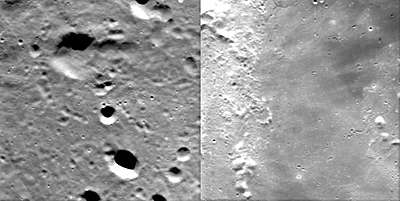
These two images, taken by the advanced Moon Imaging Experiment (AMIE) on board ESA's SMART-1 spacecraft, show the difference between lunar highlands and a mare area from close by.

The first image, showing highlands, was obtained by AMIE on 22 January 2006, from a distance of about 1112 kilometres from the surface, with a ground resolution of 100 metres per pixel. The imaged area is centred at a latitude of 26º South and at a longitude of 157º West. The second image, showing a mare, was taken on 10 January 2006, from a distance of about 1990 kilometres and with a ground resolution of 180 metres per pixel. The geographical coordinates of the area are 27.4º North latitude and 0.8º East.

Already when looking at the Moon with the naked eye, it can be seen that there are bright and dark areas on its surface. Centuries ago, the dark areas were called 'maria', presumably assuming that the observer would be seeing water oceans. Today we know that there is no liquid water on our satellite. However, telescopic observations showed that the maria are very flat, and are very different from the so-called highlands. The highlands are heavily cratered and mountainous.

We have learned that the maria are relatively young areas on the Moon which were generated after very large impacts penetrated the crust of our Moon and excavated basins. During later volcanic episodes, liquid magma came to the surface and filled these basins. When it cooled down and solidified, it formed the large flat areas we can still see now. As this happened in comparatively recent times, the number of impact craters is far less than in the highland areas.

From the two AMIE images it is possible to see how highlands present a very irregular topography and many craters, while the mare area is comparatively flat and shows a much smaller number of craters.

Source: ESA


print this article email this article download pdf blog this article bookmark this article     Stumble it Digg this share on Facebook retweet share on Reddit add to delicious
Rate this story - 3.5 /5 (13 votes)


May 26, 2006 all stories

Comments: 0

3.5 /5 (13 votes)
  • Stumble this up

  • Digg this

  • share this

  • hide
  • Related Stories

  • Apollo 12 and Surveyor 3
    created Sep 03, 2009 | popularity not rated yet | comments 0
  • Lunar Reconnaissance Orbiter's first moon images available
    created Jul 02, 2009 | popularity not rated yet | comments 0
  • Study proposes explanation for migration of volcanic activity on Mars
    created Dec 15, 2008 | popularity not rated yet | comments 0
  • True Fakes: Scientists make simulated lunar soil
    created Jan 03, 2007 | popularity not rated yet | comments 0
  • Gassendi crater - clue on the thermal history of Mare Humorum
    created Jul 06, 2006 | popularity not rated yet | comments 0


  • hide
  • Relevant PhysicsForums posts

  • astronomy
    created 20 hours ago
  • mass of molecular clouds versus stars
    created Nov 30, 2009
  • Astronomy Problems PLEASE HELP! PLEASE PLEASE
    created Nov 30, 2009
  • geographic location determination
    created Nov 29, 2009
  • More from Physics Forums - General Astronomy

Other News

Blushing dusty nebula

Blushing dusty nebula

Space & Earth / Astronomy

created 6 minutes ago | popularity not rated yet | comments 0

On Earth, we tend to find dust nothing more than a nuisance that blankets our furniture and causes us to sneeze. Cosmic dust can also be a hindrance to astronomers because cameras using visible light cannot ...


Typhoon Nida's cloud tops dropping as it zigzags in wind shear

Typhoon Nida's cloud tops dropping as it zigzags in wind shear

Space & Earth / Earth Sciences

created 1hour ago | popularity 3 / 5 (1) | comments 0

Nida is battling to keep its typhoon strength in the Western Pacific Ocean as wind shear continues to tear at the storm and weaken it. NASA's CloudSat satellite noticed that Nida's cloud tops are not as high ...


Robert Thirsk

ISS astronauts land safely in Kazakhstan

Space & Earth / Space Exploration

created 8 hours ago | popularity 5 / 5 (1) | comments 0

A space capsule carrying a Belgian, a Canadian and a Russian landed safely in the steppes of Kazakhstan on Tuesday after the trio spent half a year on the International Space Station (ISS).


Superior Super Earths

Superior Super Earths

Space & Earth / Space Exploration

created 21 hours ago | popularity 4.8 / 5 (40) | comments 12

Super Earths are named for their size, but these planets - which range from about 2 to 10 Earth masses - could be superior to the Earth when it comes to sustaining life. They could also provide an answer to ...


First comprehensive review of the state of Antarctica's climate

Space & Earth / Earth Sciences

created 8 hours ago | popularity 2.3 / 5 (3) | comments 3

The first comprehensive review of the state of Antarctica's climate and its relationship to the global climate system is published this week by the Scientific Committee on Antarctic Research (SCAR). The review - Antarctic ...