Researchers produce images of AIDS virus that may shape vaccine
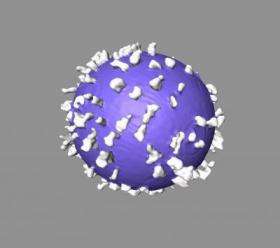
As the world marks the 25th year since the first diagnosed case of AIDS, groundbreaking research by scientists at Florida State University has produced remarkable three-dimensional images of the virus and the protein spikes on its surface that allow it to bind and fuse with human immune cells.
Findings from this AIDS research could boost the development of vaccines that will thwart infection by targeting and crippling the sticky HIV-1 spike proteins. In fact, said principal investigator and FSU Professor Kenneth H. Roux, at least two laboratories already are crafting vaccine candidates based on preliminary results uncovered by his team of structural biologists.
Those results are described in the online edition of the journal Nature.
Never before generated in such intricate detail, the super-sized images of the virus and its viral spikes have given researchers their first good look at the pathogen's complex molecular surface architecture that facilitates the infection process.
"Until now, despite intensive study by many laboratories, the design details of the spikes and their distribution pattern on the surface of the virus membrane have been poorly understood, which has limited our understanding of how the virus infection actually occurs and frustrated efforts to create vaccines," Roux said.
To produce the images, research associate Ping Zhu, Roux, and their colleagues used a state-of-the art technique called cryoelectron microscopy tomography. It generates three-dimensional images similar to those from a CAT scan, but at the level of viruses and molecules rather than tissues and organs.
They imaged HIV samples as well as a mutant SIV (non-human primate) strain, genetically engineered for the study by collaborators at the National Cancer Institute to express about 74 spikes as opposed to the 14 found on the HIV virus –- more spikes make it easier to work with. The virus samples were suspended in a thin liquid film stretched across the holes of a small copper grid and then flash-frozen, creating a solid form of ice that is more like clear glass than the typical crystalline form in ice cubes.
Once inside the electron microscope, electrons bombarded the samples from myriad angles, magnifying it more than 43,000 times to reveal its surprising structure –- absent the degree of distortion caused by the more typical imaging methods involving drying and staining of specimens.
As a result, the researchers were able to hone in on the envelope –- the lipid membrane covering the virus itself. They imaged the spikes protruding from the envelope, which contain the only viral protein molecules on the HIV surface. The FSU scientists also were able to capture super-sized images of both the head of the spike and its supporting stalk. The spike head is responsible for binding the virus to the target cell. Its stalk is responsible for the fusion event in which HIV injects its genes into the human host cells for which the virus has a natural affinity –- T lymphocytes and macrophages.
"Antibodies that effectively bind to either of these spike parts will neutralize the virus to prevent infection," said Roux, a member of FSU's biological science faculty since 1978.
His biggest surprise: the stalk has legs.
"Researchers thought the spike stalk was comprised of a tight collection of three rods bound together with the head of the spike perched on top. But our images reveal that the stalk is split into three legs, spread more like a tripod, which increases their contact with the viral membrane," Roux said. "Seeing the tripod stalk suggests a novel mechanism by which HIV-1 is able to so effectively fuse with our cells. That essential knowledge should help us design better weapons to fight the virus."
FSU Arts and Sciences Dean Joseph Travis has declared the work "a beautiful example of what happens when strong, sound basic science is applied to a very difficult problem."
The National Institutes of Health funded the two-year study, conducted by members of the department of biological science and the Institute of Molecular Biophysics at FSU.
AIDS has produced one of the worst pandemics ever known. About 25 million people have died and 40 million are infected worldwide –- including 1 million in the United States.
Source: Florida State University, by Libby Fairhurst


