Sailing the planets: Exploring Mars with guided balloons
September 27, 2005
Sailing the planets

Mars rovers, Spirit and Opportunity, have, by now, spent almost two years on the surface of Mars. They traveled several miles each, frequently stopping and analyzing scientific targets with their cameras, spectrometers and other instruments to uncover evidence of liquid water on Mars in the past. Their mission is a smashing success for NASA.

But what if NASA had a platform on Mars that was able to cover these distances in a matter of hours instead and study the rocks on the surface in the same detail as rovers do? Scientific return from such a vehicle would be immense – scientists would be able to study the whole planet in greater detail in a time span of a single year.

While orbiters can look at virtually any point on the surface of a planet, they lack the resolution provided by instruments on rovers or landers. Rovers, on the other hand, have limited mobility and cannot travel very far from their landing site. As the atmosphere of Mars is very thin, an airplane at Mars would last for just an hour until it runs out of fuel.

Global Aerospace Corporation of Altadena, CA proposes that the Mars exploration vehicle combining the global reach similar to that of orbiters and high resolution observations enabled by rovers could be a balloon that can be steered in the right direction and that would drop small science packages over the target sites. The concept being developed by the Global Aerospace Corporation is funded by the NASA Institute for Advanced Concepts (NIAC).

Balloons have been long recognized as unique, scientific platforms due to their relatively low cost and low power consumption. Two balloons flew in the atmosphere of Venus in 1984. In the past the inability to control the path of Mars balloons has limited their usefulness, and therefore scientific interest in their use.

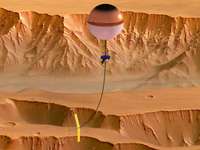
Global Aerospace Corporation has designed an innovative device, called Balloon Guidance System (BGS) that enables steering a balloon through the atmosphere. The BGS is an aerodynamic surface – a wing – that hangs on a several kilometer-long tether below the balloon. The difference in winds at different altitudes create a relative wind at the latitude of the BGS wing, which in turn creates a lifting force. This lifting force is directed sideways and can be used to pull the balloon left or right relative to the prevailing winds.

Floating just several kilometers above the surface of Mars, the guided Mars balloons can observe rock formations, layerings in canyon walls and polar caps, and other features – at very high resolution using relatively small cameras. They can be directed to fly over specific targets identified from orbital images and to deliver small surface laboratories, that will analyze the site at the level of detail rovers would do. Instruments at the balloon's gondola can also measure traces of methane in the atmospheric and follow its increasing concentrations to the source on the ground. This way the search for existing or extinct life on Mars can be accelerated.


Rank 5 /5 (1 vote)
Tags

Relevant PhysicsForums posts

More news stories

Could Venus be shifting gear?

(PhysOrg.com) -- ESA’s Venus Express spacecraft has discovered that our cloud-covered neighbour spins a little slower than previously measured. Peering through the dense atmosphere in the infrared, the ...

Space & Earth / Space Exploration

created 22 hours ago | popularity 5 / 5 (8) | comments 8 | with audio podcast

Two new moons for Jupiter

Advances in technology have lead to the discovery of new planets outside of our Solar System, and now even new moons in our own backyard.

Space & Earth / Space Exploration

created 22 hours ago | popularity 4 / 5 (1) | comments 7

Mars Science Laboratory computer issue resolved

(PhysOrg.com) -- Engineers have found the root cause of a computer reset that occurred two months ago on NASA's Mars Science Laboratory and have determined how to correct it.

Space & Earth / Space Exploration

created 23 hours ago | popularity 4.6 / 5 (7) | comments 4 | with audio podcast

NASA sees wide-eyed cyclone Jasmine

Cyclone Jasmine's eye has opened wider on NASA satellite imagery, as it moves through the Southern Pacific Ocean.

Space & Earth / Earth Sciences

created 14 hours ago | popularity 3.5 / 5 (2) | comments 2

Clam fields found at deep, low-temperature Mariana vents

(PhysOrg.com) -- Scientists have marveled at the unusual life forms thriving at high temperature hydrothermal vents of the deep ocean.

Space & Earth / Earth Sciences

created 23 hours ago | popularity 4.3 / 5 (3) | comments 0 | with audio podcast


Anonymous knocks CIA website offline (Update)

The website of the Central Intelligence Agency was inaccessible on Friday after the hacker group Anonymous claimed to have knocked it offline.

Small modular reactor design could be a 'SUPERSTAR'

(PhysOrg.com) -- Though most of today's nuclear reactors are cooled by water, we've long known that there are alternatives; in fact, the world's first nuclear-powered electricity in 1951 came from a reactor ...

New power source discovered

(PhysOrg.com) -- Researchers at the Massachusetts Institute of Technology (MIT) and RMIT University have made a breakthrough in energy storage and power generation.

The power of estrogen -- male snakes attract other males

A new study has shown that boosting the estrogen levels of male garter snakes causes them to secrete the same pheromones that females use to attract suitors, and turned the males into just about the sexiest ...

Advanced power-grid model finds low-cost, low-carbon future in West

(PhysOrg.com) -- The least expensive way for the Western U.S. to reduce greenhouse gas emissions enough to help prevent the worst consequences of global warming is to replace coal with renewable and other ...

Fool's gold may prove an unlikely alternative to overexploited catalytic materials

Catalytic materials, which lower the energy barriers for chemical reactions, are used in everything from the commercial production of chemicals to catalytic converters in car engines. However, with current catalytic materials ...