Unique Underground Ecosystem Revealed by Hebrew University Researchers Uncovers Eight Previously Unknown Species
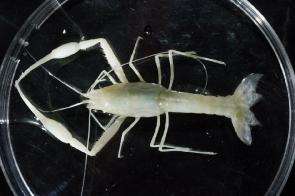
Discovery of eight previously unknown, ancient animal species within “a new and unique underground ecosystem” in Israel was revealed today by Hebrew University of Jerusalem researchers.
In a press conference on the Mt. Scopus campus of the Hebrew University, the researchers said the discovery came about when a small opening was found, leading to a cave extending to a depth of 100 meters beneath the surface of a quarry in the vicinity of Ramle, between Jerusalem and Tel Aviv. The quarry is operated by cement manufacturer Nesher Industries.
The cave, which has been dubbed the Ayalon Cave, is “unique in the world,” said Prof. Amos Frumkin of the Hebrew University Department of Geography. This is due mainly to its isolation from the outside world, since the cave’s surface is situated under a layer of chalk that is impenetrable to water. The cave, with its branches, extends over some 2½ kilometers, making it Israel’s second largest limestone cave. It is to remain closed to the public to permit further scientific research.
The invertebrate animals found in the cave – four seawater and freshwater crustaceans and four terrestial species – are related to but different from other, similar life forms known to scientists. The species have been sent to biological experts in both Israel and abroad for further analysis and dating. It is estimated that these species are millions of years old. Also found in the cave were bacteria that serve as the basic food source in the ecosystem.
“The eight species found thus far are only the beginning” of what promises to be “a fantastic biodiversity,” said Dr. Hanan Dimentman of the Hebrew University Alexander Silberman Institute of Life Sciences, another of the researchers involved in the project. He said that he expects further exploration to reveal several other unique life forms.
The animals found there were all discovered live, except for a blind species of scorpion, although Dr. Dimentman is certain that live scorpions will be discovered in further explorations and also probably an animal or animals which feed on the scorpions.
The underground cave includes an underground lake, in which the crustaceans were found. The lake is part of the Yarkon-Taninim aquifer, one of Israel’s two aquifers, yet is different in temperature and chemical composition from the main waters of the aquifer. The lake’s temperature and salinity indicates that its source is deep underground.
Among the interesting features of the discoveries thus far in the cave is that two of the crustaceans are seawater species and two others are of a types found in fresh or brackish water. This can provide insights into events occurring millions of years ago regarding the history of ancient bodies of water in the region.
In addition to Prof. Frumkin, who heads the unit for cave research in the Department of Geography, and Dr. Dimentman, others involved in the project are Prof. Dov Por and Prof. Aharon Oren of the Institute of Life Sciences, graduate student Israel Naaman, and several others. The Israel Water Commission has assisted in the research, as has Nesher Industries.
Yoel Feldschue, director-general of Nesher Industries, said today that Nesher will preserve the ecological ecosystem which has been revealed in the center of its quarry in order to avoid any damage to the important findings there. He added in that regard that he is hopeful that the planning authorities will enable the company to operate in alternate areas in order to help preserve the scientific site.
Source: Hebrew University of Jerusalem


