Ecosystems With Many Plant Species Produce More and Survive Threats Better
May 31st, 2006 Ecosystems With Many Plant Species Produce More and Survive Threats Better

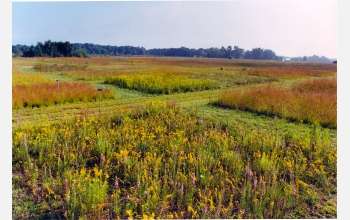
Ecosystems containing many different plant species are not only more productive, they are better able to withstand and recover from climate extremes, pests and disease over long periods, according to a new study. It is the first experiment to gather enough data--over a sufficient time and in a controlled environment--to confirm a 50-year scientific debate about whether biodiversity stabilizes ecosystems.

The findings, published in this week's issue of the journal Nature, are the result of 12 years of experiments conducted by David Tilman, an ecologist at the University of Minnesota, and colleagues Peter Reich of the University of Minnesota and Johannes Knops of the University of Nebraska. The research was conducted at the Cedar Creek Long-Term Ecological Research (LTER) site, one of 26 such National Science Foundation (NSF) sites.

"This study clearly demonstrates that stability of a plant community through time increases as species richness goes up," said Martyn Caldwell, program director in NSF's Division of Environmental Biology, which funded the research. "Only a long-term field experiment can provide this information."

Biodiversity of global ecosystems has decreased as global population has increased, said Tilman, because diverse ecosystems such as forests and prairies have been cleared to make way for agricultural fields, buildings and roads.

The research shows that ecosystems containing many different plant species are more productive than those containing only one species. A return to biodiversity may prove to be the key, Tilman and his colleagues believe, to meeting energy needs for the growing number of people on the planet and for restoring global ecosystems.

"Diverse prairie grasslands are 240 percent more productive than grasslands with a single prairie species," Tilman said. "That's a huge advantage. Biomass from diverse prairies can, for example, be used to make biofuels without the need for annual tilling, fertilizers and pesticides, which require energy and pollute the environment. Because they are perennials, you can plant a prairie once and mow it for biomass every fall, essentially forever," Tilman said.

The research was carried out in 168 plots, each of which was randomly planted with one to 16 perennial grasses and other prairie plants. Stability of plants in the plots depended upon diversity and root mass. Roots store nutrients and buffer against climate variations. Perennial prairie plants have far more root mass than crops such as corn, which must be replanted annually.

Source: The National Science Foundation


print this article email this article download pdf blog this article bookmark this article     Digg this Stumble it share on Facebook share on Reddit add to delicious save to Yahoo! bookmarks
5/5 after 1 votes


May 31st, 2006 all stories
Space & Earth / Environment

Comments: 0
Rank: 5/5 after 1 votes

  • Stumble this up

  • Digg this

  • Share it:
  • share on Facebook
  • share on MySpace
  • share on Slashdot
  • rss-newsfeed
  • share on Google
  • share on Reddit
  • add to delicious
  • save to Yahoo! bookmarks
  • share on Windows Live
  • Add to Mixx!
Rating: 5/5 after 1 votes


Tags


  • Physicists Demonstrate Quantum Memory with Matter Qubits
    Physicists Demonstrate Quantum Memory with Matter Qubits
    Physics / General Physics
    created Jul 03, 2009 | popularity 4.4 / 5 (17) | comments 1
  • 'Holey' Nanosheets for Wastewater Dye Removal
    Nanotechnology / Nanomaterials
    created Jul 01, 2009 | popularity 5 / 5 (5) | comments 1
  • Jellyfish Robot Swims Like its Biological Counterpart
    Jellyfish Robot Swims Like its Biological Counterpart
    Electronics / Robotics
    created Jun 26, 2009 | popularity 4.4 / 5 (8) | comments 1
  • Could Maxwell's Demon Exist in Nanoscale Systems?
    Could Maxwell's Demon Exist in Nanoscale Systems?
    Physics / General Physics
    created Jun 24, 2009 | popularity 4.4 / 5 (18) | comments 29
  • Living Safely with Robots, Beyond Asimov's Laws
    Living Safely with Robots, Beyond Asimov's Laws
    Electronics / Robotics
    created Jun 22, 2009 | popularity 4.6 / 5 (52) | comments 40
  • Other News

    Forty years ago man first walked on the moon

    Space & Earth / Space Exploration

    created 17 hours ago | popularity 4.3 / 5 (3) | comments 2

    Forty years ago on July 20, 1969, American astronaut Neil Armstrong realized the oldest dream of human civilizations when he became the first man to walk on the moon.


    The least sea ice in 800 years

    The least sea ice in 800 years

    Space & Earth / Earth Sciences

    created Jul 01, 2009 | popularity 4.2 / 5 (62) | comments 59

    New research, which reconstructs the extent of ice in the sea between Greenland and Svalbard from the 13th century to the present indicates that there has never been so little sea ice as there is now. The ...


    Gas around young galaxy

    Intense heat killed the Universe's would-be galaxies, researchers say

    Space & Earth / Astronomy

    created Jul 01, 2009 | popularity 3.4 / 5 (21) | comments 27

    (PhysOrg.com) -- Our Milky Way galaxy only survived because it was already immersed in a large clump of dark matter which trapped gases inside it, scientists led by Durham University's Institute for Computational ...


    Scientists' Drill Hits Magma: Only Third Time on Record

    Scientists' Drill Hits Magma: Only Third Time on Record

    Space & Earth / Earth Sciences

    created Jun 29, 2009 | popularity 4.7 / 5 (22) | comments 19

    (PhysOrg.com) -- Scientists drilling a borehole deep into Iceland’s rocky crust to explore new methods of using geothermal energy hit a major roadblock on Thursday: Their drill ran into molten rock at a depth ...


    NASA manager pitches a cheaper return-to-moon plan

    Space & Earth / Space Exploration

    created Jun 30, 2009 | popularity 4 / 5 (7) | comments 18

    (AP) -- Like a car salesman pushing a luxury vehicle that the customer no longer can afford, NASA has pulled out of its back pocket a deal for a cheaper ride to the moon.