North Pole's ancient past holds clues about future global warming
A treasure trove of scientific data is revealing detailed information about conditions of subtropical warmth at the North Pole about 55 million years ago while also providing a window into the future, when greenhouse gases are expected to reach the same levels that caused Earth's ancient heat wave.
Researchers aboard a fleet of icebreakers collected samples by drilling into the floor of the Arctic Ocean during a 2004 expedition, and scientific findings will be published for the first time in several papers to appear Thursday (June 1) in Nature magazine.
"This project was a technological feat, and all of the findings in these papers are especially new and exciting given the fact that nobody's ever taken core samples like this before from the floor of the Arctic Ocean," said Matthew Huber, an assistant professor of earth and atmospheric sciences in Purdue University's College of Science. "As a climate modeler, gaining access to this data is a once-in-a-lifetime opportunity."
The expedition was part of an international research effort called the Integrated Ocean Drilling Program, which explores the Earth's history and structure as recorded in seafloor sediments and rocks.
Huber used new data from the research to compare against results from complex climate-model simulations he performed to study and predict the effects of greenhouse gases. He co-authored two research papers to appear in Nature detailing conditions in the Arctic Ocean 55 to 50 million years ago during a time of unprecedented global warmth.
The cylindrical core samples contained the remains of ancient plant and animal life, which yielded critical new information about the Arctic Ocean during that time. Researchers used a recently developed technique called TEX-86, which enables scientists to measure the temperatures that existed when ancient organisms lived by analyzing the composition of fatty substances called lipids in their cell membranes. Using this technique, the researchers found that sea surface temperatures at the North Pole had soared to 23 degrees Celsius, or around 73 degrees Fahrenheit, during the Paleocene-Eocene Thermal Maximum, or the PETM, about 55 million years ago. Today's mean annual temperature at the North Pole is around minus 20 degrees Celsius, Huber said.
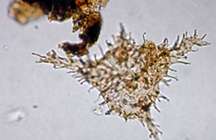
Researchers also discovered the remains of tiny algae called dinoflagellates, belonging to the species Apectodinium, which previously had been restricted to warmer regions of the world.
"The presence of Apectodinium during the Paleocene-Eocene Thermal Maximum provides confirmation that subtropical conditions arrived in the Arctic during this time," Huber said.
Among the most important reported findings was the discovery that 5 million years later, around 50 million years ago, the Arctic Ocean was frequently covered with dense mats of a freshwater fern called Azolla, which flourishes in ponds, said Henk Brinkhuis, a marine palynologist and biogeologist from Utrecht University in the Netherlands and lead author on one of the Nature papers.
"Imagine that the Arctic Ocean was a giant lake, with this vegetation growing in it," Brinkhuis said. "What these findings say is that the Arctic Ocean must have been isolated, or nearly cut off, from the Atlantic Ocean by land masses that later shifted into the present continents. Today, if you hop in a boat and head north in the Atlantic Ocean, you could go all the way to the Arctic Ocean. But back then it was more isolated, which prevented salt water from ocean surface currents from reaching there."
The beginning of the Paleocene-Eocene Thermal Maximum was marked by a huge release of a greenhouse gas, possibly carbon dioxide or methane, into the atmosphere. Methane, frozen in solid "methane hydrate" deposits on the ocean floor, might have been disturbed by some geologic event, such as mudslides or an earthquake, causing the gas to bubble to the surface. The methane would have then broken down into carbon dioxide in the atmosphere.
The resulting greenhouse effect caused global temperatures to rise by an average of about 5 degrees Celsius.
"This provides a beautiful natural experiment for understanding global warming and environmental change and is probably the best historical analogy for today's release of greenhouse gases from human-related sources," said Appy Sluijs, a doctoral student at Utrecht University's Institute of Environmental Biology and lead author on the other Nature paper. "There is no clearer evidence for greenhouse-gas-induced global warming in the geologic record."
The concentration of carbon dioxide in today's atmosphere is about 380 parts per million, whereas the concentration 55 million years ago was about 2,000 parts per million.
"We now have a pretty good correlation between records of past warmth and higher carbon dioxide concentrations," Huber said. "What it tells you is that it's not too difficult to push the climate system to a warm state. This event was a large release of a greenhouse gas. That's why it's a good analog for today's greenhouse-gas emissions, and it shows without a doubt that if you pump a bunch of greenhouse gas into the atmosphere, the planet warms.
"If you work out the numbers, it's almost identical to what we are expected to do over the next few hundred years."
While the climate models had predicted that researchers would discover the Arctic Ocean's freshwater past, the models have consistently underestimated by at least 10 degrees how hot the Earth would have been during that time, Huber said.
The models fail to explain another puzzling fact. The temperature difference between the North Pole and the equator today is about 45 degrees C. But the difference appears to have been much smaller during the Paleocene-Eocene Thermal Maximum time frame. Otherwise, it would have been too hot for vegetation to survive in equatorial latitudes.
"We still haven't explained why the tropics stayed cool," Huber said. "Somehow, we have to explain how you can warm the poles up to 23 degrees Celsius without having the tropics rise to at least 50 degrees, which is 10 degrees too hot for plants to carry out photosynthesis."
He said the implications are troubling because current models may be providing optimistic predictions.
"Today's models underpredict how warm the poles were back then, which tells you something disturbing — that the models, if anything, aren't sensitive enough to greenhouse gases," Huber said. "At the same time, it is possible that other forces in addition to higher-than-normal greenhouse gas concentrations were involved, otherwise we can't explain how the tropics maintained livable conditions.
"People have conjectured that polar stratospheric clouds or hurricane-induced ocean heat transport might have played crucial roles in amplifying polar heating, but much work needs to be done to prove this. Mechanisms that feed back onto global warming are poorly understood and not well represented into our current generation of models. This should be of great concern and will continue to be debated and explored in future research.
"Even people who describe themselves as global warming skeptics can accept the fact that massive changes happened in the past because research shows that climate change is natural. But the real point is that not only is climate change natural, but it's also easy to set in motion. All it takes is an increase in the concentration of greenhouse gases."
Scientists may explore several issues in future work, including research aimed at explaining specifically why the temperatures were so high 55.5 million years ago.
"There is a fundamental discrepancy between what kind of climate we expect to result from high atmospheric greenhouse gas concentrations, and what kind of climate really prevailed during these ancient epochs," Sluijs said. "We, hence, need to improve our climate models. An important question is, what was seasonality like in the Arctic? Was there an as-large temperature difference between summer and winter as there is nowadays?"
Source: Purdue University


