Floating pile of rubble a pristine record of solar system's history
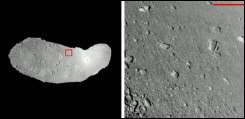
June 1st, 2006 The Itokawa asteroid and its surface (R)

The Itokawa asteroid and its surface (R)

A small, near-Earth asteroid named Itokawa is just a pile of floating rubble, probably created from the breakup of an ancient planet, according to a University of Michigan researcher was part of the Japanese space mission Hayabusa.

The finding suggests that asteroids created from rubble would be pristine records of early planet formation.

Daniel Scheeres, U-M associate professor of aerospace engineering, was part of the team that determined the asteroid's mass, surface environment, and gravitational pull and helped interpret the images that were taken of the asteroid from the spacecraft. Some of the findings will be discussed in a special issue of the journal Science on June 2. The mission is led by the Japan Aerospace Exploration Agency.

The Hayabusa space probe arrived at asteroid Itokawa last fall and orbited for three months. During that time it descended twice to the surface of the asteroid, which is named for the father of Japanese rocketry, to collect samples. In 2010 the probe will return to Earth and eject a sample canister that will reenter the atmosphere and land in central Australia. Researchers hope this will be the first asteroid sample brought back to Earth.

Scheeres said that the confirmation of Itokawa's makeup as rubble rather than a single rock has large implications for theories of how asteroids evolved, and will lead to a better understanding of the early solar system. Asteroids are thought to be the remnants of material that formed the inner planets, which include Earth, and could bear the record of events in the early stages of planet formation. It is a significant finding that Itokawa is a pile of rocks ranging in size from tiny sand grains all the way up to boulders 50 meters wide, because it verifies a number of theories about the makeup and history of asteroids.

The existence of very large boulders and pillars suggests that an earlier "parent" asteroid was shattered by a collision and then re-formed into a rubble pile, the researchers conclude in the paper.

It's likely that most asteroids have a similar past, Scheeres said. "Analysis of the asteroid samples will give us a snapshot of the early solar system, and provide valuable clues on how the planets were formed."

Also, knowing if an asteroid is a single, big rock or a pile of rubble will have a major influence on how to nudge it off course, Scheeres said, should its orbit be aimed at Earth. An asteroid collision with Earth, while unlikely, could have disastrous consequences. It's widely thought that an asteroid collision caused the mass extinction of dinosaurs 65 million years ago, so some have discussed ways to demolish or steer an approaching asteroid, should we see one coming.

Another striking finding, Scheeres said, is that regions of Itokawa's surface are smooth, "almost like a sea of desert sand" and others are very rugged. This indicates that the surfaces of asteroids are, in some sense, active, with material being moved from one region to another. Gravity holds the mass of rubble together.

"These are the first such detailed observations of an asteroid from this close," Scheeres said.

Source: University of Michigan, by Laura Bailey


print this article email this article download pdf blog this article bookmark this article     Digg this Stumble it share on Facebook share on Reddit add to delicious save to Yahoo! bookmarks
4.4/5 after 17 votes


June 1st, 2006 all stories
Space & Earth / Astronomy

Comments: 0
Rank: 4.4/5 after 17 votes

  • Stumble this up

  • Digg this

  • Share it:
  • share on Facebook
  • share on MySpace
  • share on Slashdot
  • rss-newsfeed
  • share on Google
  • share on Reddit
  • add to delicious
  • save to Yahoo! bookmarks
  • share on Windows Live
  • Add to Mixx!
Rating: 4.4/5 after 17 votes

  • Related Stories

  • Scientists close in on the origin of Mars' larger moon
    created Oct 16, 2008 | popularity not rated yet | comments 0
  • Study Puts Solar Spin on Asteroids, their Moons & Earth Impacts
    created Jul 09, 2008 | popularity not rated yet | comments 0
  • The impossible siblings
    created Mar 29, 2007 | popularity not rated yet | comments 0
  • First detailed pictures of asteroid reveal bizarre system
    created Oct 12, 2006 | popularity not rated yet | comments 0
  • In Search of Crater Chains
    created May 15, 2006 | popularity not rated yet | comments 0

Tags


  • Physicists Demonstrate Quantum Memory with Matter Qubits
    Physicists Demonstrate Quantum Memory with Matter Qubits
    Physics / General Physics
    created Jul 03, 2009 | popularity 4.4 / 5 (17) | comments 1
  • 'Holey' Nanosheets for Wastewater Dye Removal
    Nanotechnology / Nanomaterials
    created Jul 01, 2009 | popularity 5 / 5 (5) | comments 1
  • Jellyfish Robot Swims Like its Biological Counterpart
    Jellyfish Robot Swims Like its Biological Counterpart
    Electronics / Robotics
    created Jun 26, 2009 | popularity 4.4 / 5 (8) | comments 1
  • Could Maxwell's Demon Exist in Nanoscale Systems?
    Could Maxwell's Demon Exist in Nanoscale Systems?
    Physics / General Physics
    created Jun 24, 2009 | popularity 4.4 / 5 (18) | comments 29
  • Living Safely with Robots, Beyond Asimov's Laws
    Living Safely with Robots, Beyond Asimov's Laws
    Electronics / Robotics
    created Jun 22, 2009 | popularity 4.6 / 5 (52) | comments 40
  • Other News

    Forty years ago man first walked on the moon

    Space & Earth / Space Exploration

    created 12 hours ago | popularity 5 / 5 (2) | comments 1

    Forty years ago on July 20, 1969, American astronaut Neil Armstrong realized the oldest dream of human civilizations when he became the first man to walk on the moon.


    The least sea ice in 800 years

    The least sea ice in 800 years

    Space & Earth / Earth Sciences

    created Jul 01, 2009 | popularity 4.2 / 5 (61) | comments 52

    New research, which reconstructs the extent of ice in the sea between Greenland and Svalbard from the 13th century to the present indicates that there has never been so little sea ice as there is now. The ...


    Gas around young galaxy

    Intense heat killed the Universe's would-be galaxies, researchers say

    Space & Earth / Astronomy

    created Jul 01, 2009 | popularity 3.3 / 5 (20) | comments 27

    (PhysOrg.com) -- Our Milky Way galaxy only survived because it was already immersed in a large clump of dark matter which trapped gases inside it, scientists led by Durham University's Institute for Computational ...


    Scientists' Drill Hits Magma: Only Third Time on Record

    Scientists' Drill Hits Magma: Only Third Time on Record

    Space & Earth / Earth Sciences

    created Jun 29, 2009 | popularity 4.7 / 5 (22) | comments 19

    (PhysOrg.com) -- Scientists drilling a borehole deep into Iceland’s rocky crust to explore new methods of using geothermal energy hit a major roadblock on Thursday: Their drill ran into molten rock at a depth ...


    NASA manager pitches a cheaper return-to-moon plan

    Space & Earth / Space Exploration

    created Jun 30, 2009 | popularity 4 / 5 (7) | comments 18

    (AP) -- Like a car salesman pushing a luxury vehicle that the customer no longer can afford, NASA has pulled out of its back pocket a deal for a cheaper ride to the moon.