The case of the neutron star with a wayward wake
June 1, 2006 The case of the neutron star with a wayward wake

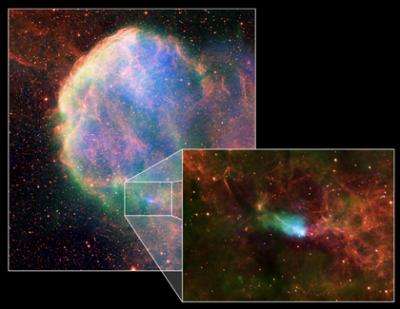
Credit: Chandra X-ray: NASA/CXC/B.Gaensler et al; ROSAT X-ray: NASA/ROSAT/Asaoka & Aschenbach; Radio Wide: NRC/DRAO/D.Leahy; Radio Detail: NRAO/VLA; Optical: DSS

A long observation with NASA's Chandra X-ray Observatory revealed important new details of a neutron star that is spewing out a wake of high-energy particles as it races through space. The deduced location of the neutron star on the edge of a supernova remnant, and the peculiar orientation of the neutron star wake, pose mysteries that remain unresolved.

"Like a kite flying in the wind, the behavior of this neutron star and its wake tell us what sort of gas it must be plowing through," said Bryan Gaensler of the Harvard-Smithsonian Center for Astrophysics in Cambridge, Mass., and lead author of a paper submitted to The Astrophysical Journal. "Yet we're still not sure how the neutron star got to its present location."

The neutron star, known as CXOU J061705.3+222127, or J0617 for short, appears to lie near the outer edge of an expanding bubble of hot gas associated with the supernova remnant IC 443. Presumably, J0617 was created at the time of the supernova -- approximately 30,000 years ago -- and propelled away from the site of the explosion at about 500,000 miles per hour.

However, the neutron star's wake is oriented almost perpendicularly to the direction expected if the neutron star were moving away from the center of the supernova remnant. This apparent misalignment had previously raised doubts about the association of the speeding neutron star with the supernova remnant.

Gaensler and his colleagues provide strong evidence that J0617 was indeed born in the same explosion that created the supernova remnant. First, the shape of the neutron star's wake indicates it is moving at the predicted pace, which is a little faster than the speed of sound in the remnant's multimillion-degree gas. In contrast, if the neutron star were outside the confines of the remnant, its inferred speed would be a sluggish 20,000 miles per hour. Also, the measured temperature of the neutron star matches that of one born at the same time of the supernova remnant.

What then, could cause the misaligned, or wayward, neutron star wake?

The authors speculate that perhaps the doomed progenitor star was moving at a high speed before it exploded, so that the explosion site was not at the observed center of the supernova remnant. Fast moving gusts of gas inside the supernova remnant have further pushed the neutron star's wake out of alignment.

Observations of J0617 in the next 10 years should put this idea to the test. "If the neutron star was born off-center and if the wake is being pushed around by cross-winds, the neutron star should be moving close to vertically, away from the center of the supernova remnant. Now we wait and see," said Gaensler.

Another group, led by Margarita Karovska, also of the Harvard-Smithsonian Center, has concentrated on other, previously unnoticed intriguing features of J0617. At a recent conference on neutron stars in London, England, they announced their findings, which include a thin filament of cooler gas that appears to extend from the neutron star along the long axis of its wake, and a second point-like feature embedded in the X-ray nebula around the neutron star

"There are a number of puzzling observational features associated with this system crying out for longer observations" said Karovska.

Source: Chandra X-ray Center


print this article email this article download pdf blog this article bookmark this article     Stumble it Digg this share on Facebook retweet share on Reddit add to delicious
Rate this story - 4.8 /5 (5 votes)


June 1, 2006 all stories

Comments: 0

4.8 /5 (5 votes)
  • Stumble this up

  • Digg this

  • share this

  • hide
  • Related Stories

  • Two Earth-sized bodies with oxygen rich atmospheres found -- but they're stars not planets
    created 1hour ago | popularity not rated yet | comments 0
  • Carbon Atmosphere Discovered on Neutron Star
    created Nov 04, 2009 | popularity not rated yet | comments 0
  • Gamma-ray photon race ends in dead heat; Einstein wins this round
    created Oct 28, 2009 | popularity not rated yet | comments 0
  • Very High Energy Gamma Rays
    created Sep 25, 2009 | popularity not rated yet | comments 0
  • High-School Student Discovers Strange Astronomical Object
    created Sep 22, 2009 | popularity not rated yet | comments 0


  • hide
  • Relevant PhysicsForums posts

Other News

Greenland ice cap melting faster than ever

Greenland ice cap melting faster than ever

Space & Earth / Earth Sciences

created 1hour ago | popularity 4.2 / 5 (5) | comments 0

Satellite observations and a state-of-the art regional atmospheric model have independently confirmed that the Greenland ice sheet is loosing mass at an accelerating rate, reports a new study in Science.


2 Earth-sized bodies with oxygen rich atmospheres found -- but they're stars not planets

Two Earth-sized bodies with oxygen rich atmospheres found -- but they're stars not planets

Space & Earth / Astronomy

created 1hour ago | popularity 5 / 5 (5) | comments 1

Astrophysicists at the University of Warwick and Kiel University have discovered two earth sized bodies with oxygen rich atmospheres - however there is a bit of a disappointing snag for anyone looking for ...


A faraway planet intrigues: Exoplanet with extremely tilted orbit raises new interest in stellar astronomy

A faraway planet intrigues: Exoplanet with extremely tilted orbit raises new interest in stellar astronomy

Space & Earth / Astronomy

created 8 hours ago | popularity 4.9 / 5 (7) | comments 5

(PhysOrg.com) -- Two teams of astronomers have found a planet outside the solar system that might be orbiting backwards compared to its star's rotation, a discovery that could shed light on how unique the ...


A glimpse at the Earth's crust deep below the Atlantic

A glimpse at the Earth's crust deep below the Atlantic

Space & Earth / Earth Sciences

created 4 hours ago | popularity 5 / 5 (2) | comments 0

Long-term variations in volcanism help explain the birth, evolution and death of striking geological features called oceanic core complexes on the ocean floor, says geologist Dr Bram Murton of the National ...


Record high temperatures far outpace record lows across US

Record high temperatures far outpace record lows across US (w/ Video)

Space & Earth / Earth Sciences

created 2 hours ago | popularity 2.3 / 5 (6) | comments 1

Spurred by a warming climate, daily record high temperatures occurred twice as often as record lows over the last decade across the continental United States, new research shows. The ratio of record highs ...