Chemists forge a new form of iron
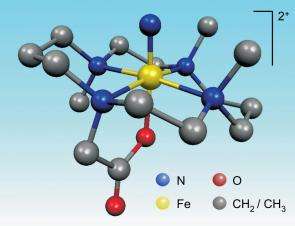
An international team of chemists has discovered a new and unexpected form of iron, a finding that adds to the fundamental understanding of an element that is among the most abundant on Earth and that, in nature, is an essential catalyst for life.
"We have synthesized something totally new that nobody has imagined could exist, and something which adds greatly to our understanding of fundamental iron chemistry," says John F. Berry, an Alexander von Humboldt postdoctoral fellow at Germany's Max-Planck Institute for Bioinorganic Chemistry in Mülheim. Berry, recently named an assistant professor of chemistry at the University of Wisconsin-Madison, is the lead author of a paper describing the new species of iron in this week's (June 1) online edition of Science, Science Express.
In addition to its role in the manufacture of thousands of everyday objects, iron, in its various manifestations, is widely known and used for its reactive properties. It occurs in nature in different ionized forms and is essential for the health and well being of virtually all kinds of life. Blood, for instance, is red because of the presence of iron II ions in hemoglobin.
The form that the metal takes is dependent on the number of electrons in the iron atom's outermost shell, known as valence electrons (there are eight in an ordinary iron atom). Iron can occur in different ionized forms determined by the number of valence electrons, which are essential for forming chemical bonds with other atoms.
"The valence electrons of an ion are those mainly responsible for how the ion reacts," Berry explains.
The new species of iron found by Berry and his colleagues is designated iron VI, which means the atom has just two valence electrons and is highly reactive as it seeks to regain iron's eight-electron stable configuration by grabbing electrons from atoms of other elements. The new form is so reactive it can only be studied at low temperatures, in this case minus 40 degrees F.
Iron VI is a designation that describes an oxidation state. In chemistry, oxidation state is a bookkeeping device to keep track of the number of valence electrons an atom has in its outermost shell when bonded to atoms of other elements. Ionized forms of iron, the most common being iron II and iron III, have varying numbers of electrons as they add or shed electrons when combined with atoms of other elements.
"Iron VI is a very rare oxidation state," explains UW-Madison chemistry professor Bassam Shakhashiri. "Synthesizing it and characterizing it are important to understanding different transition metals and their catalytic properties. This is a major contribution to understanding metals in different forms and different oxidation states."
Identifying a new species of iron is important, Shakhashiri adds, not only because it promises new insight into the chemistry of a common and already economically important element, but also because it opens a door to the future development of novel compounds for use in industry and biomedicine.
Of note is the fact the new iron compound includes nitrogen, whereas the only other known iron VI species, known as ferrate, carries oxygen.
"We hope that this complex will have practical advantages over other iron compounds, and we might expect that it does based on its structure," Berry says. "Whereas the ferrate ion easily transfers an oxygen atom to organic substrates, we might expect that our complex may transfer a nitrogen atom instead. This sort of reactivity is becoming more important in organic synthesis since it allows new synthetic pathways to nitrogen-containing organic molecules which are very important and have widespread utility."
The discovery of the new iron compound, Berry says, was the unexpected consequence of studying an iron IV compound. "During the course of our studies, we found that it was very light sensitive and changed color from cherry red to bright yellow when it was irradiated at 77 K (minus 321 F). We were really quite surprised when we found the first evidence that we had formed an iron VI ion."
With the new compound in hand, the next steps will be to explore how it reacts with other chemicals and how it might be put to use. "Now that we have made it, we can use our imagination to discover the reactivity of the compound, the reasons for its stability, synthetic routes to other compounds like this one, and practical uses for this new chemistry," says Berry.
In addition to Berry, authors of the new Science report include Karl Wieghardt, Eckhard Bill, Eberhard Bothe, Bernd Mienert and Frank Neese of the Max-Planck Institute for Bioinorganic Chemistry in Mülheim; and Serena DeBeer George of the Stanford Synchrotron Radiation Laboratory.
Source: University of Wisconsin-Madison


