Electric Fish in Africa Could be Example of Evolution in Action
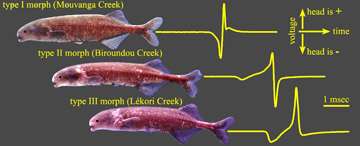
Avoiding quicksand along the banks of the Ivindo River in Gabon, Cornell neurobiologists armed with oscilloscopes search for shapes and patterns of electricity created by fish in the water.
They know from their previous research that the various groups of local electric fish have different DNA, different communication patterns and won't mate with each other. However, they now have found a case where two types of electric signals come from fish that have the same DNA.
The researchers' conclusion: The fish appear to be on the verge of forming two separate species.
"We think we are seeing evolution in action," said Matt Arnegard, a neurobiology postdoctoral researcher in the laboratory of Carl Hopkins, Cornell professor of neurobiology and behavior, who has been recording electric fish in Gabon since the 1970s.
The research, published in the June issue of the Journal of Experimental Biology, describes how some of these fish violate an otherwise regular pattern of mating behavior, and so could be living examples of a species of fish diverging into separate species.
The electric fish -- known as mormyrids -- emit weak electric fields from a batterylike organ in their tails to sense their surroundings and communicate with other fish. Each species of mormyrid gives off a single characteristic electric impulse resulting in the flash of signals, indicating, for example, aggression, courtship and fear. While the fish may be able to understand other species' impulses, said Arnegard, "They seem to only choose to mate with other fish having the same signature waveform as their own."
Except for some, Arnegard has discovered.
When he joined Hopkins' lab, the team was about to publish descriptions of two separate species. But when Arnegard decided to take a genetic look at these particular fish, he couldn't find any differences in their DNA sequences.
"These fish have different signals and different appearances, so we were surprised to find no detectable variation in the genetic markers we studied," Arnegard said.
Because all of the 20 or so species of mormyrid have distinct electric signals, Arnegard believes the different impulses of the fish he studies might be their first step in diverging into different species.
"This might be a snapshot of evolution," Arnegard said.
Understanding how animals become different species, a process known as speciation, is a major concern in understanding evolution. Arnegard's fish may allow researchers to test if a specific type of speciation is possible.
One common type of speciation is geographically dependent. Animals diverge into separate species because they become physically isolated from each other. Eventually, genes within each group mutate so that the groups can no longer be considered to be of the same species.
Another type of speciation, which many scientists have found harder to imagine, involves animals that live in the same geographic location but, for some reason, begin to mate selectively and form distinct groups and, ultimately, separate species. This so-called sympatric speciation is more controversial because there have been few accepted examples of it to date.
"Many scientists claim it's not feasible," Arnegard said. "But it could be a detection problem because speciation occurs over so many generations." These Gabon fishes' impulses, however, can change very quickly in comparison. So Arnegard suspects that the different shapes of the electric impulses from these mormyrids might be a first step in sympatric speciation.
One the other hand, the fish could be a single species. "This could be just a polymorphism, like eye color in humans, that violates the fishes' general evolutionary pattern but doesn't give rise to separate species," said Arnegard, who will return to Gabon in June to conduct further tests, funded by the National Geographic Society.
Source: Cornell University


