Brain on chip: Nerve tissue interfaced with a computer chip
June 2, 2006 Brain on chip: Nerve tissue interfaced with a computer chip

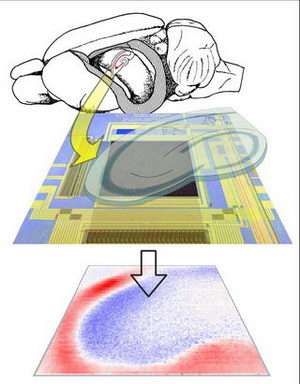
A thin tissue slice of a rat hippocampus region (top) is cultivated on a semiconductor chip with 16.384 sensory transistors per square millimetre (center, dark coloured square). Following excitation the chip maps the electrical activity of the neurons (bottom), caused by activity of synapses (red: positive, blue: negative). Credit: Max Planck Institute of Biochemistry

Before informational input perceived by the mammalian brain is stored in the long-term memory, it is temporarily memorised in the hippocampus. Understanding the function of the hippocampus as an important player in the memory process is a major topic of current brain research. Thin slices of this brain region provide the appropriate material to study the intact neural network of the hippocampus.

Methods commonly used in neurophysiology are invasive, restricted to a small number of cells or suffer from low spatial resolution. The scientists in Martinsried developed a revolutionary non-invasive technique that enables them to record neural communication between thousands of nerve cells in the tissue of a brain slice with high spatial resolution.

This technique involves culturing razor-thin slices of the hippocampus region on semiconductor chips. These chips were developed in collaboration with Infineon Technologies AG and excel in their density of sensory transistors: 16384 transistors on an area of one square millimeter record the neural activity in the brain.

Recording the activity patterns of the united cell structure of an intact mammalian brain tissue represents a significant technological breakthrough. Employing the new technique, the biophysicists working under the direction of Peter Fromherz were able to visualize the influence of pharmaceutical compounds on the neural network. This makes the "brain-chip" from Martinsried a novel test system for brain and drug research.

As early as 1991, Peter Fromherz and his coworkers succeeded in interfacing single leech nerve cells with semiconductor chips. Subsequent research gave rise to bidirectional communication between chip and small networks of a few molluskan nerve cells.

In this project, it was possible to detect the signalling between cells via their synapses. The chips used in these studies were developed and produced by the scientists themselves. The production requirements of the chip described above made collaboration with industry indispensable. With the resulting novel hybrid system of neural tissue and semiconductor, the scientists take a great step forward towards neurochip prosthetics and neurocomputation.

Citation: M. Hutzler, et. al., High-resolution multi-transistor array recording of electrical field potentials in cultured brain slices. Journal of Neuropyhsiology. Preprint online (May 10, 2006). doi:10.1152/jn.00347.2006

Source: Max Planck Institute


print this article email this article download pdf blog this article bookmark this article     Stumble it Digg this share on Facebook retweet share on Reddit add to delicious
Rate this story - 4.4 /5 (70 votes)

Rank Filter

Move the slider to adjust rank threshold, so that you can hide some of the comments.


Display comments: newest first


June 2, 2006 all stories

Comments: 1

4.4 /5 (70 votes)
  • Stumble this up

  • Digg this

  • share this

  • hide
  • Related Stories

  • Schizophrenia gene's role may be broader, more potent, than thought
    created Nov 19, 2009 | popularity not rated yet | comments 0
  • New Down syndrome treatment suggested by study in mice
    created Nov 18, 2009 | popularity not rated yet | comments 0
  • Bigger not necessarily better, when it comes to brains
    created Nov 17, 2009 | popularity not rated yet | comments 0
  • On your last nerve: Researchers advance understanding of stem cells
    created Nov 17, 2009 | popularity not rated yet | comments 0
  • To make memories, new neurons must erase older ones
    created Nov 12, 2009 | popularity not rated yet | comments 0


  • hide
  • Relevant PhysicsForums posts

  • Trying to adapt a fuel gage circuit
    created 15 hours ago
  • Pushing the piston.
    created 20 hours ago
  • Do Camcorders/ Video camera have Sensors in them?
    created Nov 22, 2009
  • Aspiring Engineering major looking for general answers
    created Nov 19, 2009
  • More from Physics Forums - General Engineering

Other News

Intel logo A

Intel wants a chip implant in your brain

Technology / Hi Tech

created 3 hours ago | popularity 4.5 / 5 (6) | comments 13

(PhysOrg.com) -- Computer chip maker Intel wants to implant a brain-sensing chip directly into the brains of its customers to allow them to operate computers and other devices without moving a muscle.


Workers at the Statkraft Osmotic power plant prototype in Tofte

Harnessing the power of salt, Norway tries osmotic power

Technology / Energy

created 4 hours ago | popularity not rated yet | comments 2

After wind, sun, currents and tides, a company is preparing to make clean electricity by harnessing another natural phenomenon, the energy-unleashing encounter of freshwater and seawater.


Microsoft has held talks with Rupert Murdoch's News Corp over removing its news websites from Google, a report said

News Corp, Microsoft hold talks on Google: report

Technology / Internet

created 4 hours ago | popularity 3 / 5 (2) | comments 1

Microsoft has held talks with Rupert Murdoch's News Corp over a possible plan for the software giant to pay the media company to remove its news websites from Google, a report said Monday.


The Symbian platform is used on almost 50% of mobiles worldwide

Spotify launches application for Nokia phones

Technology / Software

created 3 hours ago | popularity not rated yet | comments 0

Swedish streaming software Spotify announced on Monday the launch of a music application for the Symbian platform, used by the world's biggest mobile phone maker Nokia and other smartphones.


A woman uses her mobile phone near a share prices board in Tokyo

Mobile multimedia revenues tipped to dethrone text

Technology / Telecom

created 4 hours ago | popularity not rated yet | comments 0

Multimedia services will surpass text messaging this year as the main source of mobile operators' non-voice revenue in the Asia-Pacific region, industry analyst IDC said Monday.