Spider blood found in 20 million year old fossil
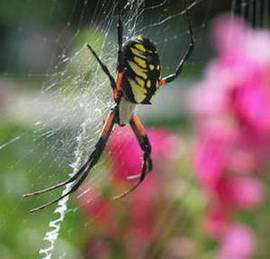
September 29, 2005A scientist from the University of Manchester has discovered the first identified droplets of spider blood in a piece of amber up to 20 million years old.
Two droplets of blood, technically known as haemolymph, have been preserved in the amber which also contains the spider – Filistatidae – a family commonly found in South America and the Caribbean.
The droplets are the first identified examples of spider blood ever found in an amber fossil. It is possible the blood could be used to extract DNA.
The fossil, which is 4cm long and 2cm wide, was discovered in the Dominican Republic and dates back to the Miocene period.
Palaeontologist Dr David Penney, of the School of Earth, Atmospheric and Environmental Sciences, has now used the blood droplets to trace how, when, and where the spider died all those years ago.
David, said: “It’s amazing to think that a single piece of amber with a single spider in it can open up window into what was going on 20 million years ago.
“By analysing the position of the spider’s body in relation to the droplets of blood in the amber we are able to determine how it died, which direction it was travelling in and even how fast it was moving.”
In the latest issue of the journal Palaeontology (2005, vol. 48, part 5) David describes how the spider died. He believes the spider was climbing up a tree when it was struck head-on by a sudden strong flow of resin. The spider then became engulfed in the resin and died.
He argues that the shape and position of the blood droplets reveals which direction the spider was travelling in. It also reveals which of the spider’s legs broke first.
David discovered the fossil in 2003 during a visit to the Museo del Ambar Dominicano in Puerto Plata, Dominican Republic. His research initially focused on the spider which he identified as an entirely new species of spider. On his return to the UK, further research revealed the droplets of blood and the information the fossil contained.
Source: The University of Manchester
-
Open Microfluidic and Nanofluidic Systems
Feb 16, 2005 |
2.1 / 5 (9) |
0
-
Protein causes varicose veins
Nov 04, 2011 |
not rated yet |
0
-
Spider silk glue inspires next-generation technology
Jul 22, 2011 |
5 / 5 (2) |
0
-
Scans capture spider's heart beat
Jul 07, 2011 |
4.5 / 5 (2) |
0
-
Spider's double beating heart revealed by MRI
Jul 01, 2011 |
5 / 5 (4) |
0
-
Engineers build first sub-10-nm carbon nanotube transistor
Feb 01, 2012 |
4.9 / 5 (31) |
30
-
Something old, something new: Evolution and the structural divergence of duplicate genes
Jan 31, 2012 |
4.6 / 5 (7) |
1
-
The hidden nanoworld of ice crystals: Revealing the dynamic behavior of quasi-liquid layers
Jan 30, 2012 |
5 / 5 (3) |
1
-
Stock market network reveals investor clustering
Jan 27, 2012 |
3.9 / 5 (23) |
8
-
Of microchemistry and molecules: Electronic microfluidic device synthesizes biocompatible probes
Jan 26, 2012 |
5 / 5 (1) |
0
More news stories
Employers feel no love for unscrupulous practice of 'service sweethearting'
A new study led by two Florida State University marketing professors finds that some frontline service employees who are rewarded for hikes in customer loyalty and satisfaction also may engage in "service ...
Other Sciences / Economics & Business
52 minutes ago |
not rated yet |
0
A frank discussion of the power law and linking correlation to causation
(PhysOrg.com) -- Michael Stumpf a mathematics professor at Imperial College in London, and Mason Porter a lecturer at Oxford have teamed together to write and publish a perspective piece in Science regarding the in ...
The question of life in the ancient world
Theres a general feeling that we dont get the Greeks ancient or modern. Many, including heads of state like Angela Merkel, visibly shake their head in exasperation, rightly or wrongly, at ...
Other Sciences / Archaeology & Fossils
6 hours ago |
1 / 5 (1) |
2
Sonic Cradle lands spot in TED exhibition
A Simon Fraser University graduate student project that melds music, meditation and modern technology has landed a rare spot as an exhibit at TEDActive 2012 in Palm Springs, California this month.
2 hours ago |
not rated yet |
0
US workers are 'giving away the store,' costing firms billions
Nearly 70 percent of the nation's service employees give away free goods and services from hamburgers to cable TV costing companies billions of dollars a year, according to a groundbreaking study.
Other Sciences / Economics & Business
Feb 09, 2012 |
4.5 / 5 (2) |
10
Putting the squeeze on planets outside our solar system
(PhysOrg.com) -- Using high-powered lasers, scientists at Lawrence Livermore National Laboratory and collaborators discovered that molten magnesium silicate undergoes a phase change in the liquid state, abruptly ...
US issues guidelines to avoid heparin contamination
Four years after US drug-maker Baxter International's blood thinner heparin was contaminated in China, causing dozens of deaths, US regulators on Friday issued draft guidelines for safe production.
Expat French get Internet vote for first time
French citizens will for the first time this year be able to vote in a parliamentary election over the Internet, an experiment that could be extended to other elections if successful.
"Twisted Metal" gamers get shot at real gunplay
Fans of "Twisted Metal" will get to welcome a long-awaited sequel of the car-battle videogame with a real-world bang by blasting an ice cream truck to bits with a machine gun.
The power of estrogen -- male snakes attract other males
A new study has shown that boosting the estrogen levels of male garter snakes causes them to secrete the same pheromones that females use to attract suitors, and turned the males into just about the sexiest ...
New error-correcting codes guarantee the fastest possible rate of data transmission
Error-correcting codes are one of the triumphs of the digital age. Theyre a way of encoding information so that it can be transmitted across a communication channel such as an optical fiber o ...