First helical structure in the nano-world
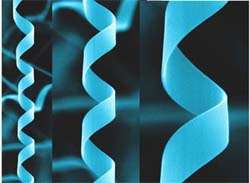
Although a commonplace structure in nature, the helix remains a mystery to scientific researchers. In biology, the structure is important as DNA is helical and so does the substructure of many proteins. Since its discovery about more than 50 years ago, the double helix has offered an important approach to interpret and make use of bio-organic structures. Yet, it is seldom to see a helical structure formed by inorganic crystal-state materials.
Recently a previously-unknown zinc oxide nanostructure that resembles the helical configuration of DNA has been brought about by a research team headed by Prof. WANG Zhong Lin, a researcher concurrently working for the Georgia Institute of Technology in US, Peking University and the National Center for Nanoscience and Technology of China (NCNST) at CAS in China. Hailed as an exciting event in the field, their work was reported in the September 9 issue of the journal Science.
Zinc oxide is known as an important semiconductive and piezoelectric material with many applications in opto-electronics, telemetric sensors and bio-functions. Its function in the anisotropic growth along the polarized orientation enables itself to become a semiconductor in limelight for the world today. Until now its only nano-forms have been nanobelts, nanosprings and nanorings.
With the support from several institutions including CAS, Prof. Wang and colleagues have realized the self-assembly of superlattice nanohelices from the zinc oxide nanobelt. The nanohelices, which get their shape from twisting forces created by a small mismatch between the stripes, are produced using a vapor-solid growth process at high temperature. At first the zinc-oxide powder with a wurtzite-crystal structure was heated to 1000°C in a vacuum before introducing an argon carrier gas. Nanohelix structures were formed on a polycrystalline aluminium oxide substrate when the materials were further heated to 1400°C.
"The key difference between growing nanohelices and the earlier types of nanobelt is that we control raising the temperature and when we introduce the carrier gas," said Wang. "With the earlier structures, we introduced the carrier-gas flow at the beginning. With these nanohelices, we only introduce the carrier gas when the temperature reaches a certain level. That allows formation to begin in a vacuum, which is the key to controlling the helix formation."
Heating zinc oxide in a vacuum creates structures with polar surfaces. The scientists believe that the introduction of the carrier gas caused the growth to minimize the amount of polar surface produced, leading to a superlattice structure with mismatches at the crystalline interfaces.
As the superlattice is composed of many near-parallel single-crystal stripes each about 3.5 nanometers wide and offset about five degrees, the nanohelices are very different from the nanosprings and nanorings of zinc oxide previously reported by the same research group in Science in 2004. Nanosprings are composed of a single crystal whose shape is governed by balancing the electrostatic forces created by opposite electrical charges on their edges with the elastic deformation energy of the entire structure.
The nanohelices reach lengths of up to 100 microns each, with a diameter ranging from 300 to 700 nanometers and a width from 100 to 500 nanometers. The nanohelices exist in both right- and left-handed versions, with production split approximately 50-50 between the two directions.
"This is a brand-new structure that shows a new growth model for nanomaterials," said Prof. Wang. "But from the properties point of view, these are like the earlier nanobelts in having semiconducting and piezoelectric properties which make them good for electromechanical coupling."
Such a material of nano-helices is found in a perfect structure and noted for its rigidity. The work could open new horizons for expanding the research & application of functional oxide nano-materials and provide engineers with a new building block for creating nanometre-scale sensors, transducers, resonators and other devices that rely on electromechanical coupling, notes Prof. Wang.
For now the researchers are focused on building novel resonators, inductors and piezoelectric devices based on the nanohelix for use in sensors. After that they plan to make multifunctional devices by integrating nanohelix devices with those made from other materials.
Source: CAS


