Illinois physicists produce two most important scientific papers
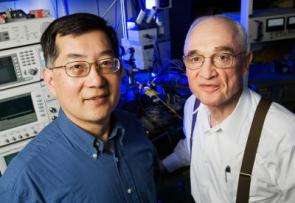
Two of the five most important papers published in the 43-year history of the journal Applied Physics Letters were written by researchers at the University of Illinois at Urbana-Champaign. Nick Holonyak Jr., a John Bardeen Chair Professor of Electrical and Computer Engineering and Physics at Illinois, was an author of both papers, which span the development of the light-emitting diode to the invention of the transistor laser.
As the American Institute of Physics celebrates its 75th anniversary this year, editors of the organization's research journals were asked to select the five most significant papers published in each journal. In the case of Applied Physics Letters, thousands of papers were considered -- not only for scientific content, but also for the impact a paper had, or might have, on industry or the general public.
The first of Holonyak's chosen papers appeared in the journal's Dec. 1, 1962, issue and reported the first semiconductor laser in the visible spectrum and the first visible light-emitting diode, which formed the basis for today's high brightness light-emitting diodes.
"This may be the most important piece of work I've ever done," said Holonyak, who was employed at the General Electric Co. in Syracuse, N.Y., at the time. Holonyak's technician, Sam (Severio) Bevacqua, was the paper's only co-author.
The second paper selected by the journal appeared in the Sept. 26, 2005, issue and reported the first room-temperature operation of a transistor laser. "I consider this a very important development and maybe -- time will tell -- a great development," Holonyak said.
In addition to Holonyak, the paper's co-authors were electrical and computer engineering professor Milton Feng, and postdoctoral research associate Gabriel Walter and graduate research assistant Richard Chan (now at BAE Systems).
The Illinois researchers first reported the demonstration of a light-emitting, heterojunction bipolar transistor in the journal's Jan. 5, 2004, issue. They described the first laser operation of the light-emitting transistor in the Nov. 15, 2004, issue, but at that time the transistor laser had to be chilled with liquid nitrogen to minus 73 degrees Celsius.
By demonstrating room-temperature operation, the researchers moved the transistor laser much closer to practical applications.
"Room-temperature transistor lasers could facilitate faster signal processing, large capacity seamless communications, and higher performance electrical and optical integrated circuits," said Feng, the Holonyak Chair Professor of Electrical and Computer Engineering at Illinois. Feng has received worldwide recognition for his research on heterojunction bipolar transistors. He has produced the world's fastest bipolar transistor, a device that operates at a frequency of more than 700 gigahertz.
The transistor laser combines the functionality of both a transistor and a laser by converting electrical input signals into two output signals, one electrical and one optical.
"By incorporating quantum wells into the active region, we have enhanced the electrical and optical properties, making possible stimulated emission and transistor laser operation," said Holonyak, who also is a professor in the university's Center for Advanced Study, one of the highest forms of campus recognition. "What we have here is a new form of transistor and a new form of laser."
The transistor laser also raises the possibility of replacing wiring between components at the chip- or board-level with optical interconnects, offering more flexibility and capability in true electronic-integrated circuits.
"Fifty-eight years after (John) Bardeen and (Walter) Brattain invented the transistor, we have hit upon something new that is surprisingly fundamental and rich in possibilities," Holonyak said. "I am happy to have had a hand in this."
Source: University of Illinois at Urbana-Champaign


