Galaxy evolution in cyber universe matches astronomical observations in fine detail
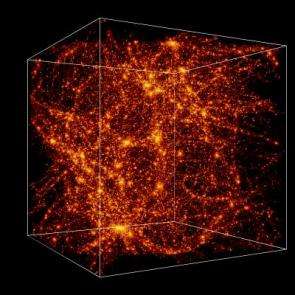
Scientists at the University of Chicago have bolstered the case for a popular scenario of the big bang theory that neatly explains the arrangement of galaxies throughout the universe. Their supercomputer simulation shows how dark matter, an invisible material of unknown composition, herded luminous matter in the universe from its initial smooth state into the cosmic web of galaxies and galaxy clusters that populate the universe.
Previous studies by other researchers had already verified the main features of this scenario, called the cold dark matter model. The Chicago team further extended this work by comparing the results of their supercomputer simulations to the newest, most detailed astronomical observations available today. They found an excellent fit, and they did so without basing their simulations on a lot of complex assumptions.
"The model we use is really, really simple," said Andrey Kravtsov, Associate Professor in Astronomy & Astrophysics. "We want to see how well this framework can do with a minimum number of assumptions."
A paper co-authored by Kravtsov, Charlie Conroy and Risa Wechsler describing these findings will be published in the June 20 issue of the Astrophysical Journal. The research was funded by a grant from the National Science Foundation, with additional support from the National Aeronautics and Space Administration.
Simulations that Kravtsov's team conducted two years ago had predicted that galaxies of different luminosity or brightness would cluster differently when the universe was young than they do today. The team's Astrophysical Journal paper verifies that prediction and shows that similar differences appear in the recent data.
"In the early stages of evolution of the universe, each galaxy has a high probability of having a close neighbor of similar luminosity," Kravtsov said, much more so than galaxies today. "That was what was predicted and that's what the observations now seem to show us."
The data that Kravtsov's team compared to its simulations came from the Deep Extragalactic Evolutionary Probe 2 (DEEP2) survey, and from the Sloan Digital Sky Survey.
Using the Keck 10-meter telescopes in Hawaii, DEEP2 took detailed observations of how galaxies were clustered seven billion years ago, when the universe was approximately half its current age. The Sloan Survey, meanwhile, provided additional data regarding galaxy clustering from more recent epochs in the history of the universe.
"We essentially have data on the distribution of galaxies over most of the evolution of the universe, and the data are accurate," Kravtsov said. "Although the measurements at earlier epochs have larger errors, due to smaller data sets, their accuracy and power to constrain theoretical models is quite remarkable."
The Chicago scientists based their supercomputer simulations on the assumption that galaxies form in the center of dark-matter halos.
According to this scheme, gravity causes the dark matter in these regions to collapse into halos. These halos provide a central location where normal matter consisting of hydrogen, helium and a small amount of heavier elements would collect in gaseous form. Once this gas had cooled and condensed, it achieved sufficient density for star formation to begin on a galactic scale.
When the Chicago team compared the distribution of galaxies in its cyber universe to the real one, "that scheme turned out to work extremely well," Kravtsov said. "It wasn't guaranteed that it would actually work so well in reproducing the data."
Some fields of astrophysics are less fortunate: they have a large body of data but no way to explain it. "The data just kind of hang there. Nobody quite understands what it's telling us or how to interpret it."
But the Chicago simulations further support the idea that the universe behaves the way the cold dark matter scenario tells them it should, that galaxies tend to form in high-density regions of dark matter.
"We understand the distribution of these dark-matter halos, and the implication of this analysis is that we also understand how the properties of these halos are related to galaxy luminosity, how bright the galaxy is," Kravtsov said.
Brighter galaxies also are found in more pronounced large-scale structures. "If you look at fainter galaxies, their distribution becomes more diffuse. We can still see structure, but it's not as pronounced."
Additional data continues to become available. For example, the Sloan Survey has gone beyond mapping the galaxies to include measurements of the dark matter that surrounds them. And other new, high-quality data regarding the distribution of galaxies from the very early stages in the evolution of the universe are becoming available. The first comparisons of the theory's predictions with that data indicate good agreement over the span of about 12 billion years, Kravtsov said.
Source: University of Chicago


