Growing Nanostructures on Micro Cantilever Provides New Platform for Materials Discovery
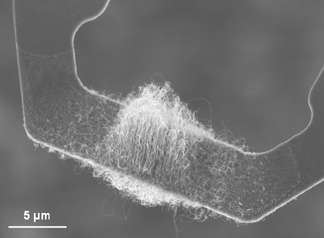
Researchers have developed a new technique that could provide detailed information about the growth of carbon nanotubes and other nanometer-scale structures as they are being produced. The technique offers a way for researchers to rapidly and systematically map how changes in growth conditions affect the fabrication of nanometer-scale structures.
Instead of a large furnace that is normally used to grow nanotubes as part of the chemical vapor deposition process, the Georgia Institute of Technology researchers grew bundles of nanotubes on a micro-heater built into an atomic force microscope (AFM) tip. The tiny device provided highly localized heating for only the locations where researchers wanted to grow the nanostructures.
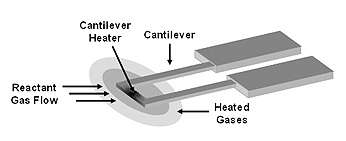
Because the resonance frequency of the cantilever changed as the nanotubes grew, the researchers were able to use it to accurately measure the mass of the structures they produced. The next step in the research will be to combine the growth and measurement processes to permit in situ study of mass change during nanostructure growth.
“There are hundreds of materials – electronic, magnetic and optical – that are grown using a similar thermally-based technique,” said William P. King, an assistant professor in Georgia Tech’s School of Mechanical Engineering. “By growing these structures on cantilevers, we will be able to determine exactly what is happening with the materials growth as it occurs. This could provide a new tool for investigating the growth of these structures under different conditions.”
Using arrays of cantilevers operating at different temperatures would allow researchers to accelerate the process for mapping the kinetics of nanostructure growth. Because the cantilevers can be heated and cooled more rapidly than a traditional furnace, batches of nanostructures can be produced in just 10 minutes – compared to two hours or more for traditional processing.
“We can change the structures being grown by rapidly changing the temperature,” explained Samuel Graham, also an assistant professor in Georgia Tech’s School of Mechanical Engineering. “We can also change the kinetics of growth, which is something that is difficult to do using conventional technology.”
By demonstrating that carbon nanotubes can be growth on an AFM cantilever, the technique also provides a new way to integrate nanometer-scale structures with microdevices.
The research was supported in part by the National Science Foundation’s CAREER award, and has been reported in the journal Applied Physics Letters.
King, Graham and collaborators Erik O. Sunden, Jungchul Lee and Tanya L. Wright began with an AFM cantilever fabricated in their Georgia Tech lab. The cantilever had an integrated electric-resistance heater whose output temperature could be controlled by varying the current. Actual heater temperatures were measured to within four degrees Celsius using Laser Raman thermometry.
Calibration of the cantilevers over a large temperature range using Raman spectroscopy was a key aspect of the success of this research, allowing the first detailed temperature maps of these devices, Graham noted.
The researchers used electron beam evaporation to deposit a 10 nanometer iron catalyst film onto the cantilever. After heating, the iron film formed islands that provided catalytic sites for growing nanotubes.
The cantilever was then placed into a quartz tube, which was purged of contaminants with argon gas. The cantilever heating was then turned on and the temperature held at approximately 800 degrees Celsius for 15 minutes. A combination of methane, hydrogen and acetylene – precursors for carbon nanotubes – was then flowed into the chamber. Only the cantilever tip and the reaction gas immediately around it were heated, leaving the remainder of the experimental set-up at room temperature.
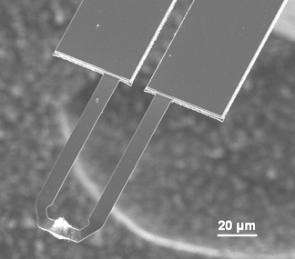
After removal from the tube, the cantilever was examined using a scanning electron microscope, which showed vertically aligned carbon nanotubes growing from the cantilever heater region. The nanotubes ranged in length from five to 10 microns, and were 10 to 30 nanometers in diameter. Although the entire cantilever was coated with the iron catalyst, the nanotubes grew only on the heated area. A temperature gradient on the heater created differences in the types of nanotubes grown.
Both before and after the growth, the cantilever was vibrated so its resonance frequency could be measured. Those measurements showed a frequency decline from 119.10 to 118.23 kHz after the nanotubes were grown on the cantilever. After the resonance measurements were made, the cantilever was heated beyond 900 degrees Celsius in air to burn off the nanotubes. When the resonance frequency was measured again, it had changed to 119.09 kHz, showing that the frequency drop had been due to the mass of the nanotubes.
From change in the resonance frequency, the researchers were able to calculate the mass of the carbon nanotubes they had grown as approximately four picograms (4 x 10-14) kg.
“We are working on integrating the growing and weighing of the nanotubes so we can do both of them at the same time,” said King. “That would allow us to monitor the materials growth as it happens.”
Once the two processes are integrated, the researchers expect to increase the number of cantilevers operating simultaneously. Cantilever arrays could allow many different growth temperatures and conditions to be measured in parallel, accelerating the task of charting the growth kinetics to determine the optimal settings.
“This is a platform for materials discovery, so we could test tens or even thousands of different chemistry or growth conditions in a very short period of time,” King said. “With a thousand cantilevers, we could do in a single day experiments that would take years using conventional growth techniques. Once the right conditions were found, the production process could be scaled up.”
Source: Georgia Institute of Technology


