Physicists generate ball-lightning in the lab
June 6, 2006
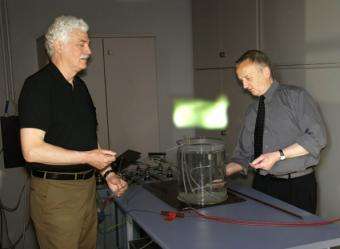
A ball-lightning-like plasma cloud is produced in an underwater discharge. (Photo: D. Lange, IPP)
Scientists in the joint study group of Max-Planck-Institut für Plasmaphysik and Berlin’s Humboldt University have generated ball-lightning in the laboratory - or, to be more precise, ball-lightning-like plasma clouds. The physicists produce luminous plasma balls above a water surface which have lifetimes of almost half a second and diameters of 10 to 20 centimetres.
Ball-lightning is described as a luminous phenomenon occurring during thunderstorms. It is a mystery, however, that they should be visible not as a brief flash, i.e. just for microseconds, but exist for several seconds, i.e. a hundred thousand times as long as a flash of lightning. Besides such famous figures as the Roman philosopher Seneca, Pliny the Elder, Charlemagne and Henry II of England, in modern times the Nobel Prize winners in physics, Niels Bohr and Pjotr Kapitza, claim to have observed this phenomenon.
Less renowned observers also report unexpected encounters with ball-lightning; the internet features more than a million entries on the subject. On the other hand, the phenomenon is so rare that there are still no reliable data available. Accordingly, doubtful attempts at interpretation are rampant, ranging from black holes to mini nuclear explosions and esoteric explanations.
"In view of this incertitude it has been variously attempted to induce the phenomenon under controlled conditions in the laboratory", states Prof. Gerd Fussmann, head of the plasma physics study group of IPP and HUB in Berlin. One research group already succeeded in producing plasmoids fed with microwaves - luminous plasma balls consisting of an ionised gas - which it would be fair to class as ball-lightning. A similar effect is caused by electric sparks conducted over organic materials. About four years ago a study group in St. Petersburg successfully used electric discharges above water surfaces to produce spherical luminous formations that come appreciably closer to the natural phenomenon. For it is probable that flashes of lightning and water must be interacting when ball-lightning occurs.
Stimulated by the Russian experiments, the plasma physics study group in Berlin is conducting investigations in which plasmoids are produced above a water surface that have lifetimes of about 0.3 second and diameters of 10 to 20 centimetres. This involves igniting a short high-voltage discharge in a water tank; when it decays a plasma ball then emerges from the surface.
Apart from the powerful capacitor bank needed to supply energy, the experimental setup is rather simple: A glass beaker filled with salt water contains two protruding electrodes, one of which being insulated from the surrounding water by a clay tube. When a high voltage is applied, a current of up to 60 amperes flows through the water for 0.15 second. Flashover from the water enables the current to enter the clay tube, where it causes the water contained there to evaporate. After the current pulse a luminous plasmoid consisting of ionised water molecules appears.
The facility can generate impressive "ball-lightning" in every possible manifestation and colour about every five minutes. Professor Fussmann: "Why luminous phenomena occur at all is anything but clear: They continue to be visible about 300 milliseconds after the current has decayed and the energy input is thus cut off; however, they should really be quenched after a few milliseconds at most. Furthermore, the plasma glows very brightly, although the plasmoids appear to be rather cold. A sheet of paper placed above them does get lifted, but it does not catch fire."
These puzzling physical phenomena are now to be clarified in several diploma theses. This calls for systematic analysis of the processes involved - for example, by spectroscopic methods - and comparison with the existing theoretical formulations. "Although "ball-lightning" does not directly fit into the research field of IPP, viz. investigation of extremely hot plasmas such as are needed for a fusion power plant", states Prof. Fussmann, "it is also an attractive plasma physics topic with which students can acquire knowledge of sophisticated measuring technique and theory from an interesting natural phenomenon."
Source: Max-Planck-Institut
-
Electrons in concert: A simple probe for collective motion in ultracold plasmas
Feb 06, 2012 |
4.2 / 5 (5) |
0
-
Elements of ExoPlanets
Feb 02, 2012 |
5 / 5 (7) |
0
-
Darpa developing novel new fire suppression method
Jan 23, 2012 |
5 / 5 (1) |
1
-
Study reveals potential of manganese in neutralizing deadly Shiga toxin
Jan 19, 2012 |
5 / 5 (4) |
0
-
The perfect liquid -- now even more perfect
Jan 17, 2012 |
4.9 / 5 (10) |
9
-
Engineers build first sub-10-nm carbon nanotube transistor
Feb 01, 2012 |
4.9 / 5 (30) |
30
-
Something old, something new: Evolution and the structural divergence of duplicate genes
Jan 31, 2012 |
4.6 / 5 (7) |
1
-
The hidden nanoworld of ice crystals: Revealing the dynamic behavior of quasi-liquid layers
Jan 30, 2012 |
5 / 5 (3) |
1
-
Stock market network reveals investor clustering
Jan 27, 2012 |
3.9 / 5 (23) |
8
-
Of microchemistry and molecules: Electronic microfluidic device synthesizes biocompatible probes
Jan 26, 2012 |
5 / 5 (1) |
0
-
Rubber production is likely to gradually reduce
1 hour ago
-
Help! Physics Momentum/Impulse problem!
1 hour ago
-
Gauss' law cubes, how to prove
3 hours ago
-
A grandfather pulls his granddaughter, whose mass is 20.5 kg
4 hours ago
-
what is significance of torque
4 hours ago
-
Difference between volume displaced fluid and volume of the object
5 hours ago
- More from Physics Forums - General Physics
More news stories
Explained: Sigma
It's a question that arises with virtually every major new finding in science or medicine: What makes a result reliable enough to be taken seriously? The answer has to do with statistical significance -- but ...
18 hours ago |
5 / 5 (10) |
30
Borexino Collaboration succeeds in spotting pep neutrinos emitted from the sun
(PhysOrg.com) -- To learn more about how the sun works, scientists study particles that are emitted from it into space due to thermonuclear reactions that occur inside; by applying known physics principles, ...
Physics research suggests new pathways for cancer progression
Observing that certain cancer cells may exhibit greater flexibility than normal cells, some scientists believe that this capability promotes rapid tumor growth. Now computer simulations developed by Boston University Biomedical ...
16 hours ago |
5 / 5 (1) |
0
Quantum physicist explains $100K offer for proof scaled-up quantum computing is impossible
(PhysOrg.com) -- MIT researcher Scott Aaronson has certainly riled the physics community with his offer this past Friday, of $100,000 to anyone who can prove that scaled-up quantum computing is impossible. ...
Physicists 'record' magnetic breakthrough
An international team of scientists has demonstrated a revolutionary new way of magnetic recording which will allow information to be processed hundreds of times faster than by current hard drive technology.
Feb 07, 2012 |
4.5 / 5 (39) |
14
|
'Dark plasmons' transmit energy
Microscopic channels of gold nanoparticles have the ability to transmit electromagnetic energy that starts as light and propagates via "dark plasmons," according to researchers at Rice University.
FDA-approved drug rapidly clears amyloid from the brain, reverses Alzheimer's symptoms in mice
Neuroscientists at Case Western Reserve University School of Medicine have made a dramatic breakthrough in their efforts to find a cure for Alzheimer's disease. The researchers' findings, published in the journal Science, show t ...
Hydrogen from acidic water: Researchers develop potential low cost alternative to platinum for splitting water
A technique for creating a new molecule that structurally and chemically replicates the active part of the widely used industrial catalyst molybdenite has been developed by researchers with the Lawrence Berkeley ...
Ultraviolet protection molecule in plants yields its secrets
Lying around in the sun all day is hazardous not just for humans but also for plants, which have no means of escape. Ultraviolet (UV) radiation from the sun can damage proteins and DNA inside cells, leading ...
Anyone can learn to be more inventive, cognitive researcher says
There will always be a wild and unpredictable quality to creativity and invention, says Anthony McCaffrey, a cognitive psychology researcher at the University of Massachusetts Amherst, because an "Aha moment" is rare and ...
Soraa LED light may dim 50-watt halogen rivals
(PhysOrg.com) -- Soraa, a Fremont, California company founded in 2008, this week launched its first product, a light that uses LEDS (light emitting diodes). The "Soraa LED MR16 lamp" is the "perfect" replacement ...