Scientists resolve 60-year-old plutonium questions
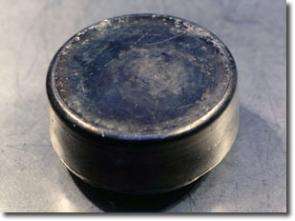
June 6, 2006 A plutonium-gallium alloy ingot reclaimed from a nuclear weapon

A plutonium-gallium alloy ingot reclaimed from a nuclear weapon.

Scientists have solved a question about the nature of plutonium that had remained a mystery since the Manhattan Project.

Plutonium behaves like no other element in nature. The bonding of its electrons causes its crystal structure to be uneven, similar to a mineral, and the nucleus is unstable, causing the metal to spontaneously decay over time and damage the surrounding metal lattice.

First batches of the metal were too brittle to machine due to the mineral-like structure of the crystal. In order to make the metal machinable, the high-temperature, high-symmetry cubic structure of plutonium needed to be retained to room temperature.

Scientists during the Manhattan Project achieved this by adding a small amount of gallium.

“There was never a clear explanation as to why gallium stabilized the ductile cubic structure over the low-symmetry mineral-like structure; they just did it and it worked,” said Kevin Moore, a staff scientist in the Materials Science and Technology Division at Lawrence Livermore National Laboratory.

For the first time, researchers have determined why gallium works. In pure plutonium, the bonds between Pu atoms are very uneven, causing the metal’s high propensity to adopt a low-symmetry structure. However, when a gallium atom is put in the plutonium lattice, it causes the bonds to become more uniform and thus leads to the high-symmetry cubic structure.

“Gallium evens out the plutonium bonds,” Moore said. “The calculations strongly illuminate why gallium stabilizes the machinable cubic structure to room temperature.

“Previous experiments tell us that the plutonium lattice distorts as it ages, but there was no clear explanation as to why this happens,” said Moore, an experimentalist by training. “Our calculations explain the observations, showing the distortions are the response of plutonium and its uneven bonds to having defects produced in the crystal due to self irradiation. These calculations further our confidence in the safety, security and reliability of aging plutonium in stockpile warheads.”

Through a series of calculations, Moore and his Livermore colleagues, Per Söderlind and Adam Schwartz, and David Laughlin of Carnegie Mellon University have produced results that appear in the May 26 online edition of Physical Review Letters.

The team next proposes to test their calculations in the laboratory.

Source: Lawrence Livermore National Laboratory


print this article email this article download pdf blog this article bookmark this article     Stumble it Digg this share on Facebook retweet share on Reddit add to delicious
Rate this story - 3.8 /5 (57 votes)


June 6, 2006 all stories

Comments: 0

3.8 /5 (57 votes)
  • Stumble this up

  • Digg this

  • share this

  • hide
  • Related Stories


  • hide
  • Relevant PhysicsForums posts

  • Ionization vs. photo-generation - what is the difference?
    created Nov 25, 2009
  • Ising model
    created Nov 24, 2009
  • Photon replica
    created Nov 24, 2009
  • Planck's Radiation Law and Stefan's Law
    created Nov 24, 2009
  • More from Physics Forums - Atomic, Solid State, Comp. Physics

Other News

Superconductor magnet heat shield being developed

Superconductor magnet spacecraft heat shield being developed

Physics / General Physics

created 20 hours ago | popularity 4.9 / 5 (19) | comments 16

(PhysOrg.com) -- European space agencies and an aerospace giant are developing a new re-entry heat shield that will use superconductor magnets to generate a magnetic field strong enough to deflect the superhot ...


Bacteria

Plasma produces KO cocktail for MRSA

Physics / General Physics

created 22 hours ago | popularity 4.9 / 5 (12) | comments 2

MRSA (methicillin-resistant Staphylococcus Aureus) and other drug-resistant bacteria could face annihilation as low-temperature plasma prototype devices have been developed to offer safe, quick, easy and un ...


Restored machine to explore mysteries of Big Bang (AP)

Restored machine to explore mysteries of Big Bang

Physics / General Physics

created Nov 21, 2009 | popularity 4.6 / 5 (18) | comments 26

(AP) -- Scientists are preparing the world's largest atom smasher to explore the depths of matter after successfully restarting the $10 billion machine following more than a year of repairs.


Scientists react as they stand in front of a screen at CERN

First atoms reported smashed in Large Hadron Collider (Update)

Physics / General Physics

created Nov 23, 2009 | popularity 4.5 / 5 (30) | comments 22

Two circulating beams on Monday produced the first particle collisions in the world's biggest atom smasher, the Large Hadron Collider (LHC), three days after its restart, scientists announced.


nuclear power plant

Doubts raised on nuclear industry viability

Physics / General Physics

created Nov 19, 2009 | popularity 3 / 5 (22) | comments 19

(PhysOrg.com) -- The investment in nuclear power has been growing around the world over the last few years, being viewed as a means for countries to control their energy security, avoid the price fluctuations ...