MAGIC Telescope Finds Microquasar
June 6, 2006 MAGIC Telescope Finds Microquasar

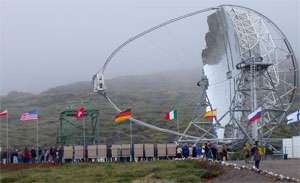
The MAGIC (Major Atmospheric Gamma-ray Imaging Cherenkov) telescope is located in the Canary Islands. (Winston Ko/UC Davis photo)

The variable emission of high-energy gamma rays from a variable microquasar within our galaxy has been detected by the MAGIC (Major Atmospheric Gamma-ray Imaging Cherenkov) telescope located in the Canary Islands. The object is the first seen to fluctuate in the high-energy gamma spectrum, said Daniel Ferenc, professor of physics at UC Davis and a member of the MAGIC scientific team.

The microquasar LS I +61 303 probably consists of a normal star and an extremely dense object, either a black hole or a neutron star, Ferenc said. As the stars orbit each other every 26 days, matter is pulled from the regular star and spirals towards the other object. Jets of particles traveling at nearly the speed of light are blasted out as the material collapses in the gravitational field.

The MAGIC telescope measured gamma rays coming from the microquasar over about six months. New light detection technology allowed MAGIC to measure the microquasar's activity continuously during several 26-day orbits, despite the presence of moonlight. The brightest emissions occurred a few days after the point when the star and the black hole were closest together.

The results will help physicists understand how microquasars and quasars emit gamma rays, Ferenc said.

The MAGIC telescope, inaugurated in 2003 at La Palma in the Canary Islands, looks for objects that emit high-energy gamma rays from deep in the universe. It detects gamma rays by picking up the flashes of light given off as the rays hit the atmosphere.

The MAGIC team includes 130 scientists from nine countries. Ferenc's laboratory at UC Davis, including research fellows Daniel Kranich and Alvin Laille, has worked on camera design, mirror control and developing new types of photosensors for MAGIC and for a second telescope now under construction at the same site, as well as for the next generation of very large neutrino telescopes.

Eckart Lorenz, visiting professor at the Swiss Federal Institute for Research and a leader of the MAGIC project, also is an adjunct professor at UC Davis. The research was recently published online in Science Express.

Source: UC Davis


print this article email this article download pdf blog this article bookmark this article     Stumble it Digg this share on Facebook retweet share on Reddit add to delicious
Rate this story - 4.6 /5 (10 votes)

Rank Filter

Move the slider to adjust rank threshold, so that you can hide some of the comments.


Display comments: newest first

  • James_DeMeo - Oct 12, 2007
    • Rank: not rated yet
    The idea of space having unusual properties is not new to anyone who has read the materials typically censored out of the mainstream science publcations -- ie, the materials which flatly contradict Einstein's relativity and the "big bang" creationist theories. For example, the early ether-drift experiments of Dayton Miller, whom nearly nobody knows about, got very positive results, as did Michelson himself, along with about a half-dozen others, including into more recent years. But none of it is tolerated and the researchers are treated quite badly. See my paper "A Dynamic and Substantive Cosmological Ether" posted to the given weblink... www.orgonelab.org...ther.pdf The primary scientist who proposed such things in the 1950s was imprisoned with his books burned. Today much contempt and arrogant censorship typifies the orthodox reaction to such empirical findings, as with the "Axis of Horror" -- mainstream cosmology and astrophysics is literally "lost in space" without a clue. New findings like the one reported here continue to speak that space has substance, but the most simple explanations will require a whole generation of old professors to retire before they are given some open tolerance.

June 6, 2006 all stories

Comments: 1

4.6 /5 (10 votes)
  • Stumble this up

  • Digg this

  • share this

  • hide
  • Related Stories

  • VLBA locates superenergetic bursts near giant black hole
    created Jul 02, 2009 | popularity not rated yet | comments 0
  • The MAGIC-II Telescope is ready to team up
    created Apr 15, 2009 | popularity not rated yet | comments 0
  • Unexpected source of gamma rays discovered
    created Mar 06, 2009 | popularity not rated yet | comments 0
  • Gamma Ray Delay May Be Sign of 'New Physics'
    created Oct 01, 2007 | popularity not rated yet | comments 0
  • Scientists take giant step forward in understanding exotic nuclei
    created Aug 29, 2007 | popularity not rated yet | comments 0


  • hide
  • Relevant PhysicsForums posts

  • life on Mars
    created 1hour ago
  • Semi-major axis from cartesian co-ordinates
    created 13 hours ago
  • Primary Mirror grinding
    created 15 hours ago
  • dark energy can escape black holes.
    created Nov 23, 2009
  • More from Physics Forums - General Astronomy

Other News

From Greenhouse to Icehouse

From Greenhouse to Icehouse

Space & Earth / Earth Sciences

created 1minute ago | popularity not rated yet | comments 0

A new study that reconstructed ocean temperatures from millions of years ago could provide new insight into how the Earth responds to climate change.


Astronauts rest up after 3 spacewalks

Space & Earth / Space Exploration

created 43 minutes ago | popularity not rated yet | comments 0

(AP) -- The astronauts aboard the orbiting shuttle-station complex are resting after their three successful spacewalks.


Kepler Mission Manager Update

Space & Earth / Space Exploration

created 20 minutes ago | popularity not rated yet | comments 0

(PhysOrg.com) -- Kepler experienced a safe mode event on Nov. 18, 2009.


'Cosmic fruit machine' matches collisions

'Cosmic fruit machine' matches collisions

Space & Earth / Astronomy

created 2 hours ago | popularity not rated yet | comments 0

(PhysOrg.com) -- A new website will give everyone the chance to contribute to science by playing a 'cosmic fruit machine' and compare images of colliding galaxies with millions of simulated images of galactic ...


New computer-developed map shows more extensive valley network on Mars

New computer-developed map shows more extensive valley network on Mars

Space & Earth / Space Exploration

created 15 hours ago | popularity 4.5 / 5 (8) | comments 0

New research adds to the growing body of evidence suggesting the Red Planet once had an ocean.