Mysterious carbon excess found in infant solar system
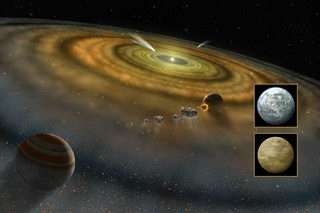
Astronomers detected unusually high quantities of carbon, the basis of all terrestrial life, in an infant solar system around nearby star Beta Pictoris, 63 light-years away.
"For years we've looked to this early forming solar system as one that might be going through the same processes our own solar system did when the rocky planets, including Earth, were forming," commented lead author Aki Roberge, who began the research while at Carnegie's Department of Terrestrial Magnetism. "But we got a big surprise--there is much more carbon gas than we expected. Something very different is going on." The research, published in the June 8, 2006, Nature, suggests that either carbon-rich asteroids or comets, unlike any in our own solar system, have vaporized, or that bodies outgassing carbon-bearing species such as methane contribute the curious carbon excess.
Dusty, gaseous disks around stars are the birthplaces of planetary systems. Carnegie researcher Alycia Weinberger, co-author of the study, explains: "Since we can't observe our own solar system as it was 4.5 billion years ago, we look at young stars to learn about the evolution of planet-forming disks. Ultimately, we want to understand the environments and processes around other stars that lead to the rise of life."
The new research was made possible by FUSE--NASA's Far Ultraviolet Spectroscopic Explorer--and data from the Hubble Space Telescope's imaging spectrograph. Beta Pictoris is almost twice the mass of our Sun and between 8 and 20 million years old. Previous studies indicated that the gas around the star had a composition of elements very similar to that in our own solar system. The new measurements mark the "most complete inventory of gas in any debris disk," and may radically change the picture.
"Astronomers have been puzzled by the very existence of the gaseous disk for some time," commented Roberge. "The star's radiation should blow the gas away, so we should not be able to see gas orbiting the star at all." For a long time it was thought that maybe there was a hidden mass of gas, perhaps hydrogen, which braked the outflow, just as water slows a swimmer. Now, the authors think the mystery braking material is the ionized carbon (atoms which have lost an electron giving them a net positive charge). Ions attract and repel each other due to electrostatic force. Carbon is not blown away from the star, so the ionized carbon seen is very good at slowing down the other gaseous ions.
What the data do not answer, however, is what put the carbon there in the first place. The astronomers compared the elemental composition of the gas with that of dust from Halley's Comet, a very old type of meteorite, and the elemental abundances of our Sun. "It didn't match up at all," remarked Roberge.
The surprisingly carbon-rich gas points in two possible directions. The asteroids and comets orbiting Beta Pictoris might contain large amounts of carbon-rich material like graphite and methane. Planets that formed out of such bodies would be very different from those in the solar system, and might have methane-rich atmospheres, like Titan, a moon of Saturn. Or the Beta Pictoris asteroids and comets might be just like the ones in our solar system when they were young. At that time, they might have contained much more organic material than asteroids and comets appear to today. If so, more of the building blocks of life were delivered to the early Earth than was previously thought.
Commenting on how to determine where the carbon originated, Weinberger noted: "If we could figure out how carbon-rich the dust near the star is, which may be possible with future large infrared telescopes, we could figure out if the dust is a plausible source of the carbon." In a break-up of a planetesimal, all the elements found in meteorites would be produced, so the dust would match that of a meteorite. These collisions are almost certainly happening in the portion of the Beta Pictoris disk near the star. Icy bodies, fairly far from the star, could be losing volatile methane, but not water. And this would enrich the disk in carbon and hydrogen.
Are systems like Beta Pictoris common or rare? This information would help scientists to better understand the implications of the current work. Beta Pictoris is by far the best-studied disk of its kind and the only one in which the gas has been observed in this much detail. This situation will very likely remain the case until the advent of a future ultraviolet space telescope, or large ground-based telescope facilities operating at radio wavelengths, such as the Atacama Large Millimeter Array, scheduled for completion in 2012.
Source: Carnegie Institution


