Magnetic fields may help brain work
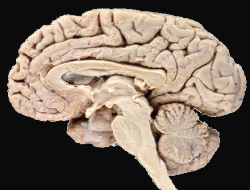
June 8th, 2006 brain

Australian researchers say magnetic fields could make ordinary people capable of extraordinary mental feats.

A joint venture of the Australian National University and the University of Sydney investigated whether repetitive transcranial magnetic stimulation, TMS, can improve a healthy person's ability to guess accurately the number of elements in a scene, the London Telegraph reported.

The study was published this month in the journal Perception.

Participants in the study were presented with 50 to 150 random elements on a monitor. Ten of the 12 participants improved their ability accurately to guess the number of elements immediately following TMS treatment to the left anterior temporal lobe, a skill that receded an hour later, the newspaper said.

Copyright 2006 by United Press International


print this article email this article download pdf blog this article bookmark this article     Digg this Stumble it share on Facebook share on Reddit add to delicious save to Yahoo! bookmarks
3.2/5 after 78 votes


June 8th, 2006 all stories
Medicine & Health /

Comments: 0
Rank: 3.2/5 after 78 votes

  • Stumble this up

  • Digg this

  • Share it:
  • share on Facebook
  • share on MySpace
  • share on Slashdot
  • rss-newsfeed
  • share on Google
  • share on Reddit
  • add to delicious
  • save to Yahoo! bookmarks
  • share on Windows Live
  • Add to Mixx!
Rating: 3.2/5 after 78 votes


Tags


  • Physicists Demonstrate Quantum Memory with Matter Qubits
    Physicists Demonstrate Quantum Memory with Matter Qubits
    Physics / General Physics
    created Jul 03, 2009 | popularity 4.4 / 5 (17) | comments 1
  • 'Holey' Nanosheets for Wastewater Dye Removal
    Nanotechnology / Nanomaterials
    created Jul 01, 2009 | popularity 5 / 5 (5) | comments 1
  • Jellyfish Robot Swims Like its Biological Counterpart
    Jellyfish Robot Swims Like its Biological Counterpart
    Electronics / Robotics
    created Jun 26, 2009 | popularity 4.4 / 5 (8) | comments 1
  • Could Maxwell's Demon Exist in Nanoscale Systems?
    Could Maxwell's Demon Exist in Nanoscale Systems?
    Physics / General Physics
    created Jun 24, 2009 | popularity 4.4 / 5 (18) | comments 29
  • Living Safely with Robots, Beyond Asimov's Laws
    Living Safely with Robots, Beyond Asimov's Laws
    Electronics / Robotics
    created Jun 22, 2009 | popularity 4.6 / 5 (52) | comments 40
  • Other News

    Wind power may have its own environmental problems

    Medicine & Health / Health

    created 57 minutes ago | popularity not rated yet | comments 0

    Wind power generation is expected to be a clean and environmentally friendly natural energy source, but a new kind of environmental problem has surfaced as infrasonic waves caused by windmills are suspected of causing health ...


    Variations in 5 genes raise risk for most common brain tumors

    Medicine & Health / Genetics

    created 1hour ago | popularity not rated yet | comments 1

    Common genetic variations spread across five genes raise a person's risk of developing the most frequent type of brain tumor, an international research team reports online in Nature Genetics.


    MicroRNAs hold promise for treating diseases in blood vessels

    Medicine & Health / Research

    created 1hour ago | popularity not rated yet | comments 0

    A newly discovered mechanism controls whether muscle cells in blood vessels hasten the development of both atherosclerosis and Alzheimer's disease, according to an article published online today in the journal Nature.


    Malaysian authorities seize 'Viagra coffee' : report

    Medicine & Health / Health

    created 4 hours ago | popularity not rated yet | comments 0

    Malaysia's health authorities have seized over 20,000 dollars worth of coffee mixed with sildenafil, the main ingredient in erectile dysfunction drug Viagra, a report said Sunday.


    People sometimes seek the truth, but most prefer like-minded views

    People sometimes seek the truth, but most prefer like-minded views

    Medicine & Health / Psychology & Psychiatry

    created Jul 01, 2009 | popularity 4.2 / 5 (10) | comments 9

    We swim in a sea of information, but filter out most of what we see and hear. A new analysis of data from dozens of studies sheds new light on how we choose what we do and do not hear. The study found that ...