Researchers build an ultrasound version of the laser
June 8th, 2006 Researchers build an ultrasound version of the laser

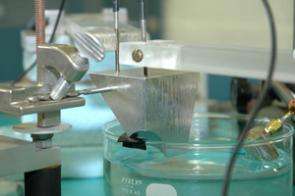
An aluminum block [acoustic cavity] interacts with two electronic auto-oscillator circuits (not shown) via piezoelectric transducers [electro-mechanical ‘atoms’] to form a uaser.

Researchers at the University of Illinois at Urbana-Champaign and at the University of Missouri at Rolla have built an ultrasound analogue of the laser.

Called a uaser (pronounced WAY-zer) -- for ultrasound amplification by stimulated emission of radiation -- the instrument produces ultrasonic waves that are coherent and of one frequency, and could be used to study laser dynamics and detect subtle changes, such as phase changes, in modern materials.

"We have demonstrated that the essential nature of a laser can be mimicked by classical mechanics -- not quantum mechanics -- in sound instead of light," said Richard Weaver, a professor of theoretical and applied mechanics at Illinois.

To make a uaser, Weaver, Illinois research associate Oleg Lobkis and Missouri physics professor Alexey Yamilov begin by mounting a number of piezoelectric auto-oscillators to a block of aluminum, which serves as an elastic, acoustic body. When an external acoustic source is applied to the body, the oscillators synchronize to its tone. Like fireflies trapped in a bottle, the oscillators synchronize to the frequency of the source.

In the absence of an external source, the tiny ultrasonic transducers become locked to one another by virtue of their mutual access to the same acoustic system.

"The phases must be correct also," Weaver said. "By carefully designing the transducers, we can assure the correct phases and produce stimulated emission. As a result, the power output scales with the square of the number of oscillators."

The uaser more closely resembles a "random laser" than it does a conventional, highly directional laser, Weaver said. "In principle, however, there is no reason why we shouldn't be able to design a uaser to generate a narrow, highly directional beam."

Optical lasers are useful because of their coherent emission, high intensity and rapid switching. These features are of little value in acoustics, where coherence is the rule and not the exception, intensity is limited by available power, and maximum switching speeds are limited by moderate frequencies.

Nevertheless, uasers may be useful. With their longer wavelengths and more convenient frequencies, uasers could prove useful for modeling and studying laser dynamics. They could also serve as highly sensitive scientific tools for measuring the elastic properties and phase changes of modern materials, such as thin films or high-temperature superconductors.

"Uasers can produce an ultrasonic version of acoustical feedback -- an ultrasonic howl similar to the squeal created when a microphone is placed too close to a speaker," Weaver said. "By slowly changing the temperature while monitoring the ultrasonic feedback frequency, we could precisely measure the phase change in various materials."

Weaver will describe the uaser and present his team's latest experiments at the annual meeting of the Acoustical Society of America, to be held at the Rhode Island Convention Center in Providence, June 5-9.

Source: University of Illinois at Urbana-Champaign


print this article email this article download pdf blog this article bookmark this article     Digg this Stumble it share on Facebook share on Reddit add to delicious save to Yahoo! bookmarks
4.6/5 after 54 votes


June 8th, 2006 all stories
Physics / General Physics

Comments: 0
Rank: 4.6/5 after 54 votes

  • Stumble this up

  • Digg this

  • Share it:
  • share on Facebook
  • share on MySpace
  • share on Slashdot
  • rss-newsfeed
  • share on Google
  • share on Reddit
  • add to delicious
  • save to Yahoo! bookmarks
  • share on Windows Live
  • Add to Mixx!
Rating: 4.6/5 after 54 votes

  • Related Stories

  • Composites for energy
    created Jun 30, 2009 | popularity not rated yet | comments 0
  • Structures from the human immune system's oldest branch shed light on a range of diseases
    created Jun 17, 2009 | popularity not rated yet | comments 0
  • Low-fat diet helps genetically predisposed animals avoid liver cancer
    created Jun 12, 2009 | popularity not rated yet | comments 0
  • Omega fatty acid balance can alter immunity and gene expression
    created May 29, 2009 | popularity not rated yet | comments 0
  • Ants get their place in Smithsonian exhibit
    created May 29, 2009 | popularity not rated yet | comments 0

Tags


  • Physicists Demonstrate Quantum Memory with Matter Qubits
    Physicists Demonstrate Quantum Memory with Matter Qubits
    Physics / General Physics
    created Jul 03, 2009 | popularity 4.4 / 5 (17) | comments 1
  • 'Holey' Nanosheets for Wastewater Dye Removal
    Nanotechnology / Nanomaterials
    created Jul 01, 2009 | popularity 5 / 5 (5) | comments 1
  • Jellyfish Robot Swims Like its Biological Counterpart
    Jellyfish Robot Swims Like its Biological Counterpart
    Electronics / Robotics
    created Jun 26, 2009 | popularity 4.4 / 5 (8) | comments 1
  • Could Maxwell's Demon Exist in Nanoscale Systems?
    Could Maxwell's Demon Exist in Nanoscale Systems?
    Physics / General Physics
    created Jun 24, 2009 | popularity 4.4 / 5 (18) | comments 29
  • Living Safely with Robots, Beyond Asimov's Laws
    Living Safely with Robots, Beyond Asimov's Laws
    Electronics / Robotics
    created Jun 22, 2009 | popularity 4.6 / 5 (52) | comments 40
  • Other News

    Scientists create first electronic quantum processor

    Scientists create first electronic quantum processor

    Physics / General Physics

    created Jun 28, 2009 | popularity 4.8 / 5 (53) | comments 40

    A team led by Yale University researchers has created the first rudimentary solid-state quantum processor, taking another step toward the ultimate dream of building a quantum computer.


    Science journals

    How to Spot an Influential Paper Based on its Citations

    Physics / General Physics

    created Jul 04, 2009 | popularity 4 / 5 (9) | comments 6

    (PhysOrg.com) -- At first it may seem that the number of citations received by a published scientific paper is directly related to that paper's quality of content. The higher the quality, the more people read ...


    Fermilab's CDF observes Omega-sub-b baryon

    Fermilab's CDF observes Omega-sub-b baryon

    Physics / General Physics

    created Jun 29, 2009 | popularity 4.7 / 5 (17) | comments 7

    (PhysOrg.com) -- At a recent physics seminar at the Department of Energy’s Fermi National Accelerator Laboratory, Fermilab physicist Pat Lukens of the CDF experiment announced the observation of a new particle, ...


    New insights, and a new angle, on high-temperature superconductivity

    New insights, and a new angle, on high-temperature superconductivity

    Physics / Superconductivity

    created Jun 29, 2009 | popularity 4.8 / 5 (13) | comments 6

    (PhysOrg.com) -- A Princeton-led research team has revealed surprising information about how electron behavior influences the conduction of electricity in a class of high-temperature superconductors. An increased ...


    The art of invisibility and the perfect cat's eye

    The art of invisibility and the perfect cat's eye

    Physics / Optics & Photonics

    created Jun 30, 2009 | popularity 4 / 5 (8) | comments 6

    (PhysOrg.com) -- In recent years scientists have explored the impossible by developing invisibility or 'cloaking' devices, but can the same technology also help make things more visible?