Researchers Discover the 'Big Sperm Paradox'
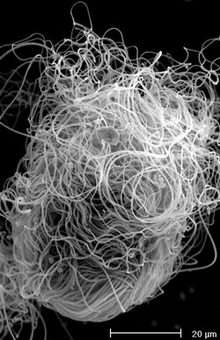
Syracuse University Ph.D. student Adam Bjork is a man on a mission: to unlock the mysteries of cryptic female choice. He’s not studying psychology or trying to get a date—he’s a student of biology in SU’s College of Arts and Sciences, and he has discovered a major paradox in the area of evolutionary biology.
A recent study by co-authors Bjork and SU biology associate professor Scott Pitnick, titled “Intensity of sexual selection along the anisogamy-isogamy continuum,” will be published in the June 8 issue of Nature.
In the article, Bjork and Pitnick discuss a paradox they have discovered within the foundations of sexual selection theory as it relates to the sperm and egg production of Drosophila (fruit flies). Previous work in the Pitnick lab has shown that post-copulatory sexual selection on males (the sperm competition that takes place after females mate with more than one male) can lead to decreased sperm quantities by favoring the production of larger sperm. In other words, their production moves toward a “quality, not quantity” mode, because female fruit flies have evolved so that longer sperm have a greater chance of successfully fertilizing eggs. Successful fertilization is important, since individuals that fail to pass their genes on to the next generation are at an evolutionary dead end.
This leads to the “big sperm paradox” because the idea that postcopulatory sexual selection could favor the evolution of giant sperm clashes with traditional sexual selection theory, which predicts that the most successful sperm competitors will be the males that produce many, tiny sperm. As males evolve to produce larger—and therefore fewer—sperm, eggs become less rare, and sexual selection should weaken, according to theory. The term “isogamy” refers to the state at which males and females have equal investment per gamete (sex cell) when producing sperm and eggs. In a truly isogamous population, each sperm and each egg would have a chance to participate in a successful fertilization. In such a population, sexual selection would be extremely weak, as there would be little or no competition among males to fertilize eggs.
To investigate this apparent paradox between empirical data and traditional theory, Bjork and Pitnick set out to measure the strength of sexual selection in four Drosophila species of varying sperm length, ranging from the anisogamous D. melanogaster (in which a male produces 30 sperm in the time it takes a female to make one egg) to the nearly isogamous D. bifurca (where just six sperm are produced per egg). They found that, contrary to theoretical predictions, the level of competition among males did not decrease; the strength of sexual selection remained high as sperm size increased. Their results show that, once females evolve a preference for longer sperm, intense sperm competition can actually reverse the trajectory of sperm evolution so that the most successful males are those with the most female-like strategy of producing very few, large gametes.
Bjork and Pitnick’s discovery brings into focus a question often pondered by evolutionary biologists. The animal kingdom is full of sometimes odd, sometimes obvious “advertising” features in male physiology, such as the ostentatious feathers of the peacock, presumably to attract the attention of females. But when all other criteria are equal, and when one female mates with a number of males, what causes females to “choose” whose sperm succeeds in fertilizing her eggs? It’s what Bjork and Pitnick call “cryptic female choice.”
It’s a question that fascinates Bjork. He has been interested in the topic since he was a sophomore at Gustavus Adolphus College in Minnesota. Bjork took a seminar in animal behavior his junior year and read the article “Sperm Wars” in Discover magazine. The article led him to Pitnick and his work in the areas of sexual selection, sexual conflict and speciation. In 1995, Pitnick discovered the longest sperm in nature; that of Drosophila bifurca. It is nearly six centimeters long. Pitnick also found that females in the species had evolved to favor this long sperm because they developed long reproductive tracts in which longer sperm have the greatest chance at competitive fertilization success.
“The sperm of Drosophila bifurca is 20 times longer than the male that produces it,” says Bjork. “To put that into perspective, if humans made sperm that long and you took a six-foot man and stood him on the goal line of a football field, his sperm would stretch out to the 40-yard line.”
Eager to study with such an authority on the subject, Bjork came to Syracuse University to pursue his Ph.D. and work in Pitnick’s lab. His level of enthusiasm for his research is matched only by his devotion to it. For example, Bjork had to journey into the highlands of central Mexico to collect specimens to breed. After baiting them with fermenting bananas and cactus fruit, Bjork carefully deposited them into plastic vials and kept them cool for the drive back to Syracuse, where he was conducting his research. For the entire trip, Bjork kept his charge safely in air conditioned environments. “I couldn’t even go into a restaurant without bringing them with me,” says Bjork. “They weren’t easy to collect, and I wasn’t going to let them die.”
While it is fascinating, the evolution of giant sperm is puzzling. Says Bjork: “Until recently, it was widely believed that selection generated by sperm competition favors males that manufacture the smallest gametes possible in order to maximize sperm number. In essence, sperm competition is attributed with the evolutionary maintenance of anisogamy. I became interested in understanding whether the very act of sexual selection, by definition, can limit its own ability to act.”
The next step is to investigate the details of the effects of sperm length evolution on the intensity of sexual selection. “For instance, our results indicate that, as sperm get longer across and within species, females actually become more ‘male-like,’” says Bjork. “The intensity of sexual selection on females increases. Traditionally, females have been thought to have the same number of progeny whether they mate once or, say, five times because there are way more than enough sperm to fertilize all of their available eggs. But our data show that, as sperm get longer, females actually benefit, in terms of increased offspring numbers by multiplying mating.”
Source: Syracuse University


