Corkscrew Asteroids

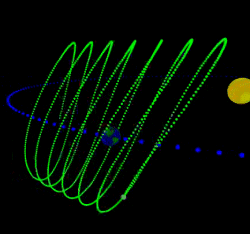
June 9, 2006 The typical corkscrew path of an Earth Coorbital Asteroid.

The typical corkscrew path of an Earth Coorbital Asteroid.

News flash: Earth has a "second moon." Asteroid 2003 YN107 is looping around our planet once a year. Measuring only 20 meters across, the asteroid is too small to see with the unaided eye—but it is there. This news, believe it or not, is seven years old.

"2003 YN107 arrived in 1999," says Paul Chodas of NASA's Near Earth Object Program at JPL, "and it's been corkscrewing around Earth ever since." Because the asteroid is so small and poses no threat, it has attracted little public attention. But Chodas and other experts have been monitoring it. "It's a very curious object," he says.

Most near-Earth asteroids, when they approach Earth, simply fly by. They come and they go, occasionally making news around the date of closest approach. 2003 YN107 is different: It came and it stayed.
Asteroid mining, an artist's concept.

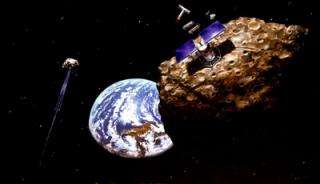
Asteroid mining, an artist's concept.

"We believe 2003 YN107 is one of a whole population of near-Earth asteroids that don't just fly by Earth. They pause and corkscrew in our vicinity for years before moving along."

These asteroids are called Earth Coorbital Asteroids or "coorbitals" for short. Essentially, they share Earth's orbit, going around the Sun in almost exactly one year. Occasionally a coorbital catches up to Earth from behind, or vice versa, and the dance begins: The asteroid, while still orbiting the sun, slowly corkscrews around our planet.

"These asteroids are not truly captured by Earth's gravity," notes Chodas. "But from our point of view, it looks like we have a new moon."

Astronomers know of at least four small asteroids that can do this trick: 2003 YN107, 2002 AA29, 2004 GU9 and 2001 GO2. "There may be more," says Chodas. He believes the list will grow as asteroid surveys improve in sky coverage and sensitivity.

At the moment, only two coorbitals are actually nearby: 2003 YN107 and 2004 GU9. The others are scattered around Earth's orbit.

2004 GU9 is perhaps the most interesting. It measures about 200 meters across, relatively large. And according to calculations it has been corkscrewing around Earth for 500 years--and may continue for another 500. It's in a remarkably stable "orbit."

Right now, however, researchers are paying more attention to 2003 YN107 for one simple reason: it's about to depart. The asteroid's corkscrew path is lopsided and on June 10th it will dip within 3.4 million km of Earth, slightly closer than usual. Earth's gravity will then give the asteroid the nudge it needs to leave.

"This is a chance to observe one of these asteroids [on the way out]," explains Chodas.

It won't be gone forever. In about 60 years 2003 YN107 will lap Earth again, resuming its role as a temporary, corkscrewing moonlet. In due course, other coorbitals will do the same.

Each encounter is an opportunity for study--and possibly profit. Even the most powerful telescopes cannot see much of these tiny asteroids; they're just specks in the eyepiece. But one day, when the space program is more advanced, it might be possible to visit, explore the moonlets and tap their resources. "For now, they're just a curiosity," says Chodas.

News flash: Earth is about to lose a moon. More to come.

Source: Science@NASA, by Dr. Tony Phillips


print this article email this article download pdf blog this article bookmark this article     Stumble it Digg this share on Facebook retweet share on Reddit add to delicious
Rate this story - 4.7 /5 (57 votes)


June 9, 2006 all stories

Comments: 0

4.7 /5 (57 votes)
  • Stumble this up

  • Digg this

  • share this

  • hide
  • Related Stories

  • Steadier Traffic Flow Improves Health of Local Infants, Researchers Say
    created Nov 17, 2009 | popularity not rated yet | comments 0
  • NASA on crusade to debunk 2012 apocalypse myths
    created Nov 09, 2009 | popularity not rated yet | comments 0
  • First Bose-Einstein condensation of strontium
    created Nov 09, 2009 | popularity not rated yet | comments 0
  • 15,000 reasons to worry about invasive species
    created Nov 09, 2009 | popularity not rated yet | comments 0
  • 'Ultra-primitive' particles found in comet dust
    created Nov 02, 2009 | popularity not rated yet | comments 0


  • hide
  • Relevant PhysicsForums posts

  • Semi-major axis from cartesian co-ordinates
    created 11 hours ago
  • Primary Mirror grinding
    created 13 hours ago
  • dark energy can escape black holes.
    created 22 hours ago
  • Are there green, purple and pink stars?
    created Nov 22, 2009
  • Sideral question
    created Nov 21, 2009
  • Doppler shifted blackbody spectrum
    created Nov 21, 2009
  • More from Physics Forums - General Astronomy

Other News

'Cosmic fruit machine' matches collisions

'Cosmic fruit machine' matches collisions

Space & Earth / Astronomy

created 7 minutes ago | popularity not rated yet | comments 0

(PhysOrg.com) -- A new website will give everyone the chance to contribute to science by playing a 'cosmic fruit machine' and compare images of colliding galaxies with millions of simulated images of galactic ...


New computer-developed map shows more extensive valley network on Mars

New computer-developed map shows more extensive valley network on Mars

Space & Earth / Space Exploration

created 13 hours ago | popularity 4.5 / 5 (8) | comments 0

New research adds to the growing body of evidence suggesting the Red Planet once had an ocean.


Supervolcano eruption -- in Sumatra -- deforested India 73,000 years ago

Supervolcano eruption -- in Sumatra -- deforested India 73,000 years ago

Space & Earth / Earth Sciences

created 15 hours ago | popularity 4.3 / 5 (10) | comments 2

A new study provides "incontrovertible evidence" that the volcanic super-eruption of Toba on the island of Sumatra about 73,000 years ago deforested much of central India, some 3,000 miles from the epicenter, ...


Spitzer Telescope Observes Baby Brown Dwarf

Spitzer Telescope Observes Baby Brown Dwarf

Space & Earth / Astronomy

created 12 hours ago | popularity 4.7 / 5 (9) | comments 0

(PhysOrg.com) -- NASA's Spitzer Space Telescope has contributed to the discovery of the youngest brown dwarf ever observed -- a finding that, if confirmed, may solve an astronomical mystery about how these ...


Scientist: Leak of climate e-mails appalling

Space & Earth / Environment

created 18 hours ago | popularity 3.2 / 5 (10) | comments 8

(AP) -- A leading climate change scientist whose private e-mails are included in thousands of documents that were stolen by hackers and posted online said Sunday the leaks may have been aimed at undermining next month's ...