Smashing young stars leave dwarfs in their wake
June 9, 2006 Smashing young stars leave dwarfs in their wake

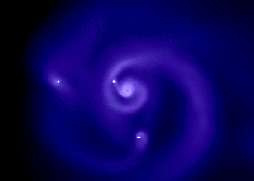
Visualizations of brown dwarf simulations completed by Sijing Shen for her Master's Thesis (May 2006) under the supervision of James Wadsley.

Astronomers have discovered that the large disks of gas and dust around young stars will fragment if two young stars pass close to each other and form smaller brown dwarfs stars with disks of their own.

The news was announced this week at the Canadian Astronomical Society in Calgary, Alta, by James Wadsley, assistant professor of Physics & Astronomy at McMaster University, and his student Sijing Shen.

"This is an exciting discovery because it may be the dominant way brown dwarfs are made," says Wadsley. "The challenge to theorists was to explain not only the origin of brown dwarfs but also the details telescopes are seeing: brown dwarfs with disks and the systems of many dwarfs orbiting a single regular star. We've done that."

Brown dwarf stars are as common in number as large stars but are no more than 8 percent of the mass of the Sun. Their low mass prevents nuclear fusion in their core so they don't shine like regular stars. Regular stars form from cold dense cores in giant molecular gas clouds. The natural mass of a core is expected to be large, closer to that of a regular star than a brown dwarf so something extra was required to understand the origin of brown dwarfs.

Using SHARCNET (Shared Hierarchical Academic Research Computing Network) parallel computing facilities at McMaster, Shen and Wadsley simulated several encounters between young stars with disks at unprecedented resolution, seeing gas pile-ups, drawn-out tidal arms and huge masses of gas driven closer to the stars. Amid this chaos several small objects were seen to form, from Jupiter-sized objects up to brown dwarfs. Reports from lower resolution simulations by other groups had shown no indication of disks. However, in every case, the new objects had disks with sizes ranging up to 18 astronomical units (the size of Saturn's orbit). As these rapidly spinning disks evolve they should produce jets of gas and even result in the formation of planets orbiting the brown dwarfs. Both these things have been observed in nature.

"We had no idea the simulated results would be so beautiful and complex, and then we found out that observations were revealing brown dwarfs with disks that matched what we were seeing, " said Shen, who is studying for her PhD in Physics & Astronomy at McMaster.

The simulated objects would either leave the stars on their own or in groups, or remain as multiple brown dwarf companions to a star. Telescopes have detected up to three brown dwarfs orbiting a regular star. Thus the brown dwarfs and planets in the simulations are remarkably similar to what is observed. However, it remains to be determined exactly how often such encounters occur in nature and what fraction of those encounters reliably produce brown dwarfs. For this, Shen and Wadsley are planning a much larger set of encounter simulations using SHARCNET's new supercomputers.

Source: McMaster University


print this article email this article download pdf blog this article bookmark this article     Stumble it Digg this share on Facebook retweet share on Reddit add to delicious
Rate this story - 5 /5 (2 votes)


June 9, 2006 all stories

Comments: 0

5 /5 (2 votes)
  • Stumble this up

  • Digg this

  • share this

  • hide
  • Related Stories

  • Spitzer Telescope Observes Baby Brown Dwarf
    created Nov 23, 2009 | popularity not rated yet | comments 0
  • NASA's Wise Gets Ready to Survey the Whole Sky (w/ Video)
    created Nov 17, 2009 | popularity not rated yet | comments 0
  • In Search of Dark Asteroids (and Other Sneaky Things)
    created Sep 16, 2009 | popularity not rated yet | comments 0
  • NASA's WISE Mission Arrives at Launch Site
    created Aug 17, 2009 | popularity not rated yet | comments 0
  • Ultracool stars take 'wild rides' around, outside the Milky Way
    created Jun 09, 2009 | popularity not rated yet | comments 0


  • hide
  • Relevant PhysicsForums posts

  • Question about 2-body gravity
    created Nov 24, 2009
  • life on Mars
    created Nov 24, 2009
  • Semi-major axis from cartesian co-ordinates
    created Nov 23, 2009
  • Primary Mirror grinding
    created Nov 23, 2009
  • More from Physics Forums - General Astronomy

Other News

Russia: no space for space tourists (AP)

Russia: no space for space tourists

Space & Earth / Space Exploration

created 2 hours ago | popularity 4 / 5 (1) | comments 1

(AP) -- A top Russian space official says there is no space for tourists wishing to fly to the International Space Station.


Monster Waves on the Sun are Real

Monster Waves on the Sun are Real (w/ Video)

Space & Earth / Astronomy

created 14 hours ago | popularity 4.8 / 5 (12) | comments 1

Sometimes you really can believe your eyes. That's what NASA's STEREO (Solar Terrestrial Relations Observatory) spacecraft are telling researchers about a controversial phenomenon on the sun known as the "solar ...


Obama to plead US case at global warming summit (AP)

Obama to plead US case at global warming summit

Space & Earth / Environment

created 1hour ago | popularity not rated yet | comments 0

(AP) -- President Barack Obama will commit the United States to substantial cuts in greenhouse gas pollution over the next decade - despite resistance in Congress over higher costs - when he travels to a ...


Thanksgiving last full day in space for shuttle (AP)

Thanksgiving last full day in space for shuttle

Space & Earth / Space Exploration

created 2 hours ago | popularity not rated yet | comments 0

(AP) -- Space shuttle Atlantis' astronauts will spend Thanksgiving checking their ship for the ride home.


Cosmic 'dig' reveals vestiges of the Milky Way's building blocks

Cosmic 'Dig' Reveals Vestiges of the Milky Way's Building Blocks

Space & Earth / Astronomy

created 19 hours ago | popularity 4.9 / 5 (15) | comments 1

(PhysOrg.com) -- Peering through the thick dust clouds of our galaxy's "bulge" (the myriads of stars surrounding its center), a team of astronomers has unveiled an unusual mix of stars in the stellar grouping ...