Scientists develop high-resolution touch nano-sensor
U.S. scientists reportedly have created a revolutionary sensor that can "feel" the texture on objects with a sensitivity equal to that of a human fingertip.
One of the trickiest decisions facing a cancer surgeon today is where to stop cutting. The surgeon doesn't want to stop too soon and leave cancer cells in the patient's body, but he or she also doesn't want to take too many cells and do unnecessary damage to organs.
That decision could soon be made much easier, though, thanks to a high-resolution touch sensor developed by chemical engineers at the University of Nebraska-Lincoln that may allow surgeons to tell at the level of a single layer of cells whether or not they have excised a tumor in its entirety.
Ravi F. Saraf, and his doctoral student, Vivek Maheshwari, report in the June 9 issue of Science, the international weekly journal of science, that they have developed a self-assembling nanoparticle device that has touch sensitivity comparable to that of the human finger, a capability far beyond any mechanical devices now available.
"The touch resolution of the human finger is 40 microns (40 millionths of a meter)," said Saraf, the Lowell E. and Betty Anderson professor of chemical engineering. "Using nanoparticles, we can attain resolution close to human touch, which is about 50 times better than what is out there today."
Saraf explained that existing technology presents problems for use in minimally invasive surgery because the devices have low resolution, and are expensive and rigid, making them unsuitable for surgical applications.
He said the device that he and Maheshwari developed will be significantly cheaper because the device self-assembles at room temperature. It can also be made to cover an area of 1 square meter or larger, and is flexible enough to cover complex shapes.
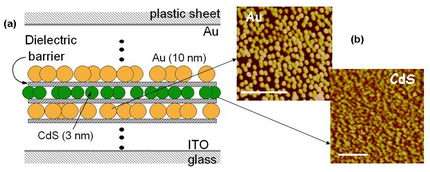
The device consists of alternating monolayers layers of gold nanoparticles 10 nanometers (10 billionths of a meter) in diameter and cadmium sulfide nanoparticles 3 nanometers thick, separated by alternating layers of polymers that act as dielectric barriers. The manufacturing process is essentially a series of dip-coatings in various solutions with intermediate washing and drying processes. Saraf said the interactions between the materials at the atomic level is strong enough that they come together in a certain direction and a certain form, but weak enough that the nanoparticles can self-adjust an incorrect fit.
"These are conductive and semiconductive materials (gold and cadmium sulfide)," Saraf said. "When you press on the device with an applied voltage across the thickness, that results in larger current and electroluminescent light from the semiconducting particle. By focusing the emitted light intensity from the cadmium sulfide particles or the change in local current throughout the device, you know how much pressure you have applied and how it changes over the contact area."
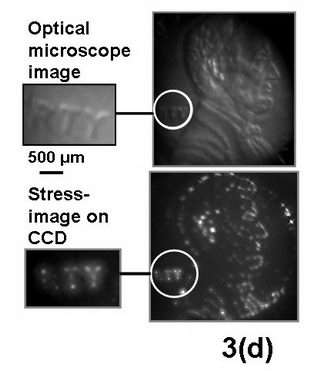
As a demonstration experiment for the Science paper, Saraf and Maheshwari pressed a penny against a sample device and, using a charged-couple device camera, they were able to decipher fine features such as wrinkles in Abraham Lincoln's clothing.
Saraf said the device also has potential uses in robotics.
"Touch is a sensation they want in robotics because to tell the difference between a cube and a sphere, an ordinary robot takes forever to do it with vision because it has to look from all directions," he said. "With touch, it would 'feel' the sharp edges and say, 'Oh, this is a cube.' And then, of course, the big thing for the military is to maneuver in darkness. Similar to a blind person, (with this device) you can touch and find your way through."
But what interests him most, he said, is the device's potential in the fight against cancer.
"I am excited about this because I want to try to decipher cancer at the single-cell level," Saraf said. "Because in some cases, cancer tissues are harder than normal tissues, if you take a tissue sample, put it on a glass slide and press on it, you would be able to see a cluster of just a few (cancer) cells with this method because it can sense down to about 10 microns (10 millionths of a meter). Surgeons will be able to know if they have taken out all of the cancer. If they haven't, they'll know where to make the next cut."
Source: University of Nebraska-Lincoln


