Nanotechnology simulations show what experiments miss
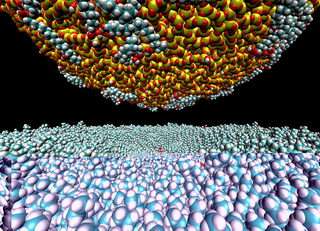
Taking issue with the perception that computer models lack realism, a Sandia National Laboratories researcher told his audience that simulations of the nanoscale provide researchers more detailed results — not less — than experiments alone.
The invited talk by Eliot Fang was delivered to members of the Materials Research Society at its recent semiannual general meeting.
Fang derided the pejorative “garbage in, garbage out” description of computer modeling — the belief that inputs for computer simulations are so generic that outcomes fail to generate the unexpected details found only by actual experiment.
Fang not only denied this truism but reversed it. “There’s another, prettier world beyond what the SEM [scanning electron microscope] shows, and it’s called simulation,” he told his audience. “When you look through a microscope, you don’t see some things that modeling and simulation show.”
This change in the position of simulations in science — from weak sister to an ace card — is a natural outcome of improvements in computing, Fang says. “Fifteen years ago, the Cray YMP [supercomputer] was the crown jewel; it’s now equivalent to a PDA we have in our pocket.”
No one denies that experiments are as important as simulations — “equal partners, in fact,” says Julia Phillips, director of Sandia’s Physical, Chemical, and Nanosciences Center.
But the Labs’ current abilities to run simulations with thousands, millions, and even billions of atoms have led to insights that would otherwise not have occurred, Fang says.
For example, one simulation demonstrated that a tiny but significant amount of material had transferred onto the tip of an atomic force microscope (AFM) as it examined the surface of a microsystem.
“The probe tip changed something very, very tiny on the surface of the material,” says Fang. “It was almost not noticeable. But the property of the surface became very different.”
Laboratory observation couldn’t identify the cause of the property change, but computer simulations provided a reasonable explanation of the results.
As for predicting the reliability of materials that coat surfaces, Fang says, “We find that when we compare our simulation models with data from the experiments, we get a more complete understanding.”
Says Sandia Fellow and materials researcher Jeff Brinker, “We use simulations quite a bit in support of Sandia’s water purification program and the NIH Nano-Medicine Center program. In all these cases I’m working with theorists and modelers to guide the design of synthetic nanopores so as to develop transport behaviors approaching those of natural water or ion channels that exist in cell membranes.”
How is this understanding achieved?
Models computationally link a variety of size and time scales to create an experimental design.
“We use as much experimental information as possible to validate our methods,” says Alex Slepoy from Sandia’s Multiscale Computational Materials Methods. “The trick is picking a correct modeling strategy from our toolbox of methods.”
Asked whether simulations are merely more complex versions of what a graphic artist produces — a product of the imagination, in short, that cannot accurately produce new details — Slepoy provisionally entertains the idea: “A graphic artist has to make choices that are somewhat subconscious: what size objects to represent, how close-in to zoom, what details to include and exclude, and are there people out there who liked what he drew. So do we.
“But there the similarity ends. For us in computer simulations, the questions are more technical: Does the modeling strategy agree with experiments and is it consistent with established models? Does it have mathematical consistency?”
A further advance in accurate model development, he says, is that “now we’re developing automated methods to tell us whether we’ve satisfied [accuracy] requirements, rather than doing that by just manually looking at results. The method automatically tunes the model to satisfy the entire set of conditions as we know them.”
There is also the matter of cost, says Fang: “With smart people developing numerical methods, models, and algorithms to use computers to study real cases, we find we can rerun calculations merely by changing computer parameters. Thus the cost to push science forward is much cheaper than running experiments — particularly in nanoscience, where the realm is so small that experiments are difficult to perform, testing devices are not available, and data acquisition is a challenge.”
For all these reasons, he says, “This is why at CINT [the Sandia/Los Alamos Center for Integrated Nanotechnology, funded by DOE’s Office of Science], theory and simulation is one of its five thrusts. People view modeling and simulation as a critical component of nanoscience.”
“We need to sit back and put our mindset in a different mode,” he told his audience. “We’re all too busy doing [laboratory] research [instead of considering] how we can leverage resources to push our science to the next level.”
Modeling tools include: meso-scale (an intermediate resolution capability functioning between the atomic and macro scales), classical atomistics (classical force-field theory), Density Functional Theory (a one-electron approximation of quantum theory, where an electron interacts with atoms but not with another electron), and the full quantum model (electrons interacting with other electrons and four or five ions).
Source: Sandia National Laboratories


