Scientists take 'snapshots' of enzyme action
June 13, 2006 Scientists take 'snapshots' of enzyme action

Enlarge

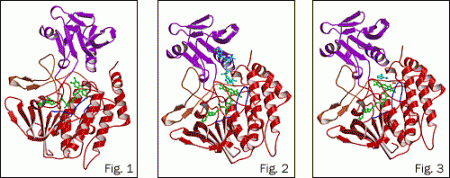
Snapshots of catalytic mechanism of FMO. The three stages in the mechanism of action of FMO are depicted here. The ribbon diagram represents the protein consisting of two domains with a long loop in the interface. The big and small domains are shown in red and purple with the interface in golden color. Figure 1 represents the first stage with the coenzyme FAD (shown as a ball and stick model in green) bound to the enzyme. In the second stage (Figure 2), the cofactor NADPH (shown as a ball and stick model in cyan) approaches the enzyme and interacts with the coenzyme. In the third stage (Figure 3), the substrate (shown as a ball and stick model in cyan) displaces the cofactor and binds in the same place to get oxygenated. The molecular oxygen (shown as a dumbbell in red) is required for oxygenation of the substrate.

Scientists at the U.S. Department of Energy's Brookhaven National Laboratory, the New York Structural Biology Center, and SGX Pharmaceuticals, Inc., have determined the atomic crystal structure and functional mechanism of an enzyme essential for eliminating unwanted, non-nutritional compounds such as drugs, industrial chemicals, and toxic compounds from the body. The detailed mechanism of action will help scientists understand how these compounds are eliminated and what goes wrong in cases where normal metabolism fails.

The research will be published online the week of June 12, 2006, by the Proceedings of the National Academy of Sciences.

According to Brookhaven biologists Eswaramoorthy Subramaniam, the lead author, and Subramanyam Swaminathan, who led the research, most non-nutritional, foreign substances such as drugs and industrial chemicals are insoluble in water. The body uses two main groups of enzymes -- flavin-containing monooxygenases (FMOs) and cytochrome P450s -- to convert these compounds to soluble forms that can be easily excreted.

"For FMOs, the end result -- that an oxygen atom gets added to make these compounds soluble -- is simple," Swaminathan says, "but the reactions require additional participants, or cofactors." In order to understand the molecular mechanism, the scientists used high-intensity x-ray beams at the National Synchrotron Light Source (NSLS) to identify the positions of individual atoms and produce crystal structures of the enzyme, the enzyme plus its cofactor, and the enzyme plus the cofactor plus the compound to be oxidized (the substrate).

"These crystal structures give step-by-step snapshots of different stages of the catalytic action," Swaminathan says, "and reveal a mechanism that is different from what had been known about this process."

Previously, it had been believed that all the "players" -- the enzyme, cofactor, and substrate -- came together at a particular time to perform the function of transferring an oxygen atom from the enzyme to the substrate. "Our finding shows that the substrate and cofactor are binding to the enzyme alternately, not together," Swaminathan says.

First, the cofactor (known as NADPH) binds to a molecule known as FAD, which is a coenzyme attached to the FMO, and transfers a hydride ion to it. That makes the FAD group capable of accepting molecular oxygen. Then, when the substrate arrives, the cofactor leaves so that the substrate can bind to the same site on the FAD group. At this moment an oxygen atom from molecular oxygen is attached to the substrate, and the hydride ion obtained from the cofactor combines with the other oxygen atom to form a water molecule, which is released. Once the substrate is oxygenated, it leaves the enzyme and the cofactor binds again.

"With this back-and-forth, alternating binding, the process repeats over and over for continuous turnover of the product," Swaminathan says.

The details of this process may help scientists understand what happens in cases where compounds are not properly metabolized, and possibly develop corrective measures.

One example is a condition called trimethylaminuria, also known as "fish odor syndrome," which results from defective FMOs. Affected individuals are unable to oxygenate trimethylamine, a byproduct of protein digestion released by bacteria living in the gut. People with the disorder release trimethylamine through breath, sweat, and urine, producing a fish-like odor that can be embarrassing and result in psychological effects such as withdrawal and depression.

People with defective FMOs might also suffer additional side effects from drugs, industrial compounds, or other chemicals.

Source: Brookhaven National Laboratory


print this article email this article download pdf blog this article bookmark this article     Stumble it Digg this share on Facebook retweet share on Reddit add to delicious
Rate this story - 4.6 /5 (5 votes)


June 13, 2006 all stories

Comments: 0

4.6 /5 (5 votes)
  • Stumble this up

  • Digg this

  • share this

  • hide
  • Related Stories

  • MIT biologists solve vitamin puzzle
    created Mar 21, 2007 | popularity not rated yet | comments 0
  • Parasite evades death by promoting host cell survival
    created Dec 08, 2009 | popularity not rated yet | comments 0
  • Venomous bite: Harmless digestive enzyme evolved into venom in two species
    created Oct 29, 2009 | popularity not rated yet | comments 0
  • Inventive approach may improve enzyme replacement therapy for Fabry disease
    created Oct 22, 2009 | popularity not rated yet | comments 0
  • Biochemical 'On-Switch' Could Solve Protein Purification Challenge
    created Oct 20, 2009 | popularity not rated yet | comments 0


Other News

New way to break some of the strongest chemical bonds

New way to break some of the strongest chemical bonds

Chemistry / Materials Science

created 19 hours ago | popularity 4.5 / 5 (19) | comments 0

(PhysOrg.com) -- Scientists at Cornell University in the U.S. have found a new way of breaking two of the strongest chemical bonds, at ambient temperature and pressure, and this breakthrough could lead to ...


Argonne scientists use bacteria to power simple machines

Chemistry / Biochemistry

created 15 hours ago | popularity 4.8 / 5 (4) | comments 0

Scientists at the U.S. Department of Energy's Argonne National Laboratory and Northwestern University, Evanston, have discovered that common bacteria can turn microgears when suspended in a solution, providing insights for ...


Food aromas could become new weapon in battle of the bulge

Food aromas could become new weapon in battle of the bulge

Chemistry / Other

created 14 hours ago | popularity not rated yet | comments 0

A real possibility does exist for developing a new generation of foods that make people feel full by releasing anti-hunger aromas during chewing, scientists in the Netherlands are reporting after a review ...


Scientists isolate new antifreeze molecule in Alaska beetle

Chemistry / Biochemistry

created Dec 14, 2009 | popularity 5 / 5 (13) | comments 4

Scientists have identified a novel antifreeze molecule in a freeze-tolerant Alaska beetle able to survive temperatures below minus 100 degrees Fahrenheit. Unlike all previously described biological antifreezes that contain ...


Researchers discover novel method for detecting MIRCERA

Chemistry / Analytical Chemistry

created 21 hours ago | popularity not rated yet | comments 0

Austrian researchers have successfully developed a new electrophoretic method for detecting MIRCERAŽ and other erythropoietins (EPO) in the blood. The technique, using SARCOSYL-PAGE, has specifically enhanced sensitivity ...