Hubble Eyes Star Birth in the Extreme
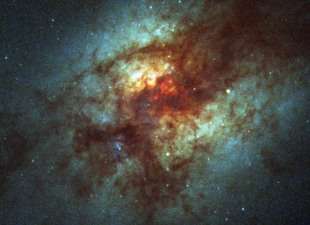
Staring into the crowded, dusty core of two merging galaxies, NASA's Hubble Space Telescope has uncovered a region where star formation has gone wild.
The interacting galaxies appear as a single, odd-looking galaxy called Arp 220. The galaxy is a nearby example of the aftermath of two colliding galaxies. In fact, Arp 220 is the brightest of the three galactic mergers closest to Earth. This latest view of the galaxy is yielding new insights into the early universe, when galactic wrecks were more common.
The sharp eye of Hubble's Advanced Camera for Surveys has unveiled more than 200 mammoth star clusters. The newly found clusters far outnumber the six spied by Hubble in a 1992 observation of Arp 220 taken by the Wide Field Planetary Camera, which did not have the sharpness of the Advanced Camera. The heftiest Arp 220 cluster observed by Hubble contains enough material to equal about 10 million suns, which is twice as massive as any comparable star cluster in the Milky Way Galaxy.
The clusters are so compact, however, that even at their moderate distance they look to Hubble like brilliant single stars. Astronomers know the clusters are not stars because they are much brighter than a star would be at that distance, 250 million light-years away in the constellation Serpens.
The star birth frenzy is happening in a very small region, about 5,000 light-years across (about 5 percent of the Milky Way's diameter), where the gas and dust is very dense. There is as much gas in that tiny region as there is in the entire Milky Way Galaxy.
"This is star birth in the extreme," said astronomer Christine D. Wilson of McMaster University in Hamilton, Ontario, Canada, and the leader of the study. "Our result implies that very high star-formation rates are required to form supermassive star clusters. This is a nearby look at a phenomenon that was common in the early universe, when many galaxies were merging."
Wilson's team obtained measurements of the masses and ages for 14 of the clusters, which allowed them to more accurately estimate the masses and ages for all the clusters. The observations revealed two populations of star clusters. One population is less than 10 million years old; the second, 70 to 500 million years old. Clusters in the younger group are more massive than those in the older group.
Wilson doesn't know whether the flurry of star birth occurred at two different epochs or at a continuous frantic pace and perhaps they are not seeing the intermediate-age population. She does know that the starburst was fueled by a collision between two galaxies that began about 700 million years ago. The effects of the merger have stretched out over hundreds of millions of years.
The team's results appeared in the April 20 issue of the Astrophysical Journal. The finding is based on new observations with Hubble's Advanced Camera for Surveys and on a previous study by the Near Infrared Camera and Multi-Object Spectrometer. The Advanced Camera observations, taken in visible light in August 2002, revealed the large cluster population and produced ages for the older grouping of clusters. The near infrared camera study snapped images of the younger cluster population.
Although the new Hubble image showcases Arp 220 in visible light, the galaxy shines brightest in infrared light. In fact, Arp 220 is called an ultra-luminous infrared galaxy (ULIRG). ULIRGs are the products of mergers between galaxies, which can create firestorms of star birth. Starlight from the new stars heats the surrounding dust, causing the galaxies to glow brilliantly in infrared light.
Only a small amount of visible light escapes through the dust-enshrouded galaxy. If astronomers had an unobstructed view of Arp 220 in visible light, the galaxy would shine 50 times brighter than our Milky Way Galaxy because of the light from its massive clusters and associated star formation.
Arp 220 shares a kinship with other interacting galaxies, such as the well-known Antennae galaxies. Both are the products of galactic mergers. The merging process in Arp 220, however, is farther along than in the Antennae. In fact, said Wilson, one cannot even see the two galaxies that combined to make up Arp 220. Radio data show two objects 1,000 light-years apart that may represent the cores of the original galaxies.
The galaxy will continue to manufacture star clusters until it exhausts all of its gas, which at the current rate will happen in about 40 million years. This may seem like a long time, but it is practically a blink of an eye for a process occurring on a galactic scale. Then Arp 220 will look like the elliptical galaxies seen today, which have little gas. Some of the giant clusters -- those that are now 100 million years old -- will still be there.
The galaxy is the 220th object in Halton Arp's Atlas of Peculiar Galaxies.
Source: Space Telescope Science Institute


