Panasonic Develops the World's Smallest 1080p Plasma Display Panel
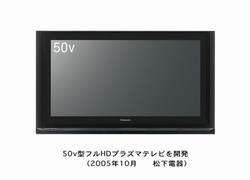
October 4, 2005 Panasonic Develops the World's Smallest 1080p Plasma Display Panel

Prototype of 50-inch PDP unveiled at CEATEC JAPAN 2005

Panasonic today announced the company has developed a prototype of a 50-inch plasma display panel (PDP) with 1080p (progressive) resolution. The prototype is the world's smallest PDP that delivers more than two million pixels (1,920 × 1,080) and the same brightness as its current high definition (1,366 × 768) model TH-50PX500.

Panasonic unveiled the prototype at CEATEC JAPAN 2005 at the Makuhari Messe in Chiba Prefecture, east of Tokyo. The exhibition commenced today and will run until October 8.

Superior characteristics of the PDP such as true-to-life color reproduction, dynamic contrast, quick response to moving images and wide viewing angles make it an ideal device for TVs. In the past, technical challenges in securing brightness and stable discharge from tiny pixels prevented manufacturers from obtaining 1080p resolution for 50-inch and smaller PDPs.

A plasma screen consists of millions of pixels. Each pixel is made up of three different cells or sub-pixels, one for each color, red, green and blue. When charged with electrical voltage, each cell produces light independently. By controlling intensity of each sub-pixel color, hundreds of thousands of colors are created, expressing subtle nuances.

Panasonic has overcome the technical hurdles. The 50-inch 1080p PDP offers the same high aperture ratio and brightness as the current 50-inch HD model. To achieve the high aperture ratio and high-speed pixel drive, the company used its own technologies developed for the 65-inch 1080p PDP. Panasonic also established technologies to make ribs (a "rib" divides each gas cell and prevents interference between adjacent cells to produce clear images) thinner and phosphors tinier. The prototype displayed at CEATEC JAPAN 2005 incorporates a new drive circuit that enables stable light emission. These technologies will enable Panasonic to offer PDPs in many popular-sized large-screen flat-panel TVs without compromising accurate and high-quality images that only PDPs can deliver.

Most of the current terrestrial digital broadcasts in Japan are 1080i (interlaced, 1,440 × 1,080) resolution. As some of these broadcasts are converted from standard definition (720 × 480), the current HD panels are more than capable of reproducing those signals. As digital HD broadcasting services are spreading and improving in the world, higher quality images, exceeding the current HD broadcasts, are expected to air in the near future.

Anticipating the future progress and increasing demand for such HD content, Panasonic has pursued development of 1080p-capable PDPs and succeeded in commercially producing the 65-inch 1080p PDP TV (TH-65PX500). The model will be available in Japan from November 1, 2005.

Source: Panasonic


print this article email this article download pdf blog this article bookmark this article     Stumble it Digg this share on Facebook retweet share on Reddit add to delicious
Rate this story - 3 /5 (4 votes)


October 4, 2005 all stories

Comments: 0

3 /5 (4 votes)
  • Stumble this up

  • Digg this

  • share this

  • hide
  • Related Stories

  • Panasonic unveils world's largest plasma television
    created Jan 07, 2008 | popularity not rated yet | comments 0
  • Samsung Develops First 70-inch LCD TV Panel
    created Aug 21, 2006 | popularity not rated yet | comments 0
  • Panasonic develops world's biggest plasma TV
    created Jan 05, 2006 | popularity not rated yet | comments 0
  • Panasonic Introduces World's First 65-inch 1080p Plasma TV
    created Aug 28, 2005 | popularity not rated yet | comments 0
  • LGE Unveils World's Largest 55-inch All-in-one LCD TV
    created Sep 06, 2004 | popularity not rated yet | comments 0


Other News

Engineers Will Create Planetary Rover From Retinal Implant Test Robot

Engineers Will Create Planetary Rover From Retinal Implant Test Robot

Electronics / Robotics

created 4 hours ago | popularity not rated yet | comments 0

(PhysOrg.com) -- The research, led by Wolfgang Fink, will aid both people with visual impairments and scientists involved in planetary exploration.


Kindle DX

Schools shun Kindle, saying blind can't use it

Electronics / Consumer & Gadgets

created 8 hours ago | popularity not rated yet | comments 4

(AP) -- Amazon's Kindle can read books aloud, but if you're blind it can be difficult to turn that function on without help. Now two universities say they will shun the device until Amazon changes the setup.


Intel Reader Transforms Printed Text to Spoken Word

Intel Reader Transforms Printed Text to Spoken Word (w/ Video)

Electronics / Consumer & Gadgets

created 6 hours ago | popularity 4 / 5 (1) | comments 0

Intel Corporation today announced the Intel Reader, a mobile handheld device designed to increase independence for people who have trouble reading standard print.


Nokia weighs in with 3 new CDMA devices - Nokia 6316s, Nokia 3806 and Nokia 1506

Electronics / Consumer & Gadgets

created 5 hours ago | popularity not rated yet | comments 0

Nokia is today strengthening its CDMA portfolio with the announcement of three new CDMA mobile devices: Nokia 6316s, Nokia 3806 and Nokia 1506. Together this new line-up highlights Nokia's continued commitment to CDMA as ...


Samsung launches a new vacuuming robot

Samsung launches a new vacuuming robot

Electronics / Consumer & Gadgets

created Nov 06, 2009 | popularity 4.4 / 5 (7) | comments 8

(PhysOrg.com) -- Samsung Electronics has launched its latest autonomous robot vacuum cleaner, the Tango, which is capable of vacuuming hardwood floors, carpets, and even beds without human assistance.