Chemists direct silicon oxide into a selected hierarchical structure
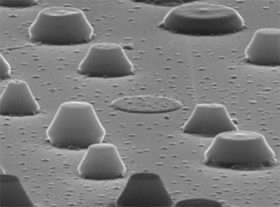
Chemistry often seems to operate at random. However, scientists from the Max Planck Institute of Coal Research and the International Max Planck Research School "SurMat" have been able to change that: they grew silica particles from a solution onto a surface in such a way that a pattern of tiny little cones was regularly formed.
Every silica cone was made of numerous spirals sitting on top of each other, and every spiral was made of tubes, in which the silica grouped itself around micelles of long-chain organic molecules. These kinds of selected hierarchical structures, which are exactly defined at large and small scales, were unknown to scientists except in nature, for example in bones, wood, and sea shells. Now, however, they can be grown in test-tubes - and that could allow engineers to produce even smaller optical and electronic components (Advanced Materials, April 18, 2006).
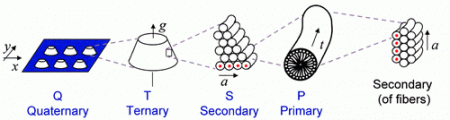
Bones are light and stable. That is because they are built optimally, at the smallest and largest levels. Their smallest elements are bound to fibrils, which fold together to make lamellae. These, in turn, organise themselves into girders that form a scaffolding, which has inspired even/also? structural engineers. Materials scientists call this kind of highly selected structure "hierarchical". Now, chemists from the Max Planck Institute of Coal Research in Mülheim an der Ruhr, Germany, have created a selected hierarchical structure from silica particles for the first time. It was made from a reaction solution in which very different forms of silica particles were able to grow. A silicon compound was mixed with an amine dragging a long tail of fatty acid. The amine molecules assemble micelles, which form long threads, and the silica accumulates on these threads. If the scientists dip an untreated support into the solution - for example, a lightly contaminated glass plate - the particles form random deposits: sometimes cone-shaped, sometimes a double cone, sometimes fibre-like shapes.
To change this unclear situation, the scientists put "baits" for special shapes on the surface. They used a silicone "stamp" to apply, to the glass, squares of a substance with alkyl chains - and thus repelling water. The glass itself attracts water. The edges of the water-repelling squares have a length of three micrometres - that is, three thousandths of a millimetre. The water-repelling squares act like seeds; when the chemists dunk the glass plate into the reaction solution, after a little more than three days a small cone builds up on every square. The cones are solids like stones but they are made of long, coiled threads. It is still not fully clear why the silica particles tend to collect on the water-repelling squares. "Possibly," says Frank Marlow, who headed up the research, "the organic micelles adsorb and coil together there, and then direct the silica assembly"
By luring the coiled particles to the surface of the glass, the scientists control the kind of hierarchical structure the particles finally take. There is no alternative to the micelles, after they lay themselves on the support in the shape of a spirals, which stack on to other spirals, as the cone grows. "In the solution, fibres or other, very strange particles can build up instead of a cone," Marlow explains. These particles are also similarly hierarchically structured.
What determines the direction of the growing cones is a global singularity - the midpoints of micelle spirals, which the silica groups itself around. "One often says that a defect, such as a hole in the crystalline structure, impedes growth," Marlow explains. "I'm convinced that in our case, the hole determines which kind of structure will develop in the end. That's why I coined the term 'global singularity'." The scientists use the squares to bring the particle self-organisation into the superstructure they choose.
"This way, we combine a bottom-up and top-down technique," Marlow says. Materials scientists use the term "bottom-up" to describe particles organising themselves into larger structures. Marlow explains, "this technique functions very well at small scales. But it's not so exact as soon as the structures reach a certain size." In top-down procedures, the advantages and drawbacks are just exchanged. Chip manufacturers use top-down procedures to draw an accurate structural plan in photoresist layers - which they then use as a pattern to etch out semiconductors. The resolution in this process, however, is limited, and so these structures are not easy to make smaller. The scientists led by Marlow, however, combined the two techniques, by printing points on the glass, with the silica particles organising themselves onto them. Using the squares at a micrometre scale, they controlled, for the first time, what happens at the nanometre scale. In this way, they can create very fine selected structures. Ultimately, this could yield new ways of developing electrical and optical components.
Citation: Ahmed S. G. Khalil, Denan Konjhodzic und Frank Marlow, Hierarchy Selection, Position Control, and Orientation by Patterned Surfaces, Advanced Materials, April 18, 2006
Source: Max Planck Institute of Coal Research


